Why Doesn't All Thunder Sound The Same?
Thunder.
We've always been...well...thunderstruck by it, but for a long time, we weren't sure
what it was: the violent tantrum of a young god, the rumbling wheels of Thor's chariot,
or the flapping of a giant bird.
It wasn't until we got a handle on the science of both storms and sounds that we figured
out what thunder is and why it sounds the way - well, the many ways - it does.
Storms have a lot going on and we'll take a rain check on explaining most of it.
The key as far as thunder goes is that during a storm, positively and negatively charged
particles build up in different places, and then zig-zag through the air to get rebalanced.
During this rebalancing - which we know as lightning - a giant electrical current rushes
through a tiny channel of air in a fraction of a second, instantaneously superheating
the surrounding air.
And since increasing air's temperature also increases its pressure, that air gets super-pressurized,
causing it to explode outward in what we call a shockwave.
This sudden explosion is what we're experiencing when we hear a thunderclap - it's a distinct
sound that seems to come out of nowhere and contains an incredible range of frequencies.
Those same qualities are actually common to any abrupt and intense burst of pressure,
from the bang of a supersonic jet to the crack of a whip to the pop of a balloon to the snap
of a tiny bolt of static electricity; that's why all shockwaves sound surprisingly similar.
At least if you're nearby.
As a shockwave travels through the air, it loses energy and that intense burst of pressure
smooths out; what's more, the wave's higher frequencies dissipate more quickly than its
low frequencies.
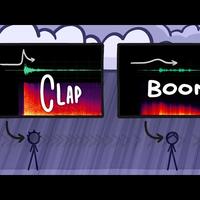
So the farther away you are from lightning, the less sudden the onset of the sound is
and the lower the sound sounds - instead of a sharp “clap”, you might hear a resonant
“boom”.
Waves from more distant parts of the lightning bolt take even longer to reach you and can
overlap and echo off trees, hills, and clouds along the way, so you'll hear them as longer,
even lower-pitched rumbles.
And when lightning happens completely within a cloud, the waves start so far away and get
so jumbled up that all you might hear is a soft rolling sound, or nothing at all.
Within a single storm, lots of waves of pressure from lots of different parts of lots of different
lightning bolts intermingle and reach your ears at different times, so you'll often
hear a symphony of claps, booms, rumbles, rolls, and more.
It's a perfect storm of sound that launched a thousand origin - and Thor-igin - stories.
I started working on this video because during a summer storm, it suddenly struck me that,
despite knowing a thing or two about science, I had no idea what thunder actually was.
And if you have that same curiosity about the world around you, you'll love CuriosityStream,
the sponsor of this video, which has tons of expertly curated shows about science, history,
food, travel, and more, for just $19.99 a year - less if you use our special promo code!
I've been geeking out on “Nature's Weirdest Events”, which explains the science behind
the strangest stuff that happens on our planet, from blood-red skies to exploding toads.
It's toad-ally awesome.
You can sign up at curiositystream.com/minuteearth and use code “minuteearth” to get a year-long
subscription for just $15 bucks - and that also includes access to Nebula, which has
exclusive content from your favorite educational YouTubers - like us!
Thanks, CuriosityStream!
