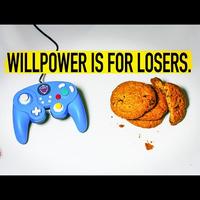
Willpower is for Losers
A couple days ago I proudly showed my girlfriend this expensive piece of tupperware I got.
You put something in it, set a timer and then it stays locked until the time runs out.
I told her I had been playing this video game too much and now I can keep myself from playing
by putting the game in this 60 dollar piece of plastic.
She was a little concerned, asking me “Can't you just resist playing?”
"I'm listening, and it says: I'm a piece of crap."
What's funny is I actually saw this thing on Shark Tank a while back and had the same
reaction - "I think I'll save my money and not eat the cookies."
This video is not an advertisement for this, but it begs an interesting question.
What's the difference between successfully resisting a temptation and just not having
a temptation?
Maybe you've heard of the Stanford Marshmallow experiment.
Researchers thought torturing kids would be fun, so they sat kids down in front of a marshmallow
and an told them: “I'm going to leave the room.
If you don't eat the marshmallow, you'll get another one when I come back so you'll
get to have two.”
And then they left and watched the kids with a hidden camera for about 10 minutes.
The kids stared at the marshmallow, held it in their hands, sniffed it and even snuck
a lick or two.
Maybe unsurprisingly only 1/3rd of the kids could resist the marshmallow long enough for
the person got back and then get the second marshmallow.
"This little girl was interesting.
She ate the inside of the marshmallow.
She wanted us to think that she had not eaten it so she would get two, but she ate it!"
Whether the kids did or didn't eat it, I think you'd agree they're clearly exerting
effort to resist the marshmallow.
A single marshmallow is an easy task for adults, but we still use effort to resist things.
An alcoholic resisting a fully stocked mini fridge in his hotel room uses a lot of effort,
and then others would use far less effort to resist watching another episode of a good
series when it's time to go to bed.
So, is there a consequence of resisting temptations even if you succeed?
A famous experiment by Roy Baumeister and colleagues had 67 participants who hadn't
eaten for at least 3 hours walk into a room filled with the aroma of just baked chocolate
chip cookies.
They sit down to a table with two bowls - one filled with warm gooey chocolate chip cookies
and one filled with radishes.
Half of the people were told they had to eat radishes and couldn't eat the cookies.
Afterwards they had the poor radish people and the lucky cookie people work on a mentally
stressing puzzle.
The puzzle was actually impossible.
The point was to see how long people would try to do it.
The radish people gave up on the puzzle almost twice as fast.
On average they quit more than 10 minutes faster than the cookie people.
The idea is that the radish people were tired from using their willpower on resisting cookies,
so they had less willpower to use on the puzzle.
This is just one of almost 200 experiments that gave credibility to the concept of “ego
depletion” - the idea that willpower draws on a limited stock of energy, willpower is
like a muscle - you can tire it out.
So if you use a bunch of willpower on one thing, then you have less willpower to use
later on resisting temptations, staying focused or even making good decisions.
Now this idea was challenged by a 2015 paper, but a more recent 2018 paper said Yes Ego
depeltion is a thing, some methods are just effective for testing it and some are not.
In any case, I think we intuitively know that temptations are distracting.
It's going to be at least a little harder to focus on your work if you're on a diet
and your friend is baking pies and cookies.
Or it'll be hard to study if it's Friday night and your friends keep texting you to
come to a party.
An experiment from a 2012 study in the Journal of Personality and Social Psychology had 205
adults wear a beeper that would ask them randomly throughout the day whether they were resisting
a desire, how strong that desire was, and whether they were successful in resisting
or not.
They then took a look at the data of nearly 8000 desire reports and found that the more
desires the person had resisted, the more likely they were to give into future desires.
This kinda makes sense.
Let's say you have a long day work.
Unless you really like your job, for the most part you are resisting desires.
Resisting the desire to skip the 10AM meeting, or the desire to play games on your phone
instead of actually working, or the desire to take an extra long lunch break or resisting
the desire to just go home early.
We might say that using all that willpower throughout the day then makes it harder to
resist the desire to watch Netflix on the couch instead of going to the gym.
But here's what's interesting.
In the study, the people who were best at self-control and said they were good at resisting
temptations, they actually reported experiencing fewer temptations throughout the study.
That is the diligent people with high self control apparently were just using less self
control.
In a study titled What's so great about Self Control, Marina Milyavskaya and Michael
Inzlicht gathered data from 159 University students and found that those exerting more
self-control were not more successful in achieving their goals.
It was the people who planned their life so they didn't have to use self-control were
more successful.
So the difference between me and successful actor Tom Cruise is that while I'm figuring
out how to resist the temptation to play video games, he would just throw them away.
Since I've been working at home most of the time lately, playing Smash Brothers is
always an option.
Because that option is always there, I'm a little distracted by it.
I'll be a bit tired from reading papers or getting frustrated because I can't think
of what to write next and then I'll be bargaining with myself like OK I'll play for just twenty
minutes and then work for an hour …or maybe play for 10 minutes then 30 imuntes - so regardless
of whether or not resisting the temptation depletes my “willpower energy,” just being
tempted to play is at least distracting me.
This lowers my focus and worsens my productivity even though I'm not actually playing.
Work by Glenn Wilson of Gresham College has found that when you're trying to focus on
a task, even the simple temptation of an unread email sitting in your inbox reduces your effective
IQ by 10 points.
Only being tempted by wanting to check a shiny new email impairs your brain's performance.
In James Clear's book Atomic Habits, he explains there is a four part habit cycle.
The cue, craving, response and reward.
First there's the cue.
Let's say you're at the office, it's 10:30 A.M., you're a little bored, tired
and unfocused.
This feeling feeling is a cue for a craving for coffee.
In response to the craving you get up and get a cup of coffee.
You are then rewarded for your behavior with the energy and the nice taste the coffee provides.
James Clear says that a habit will start to fall apart if one or some of these parts are
missing.
Let's say you start sleeping properly.
10:30 rolls around, but you're awake and alert so there's no cue for coffee.
Or let's say you're at the office, you feel tired but you respond to the cue differently
- you take a walk instead of coffee.
Or let's say you start drinking decaf coffee - you respond to your craving by grabbing
a cup of coffee, but it doesn't have that nice caffeine reward.
Any of these should help to weaken the habit.
Clear says a really effective way for breaking bad habits is just make the cue weaker or
more obscured.
If seeing cookies cues a craving to eat cookies, just put them where you can't see them or
don't buy them.
If you're trying to focus, just turn your phone off instead of resisting the temptation
to check your phone when you get a notification.
Rather than trying to exert more willpower, you can just strategize or plan better.
Going back to the Marshmallow study, they found that kids who successfully resisted
the marshmallow were more successful later in life.
They were more confident, more reliable, less likely to become obese and even got better
SAT scores.
But what how did the successful kids do it?
Did they just grit their teeth and fearlessly stare the marshmallow down?
Not quite.
As reported in one of the original studies investigating this, the successful kids “… covered
their eyes with their hands…" so they couldn't see it, " they talked to themselves, they
sang, invented games with their hands and feet…”
They did whatever they could to take their mind off the marshmallow and didn't rely
so much on brute willpower.
Similarly, what's going to put fattening foods on your mind more - taking the route
home where you walk past the delicious smelling bakery or taking a different route home?
What's going to have an alcoholic thinking about alcohol more?
Booking a hotel with a stocked mini fridge or booking one without?
In my last video I talked about how having so many choices of things to do all the time
can cause a persistent feeling of indecision or uncertainty: Should I do my work or play
smash brothers, should I work out or watch Netflix or do my taxes?
Each action provides a reward for a cost.
Taxes costs a lot of time and boring decision making but rewards me no more worries of huge
fines.
Netflix costs time but rewards me with immediate enjoyment.
From your brain's perspective, the action that provides the most reward for the cost
is not 100% clear.
And as I explained last time, this indecisiveness, this uncertainty can activate the brain in
a way generates anxiety and lowers your ability to focus.
So, at least for me, when I remove one of the choices by locking it in this box- it
feels like my brain stops doing all those calculations and I'm more relaxed and more
focused.
I would have thought I would still want to play the game but just be annoyed that it's
stuck in the box, but oddly enough I just forget about it.
Another thing I've been using is this app for mac called Self Control.
You just add websites you don't want to be able to access to a list and then you can't
access them.
This too is really effective and helps me relax and focus with no extra effort spent
on resisting watching How to get away with Murder.
We always have tons of choices throughout the day- should I do this or that or just
do this for a little bit and then do that productive thing?
A simple way to reduce that uncertainty and indecision and stop being distracted by these
choices … is to make the choices you don't want to make harder or simply delete them
- Use
less willpower, not more.
