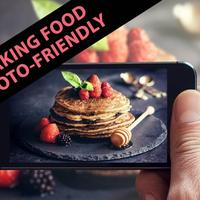
Making food photo-friendly: 6 Minute English - YouTube
Neil: Hello and welcome to 6 Minute English,
I'm Neil.
Rob: And I'm Rob.
Neil: And in this programme we're
discussing food.
Rob: Food glorious food! There's only one
thing better than talking about food and
that's eating it.
Neil: Well I know you are a bit of a
gastronome – someone who enjoys and
knows a lot about high-quality food – but
today we're talking about photographing
food, not eating it.
Rob: That is a shame because I am on a
see-food diet – if I see food, I have to eat
it. Get it?!
Neil: Yes Rob, very very funny. But in the
social media-addicted world, just seeing
food - not eating it - is big business as I will
explain shortly. But shall we feast on a
question first, Rob?
Rob: Yes, if it tastes good!
Neil: It does. So, do you know the name
for the person who's usually second in
charge in a restaurant kitchen after the
head chef and has lots of responsibility
for running it? Is it the…
a) Pastry chef, b) Commis chef, or c) Sous chef.
Rob: Hmm, I'm not a chef expert but I'll
say c) a Sous chef – it sounds important!
Neil: Well I'll give the answer later in the
programme. Now let me explain more
about food and photos. These days, how
well a dish – that's a noun for food
prepared for eating – is photographed
can matter more than how it actually
tastes.
Rob: And I suppose social media
platforms are the best way for sharing
food photos on, aren't they? And I have
been guilty of taking a picture
of my food on my smartphone – but only
when eating some amazing food at a
posh restaurant.
Neil: Which isn't very often I suppose! But
by sharing images across social media,
people see them and think the food looks
delicious, I must go to that restaurant and eat it!
Rob: You could argue it's about style over
substance, meaning the look of something
is better that the content or product.
Neil: Maybe, Rob – although I'm sure
sometimes the food tastes just as good
as it looks. Anyway, the BBC Radio 4
programme, You and Yours, has been looking into this. They spoke to several
influential Instagrammers and bloggers
– influential means having the power to
make people change what they think.
Here's one of them – Rebecca Milford,
who edits a website called Bar Chick.
What does she think about this new trend?
It sounds very cliche that a picture speaks
a thousand words but it really does and
I've got friends now that instead of doing
what you used to do and going on to the
website of a restaurant to see what they
were serving, then you'd go onto their
Instagram account and check out their
images, and choose what you want to eat
literally based on what you're seeing.
So it has to be presentable, I suppose.
Neil: Rebecca used a well-known and
well-used phrase there – one that is used
so much it has become boring –
what we call a cliche. The phrase is a
picture speaks a thousand words.
Rob: Yes – and even if it is a cliche – it
is so true. You describe a fantastic meal
in a long blog but you can quickly see
how it looks from a picture and then
create an idea in your mind of how it
tastes. So when you're promoting food, a
photo is everything.
Neil: And that's why some restaurants pay PR
companies lots of money to take stylish
photos that can be shared on social media.
It's like a fashion photoshoot for food.
Rob: Yes and Rebecca said the food has
to be presentable – that's looking good
enough for people to see – because
people are making choices on what they
see. I've also heard that some chefs and
restaurateurs have adjusted their
menus to produce meals that look good
on a smartphone camera. A restaurateur,
by the way, is the name of a person who
owns and manages a restaurant.
Neil: Now, while there is a risk that good-looking
food on social media accounts such as
Instagram, might not match how it tastes,
there is a theory your brain might trick you
in to thinking it does tastes good.
The You and Yours programme
also heard from Professor Charles Spence,
an Experimental Psychologist from
Oxford University, about how this happens…
We see the food first, or the drink in the
glass, and our brain's already imagining
what it's going to taste like. And the more
beautifully it's presented, the more
artistically, that sets better expectations
and they kind of carry over and anchor the
tasting experience.
Neil: Right, so a great photo of food can
possibly make us think it tastes better
too. We create an idea in our head of how
it will taste which influences our expectations
when we actually eat the food.
Rob: And expectation means the feeling
that something good is going to happen. Neil: Right Rob, I'm sure you're expecting
the answer to the question I set you
earlier. I asked, if you knew the name for
the person who's usually second in
charge in a restaurant kitchen after the
Head chef and has lots of responsibility
for running it? Is it the…
a) Pastry chef, b) Commis chef, or c) Sous chef. What did you say, Rob?
Rob: I said c) a Sous chef. Am I right?
Neil: You are Rob! Give that man a job,
here maybe in the BBC canteen!
Rob: Come on, Neil. I think I could do
better than that! But before I do let's
remind ourselves of some of the vocabulary
we've discussed today. Starting with gastronome – that's someone who enjoys
and knows a lot about high-quality
food – someone like me!
Neil: Maybe Rob. We also discussed the
word influential, meaning having the
power to make people change what they think.
Rob: We also mentioned cliche – a
well-known phrase that is so overused it
has become boring. Like for example 'a
picture speaks a thousand words.' You
never use cliches do you, Neil?
Neil: Absolutely never. Let's move on to
presentable – that describes something that looks good, is smart and is good
enough for people to see. A bit like me in
my smart new jumper. Do you like it?
Rob: Very nice! Well a presenter has to be
presentable, Neil! Our next word was
expectation, a word that describes the
feeling that something good is going to
happen. I have an expectation that people
will love this programme!
Neil: Well, let's hope so!
Rob: Yes, and that brings us to the end of
this programme. Don't forget to check out
our social media platforms. See you soon, bye.
Neil: Bye!
