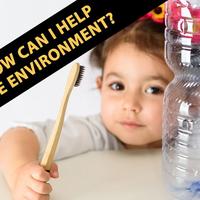
How can I help the environment? - 6 Minute English - YouTube
Neil: Hello. This is 6 Minute English. I'm Neil.
Sam: And I'm Sam.
Neil: Now, tell me about your teeth-cleaning routine.
Sam: OK. Well, it's pretty good, I think.
I brush twice a day and change my brush
every couple of months.
Neil: And what kind of brush do you use?
Sam: Nothing fancy, just a regular, cheap plastic one.
Neil: Oh dear!
Sam: What do you mean?
Neil: Well, imagine all the toothbrushes you've
used in your life,
from your first brush as a child,
to the one you currently have.
You do realise that probably they all still exist
in the environment somewhere.
We use them for a couple of months yet
they will last for hundreds of years.
Sam: Oh dear, and I thought I was actually quite
environmentally aware.
But that's quite shocking. I hadn't thought of that.
Neil: Well it's just one of the problems we are
facing with our use of plastics.
A marvellous invention that has given us so much.
But
we are beginning to realise it's causing many
long-lasting environmental problems.
More on this topic shortly, but first, a question:
Plastic has many natural variations
but where was the first artificial plastic developed?
Was it: a) England
b) Germany or
c) Switzerland
What do you think, Sam?
Sam: I'm going to have a guess at Switzerland.
Neil: OK, we'll find out if you're right
at the end of the programme.
Environmental issues are, of course,
a big story at the moment.
The topic was featured on the BBC Woman's Hour
radio programme recently.
Madeleine Murray is from an Irish organisation that
gives advice to businesses and communities
on how to operate
in an environmentally responsible way.
She was asked about what she does in her daily life
that other people could do too.
What food items does she mention?
Madeleine Murray: My personal, like, pet peeve
is multipacks and minipacks.
I buy in bulk now. I buy the biggest yoghurt I can buy.
I buy big cereal boxes. I buy big shampoo bottles.
We can decant stuff into lunch boxes and we can,
you know, refill our pasta and our rice.
Neil: So, what food does she mention, Sam?
Sam: She talked about yoghurt, cereal, pasta and rice.
Neil: And what was she saying about those foods?
Sam: She was saying that she buys the biggest
containers for those that she can
- and not just food - things like shampoo as well.
Neil: And what's the benefit of that?
Sam: Well, she says that her pet peeve is small
packs of things.
A 'pet peeve' is something that you find
particularly annoying.
She doesn't like small packs because they use a
lot of packaging for a small amount of product.
Neil: So she buys in bulk.
Buying in bulk means 'buying a lot of something'.
And if you have a lot of something like rice or pasta,
you can always transfer it to different smaller
reusable containers.
She uses the word 'decant' for this.
So that's one area where we can all be a bit more
environmentally friendly.
Another area is reusing things that are perfectly good
but which we don't need any more.
Dr Tara Shine is a colleague of Madeleine Murray
and she talked about how new parents often
buy a lot of new things for their babies,
which they then throw away when the child
gets too big or too old.
She suggests that it's better to pass these things on
- to give them to other people.
Dr Tara Shine: Pass things on.
The hand-me-down, pass-thing-on
culture is really, really important in the world of kids
and there are lots of things that can be passed down,
whether it's toys or the equipment, or the high chair,
whatever it is, all of that can be passed on
and that's really important.
It's saving someone else money.
Most of these things are in good nick
when we need to pass them on.
Neil: She used another expression for passing things
on, didn't she?
Sam: Yes, she talked about the hand-me-down culture.
When I was growing up,
I had a lot of hand-me-downs.
These were toys and clothes from my older cousins,
which saved us a lot of money
and they were then passed on to someone else.
Neil: And the thing is children grow up quickly so
often everything is in good condition.
Sam: Dr Shine used an interesting expression for
that, didn't she?
She said most of these things are 'in good nick'.
That expression means 'in good condition'.
Neil: Now, before we recycle today's vocabulary...
Sam: Oh, very good, I see what you did there!
Neil: It's time for the answer to today's question.
Where was the first artificial plastic developed?
Was it: a) England
b) Germany or
c) Switzerland?
What did you think, Sam?
Sam: I guessed Switzerland.
Neil: Well, I'm afraid, you are wrong.
The correct answer is actually, England.
Well done if you got that right.
Extra bonus points if you knew that in 1856
Alexander Parkes patented Parkesine,
the first artificial plastic.
Now, let's recap today's words and expressions.
Sam: Yes, a pet peeve is something that someone
finds particularly annoying.
Neil: Buying in bulk means 'buying many of the same
things or a large quantity of something'.
Buying in bulk is usually cheaper
and can be better environmentally.
Sam: And if you have a lot of something, you can
decant it to smaller containers, that is,
you can transfer it to those other containers
to make it easier to use. For example:
I buy huge bottles of liquid soap
and decant it into smaller dispensers
for the kitchen and bathrooms.
Neil: You can pass on clothes, toys and other kids'
stuff to family and friends.
This means 'giving them to other people to use'.
And those things can be described as 'hand-me-downs'.
Sam: But of course you'd only want to pass on
things 'in good nick', that is, 'in good condition'.
Neil: Right, that's all we have time for. We hope
you will join us again soon, though.
And you can always find us on
Facebook, Twitter, YouTube,
Instagram, online and on our app.
We are BBC Learning English.
See you soon. Good-bye!
Sam: Bye!
