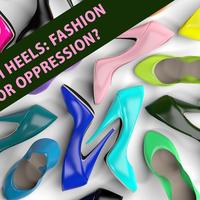
High heels: fashion or oppression? Listen to 6 Minute English - YouTube
Neil: Hello. Welcome to 6 Minute English,
I'm Neil. And joining me it's Rob.
Rob: Hello.
Neil: Today, we'll be discussing whether
wearing high heeled shoes is
a fashion statement or
a sign of oppression - and by that I mean
something you have to wear
because someone has told you to.
Rob: Now Neil, whatever style of shoe
you choose to wear, it's good
to polish them and
keep them looking shiny and new -
but one man from India called
Vickrant Mahajan set
the Guinness World Record for polishing
the most shoes. Do you know
how many pairs he
polished in eight hours? Was it...
a) 151 pairs, b) 251 pairs, or c) 351 pairs?
Neil: Well, if it was me, it would be
no more than one pair - but as it's
a world record,
I'm going to go for 351 pairs.
Hopefully you'll give me the answer later!
But let's focus now on high heels.
Rob: Yes. It's a style of shoe worn
by women around the world.
But why do millions of people choose
to walk on strange, stilt-like shoes?
Neil: Studies have suggested wearing
high heels can lead to damage
to the muscles and skeleton.
But despite this, they are worn to look
professional in the workplace or for
glamour - a word to describe
the quality of looking fashionable
and attractive.
Rob: And of course, they are associated
with female glamour, which
is something Tim Edwards,
Honorary Fellow in Sociology at
the University of Leicester has been
talking about on the BBC Radio 4
programme, Thinking Allowed. Here
he is describing why he thinks that is...
Tim Edwards: Women's shoes
in particular kind of have this kind
of transformative or even
magical quality - they can do
something for a woman, and it's quite
difficult to kind of draw parallels
quite like that with men, in a sense of
which it almost becomes something
slightly otherworldly... however one views
it as something which is a kind of act of
subordination or an act of empowerment
etc, there is a sense in which
your experience is changed - you are
suddenly raised 3-4-5-6 inches higher,
your balance is altered, your
experience is transformed.
Neil: So, he describes high heels
as having a magical quality.
He uses the word transformative -
meaning a great improvement or positive
change - so they transform or improve
how someone looks.
Rob: Well, they do make you taller and
that can make you feel more powerful
or important.
Tim even said it becomes otherworldly -
an adjective to describe belonging
to an imaginary world
rather than the real world.
Neil: Magical shoes do sound
otherworldly, but Tim also mentioned
that wearing high heels
could be seen as an act of subordination -
that's making someone do something
to give them less authority or power.
Rob: Well I guess that's only if you are
forced to wear them. But there's
another interesting point here - men don't
have a style of footwear
that can define them.
Neil: Yes, it's just sandals for you and
sports trainers for me. In fact
Tim Edwards says
it's difficult to draw parallels with men's
shoes. When you draw parallels
between two distinct things,
it means you highlight the similarities -
but here he's saying it's difficult
to find similarities - men have
nothing special to wear on their feet.
Rob: Of course there is nothing
to stop men wearing high heels -
although personally I don't think
I'd be able to keep my balance - but
Tim Edwards suggests it would be viewed
with suspicion. Let's hear
what he has to say...
Tim Edwards: I think the issue with
men and footwear is that if you
think of more contemporary
culture - I mean the guy who kind of
wears overly flamboyant shoes
or shoes which are
not kind of black, brown or flat is viewed
with a degree of suspicion - either in terms
of his sexuality, or in terms of his
work ethic - or in terms of his kind of
general moral, well, you know, his moral
standards in other kinds of ways.
Neil: He says that if you don't wear
a regular, ordinary black, brown
or flat style of shoe, you might be viewed
with suspicion. Men who wear shoes
that are flamboyant - that's brightly
coloured and that attracts attention -
have their sexuality or
their attitude to work judged.
Rob: He mentions someone's
work ethic - that's the belief that
working hard is morally right.
A man who wears flamboyant shoes
may have a different attitude to work.
It sounds like
quite an old-fashioned view.
Neil: It does, and let's hope people don't
judge you when you go out
wearing your sandals and socks!
But now, how about giving us the
answer to the question you set earlier.
Rob: Yes. I told you about
Vickrant Mahajan, who set the Guinness
World Record for polishing
the most shoes. I asked if you knew how
many pairs he polished in eight hours.
Neil: And I guessed 351 pairs. Come on,
was I right?
Rob: I'm afraid not, Neil. The answer was
251 pairs. It's still quite a lot - that's 502
individual shoes and I'm not sure
if he actually got paid for doing it.
Neil: Right, let's polish up some of
our English vocabulary and
remind ourselves of some of
the words we've discussed today,
starting with oppression.
Rob: Oppression is when you are forced
to do something by someone
more powerful.
Neil: We talked about glamour - a word
to describe the quality of looking
fashionable and attractive.
Rob: Our next word was transformative -
meaning a great improvement
or positive change.
Neil: Otherworldly is an adjective
to describe belonging to
an imaginary world rather than
the real world - it's magical or special.
Rob: We also discussed an act of
subordination - that's making
someone do something to give
them less authority or power.
To draw parallels is an idiom meaning
to highlight the similarities
between two distinct things.
Neil: And we mentioned flamboyant -
that describes someone or
something brightly coloured and
that attracts attention.
Rob: Finally, we talked about work ethic -
that's the belief that working hard
is morally right.
Something that both Neil and I have!
Neil: And that brings to the end
of the programme. Don't forget to visit
our website at bbclearningenglish.com.
Bye for now.
Rob: Bye bye.
