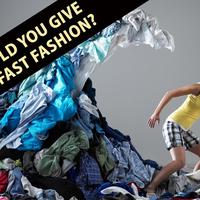
Could you give up fast fashion? Listen to 6 Minute English - YouTube
Georgina: Hello. This is 6 Minute English
from BBC Learning English.
I'm Georgina...
Neil: And I'm Neil.
Georgina: In this programme, we're
talking about buying clothes
and only wearing them
a few times before buying more clothes!
Neil: This is something known
as fast fashion - it's popular,
it might make us feel good,
but it's not great for the environment.
Georgina: Which is why lots of people this
year are pledging - or promising publicly
- to buy no new clothes.
Neil: I for one am wearing the same shirt
I bought seven years ago.
Georgina: You're certainly not
a fashion victim, Neil! But first,
let's test your knowledge
of fast fashion with a question.
Do you know how many
items of clothing were sent to landfill
in the UK in 2017? Was it...
a) 23 million items, b) 234 million items
or c) 2.3 billion items?
What do you think, Neil?
Neil: I'm sure it's lots, but not billions,
so I'm going to say 23 million items.
Georgina: I shall tell you if you're right
at the end of the programme.
Let's talk more
about fast fashion, which is being blamed
for contributing to global warming.
Neil: And discarded clothes - that means
ones that are thrown away - are
also piling up
in landfill sites, and fibre fragments are
flowing into the sea when
clothes are washed.
Georgina: It's not great - and I've heard
the average time someone
wears something is
just seven! So why is this, and what is
driving our desire to keep
buying more clothes?
Neil: I think we should hear
from fashion journalist Lauren Bravo,
who's been speaking
on the BBC Radio 4 programme,
You and Yours. She explained
that clothes today are relatively
cheaper than those
from her parents' days...
Lauren Bravo: A lot of clothing production
got outsourced - offshored
over to the developing
world, so countries like Indonesia,
India, Bangladesh and China
are now responsible for making
the vast bulk of all the clothes
that are sold in the UK.
And with that, we've seen what we call
'chasing the cheapest needle'
around the world, so
the fashion industry constantly looking
to undercut competitors,
and with that clothes
getting cheaper and cheaper and cheaper.
Georgina: Right, so clothes - in the
developed world at least - have
become cheaper because
they are produced in developing
countries. These are countries
which are trying to become
more advanced economically
and socially.
Neil: So production is outsourced - that
means work usually done
in one company is given
to another company to do, often because
that company has the skills to do it.
And in the
case of fashion production, it can be done
cheaper by another company
based in a developing country.
Georgina: Lauren used an interesting
expression 'chasing the cheapest
needle' - so the fashion
industry is always looking to find the
company which can make clothes
cheaper - a company
that can undercut another one means
they can do the same job cheaper.
Neil: Therefore the price of clothes
gets cheaper for us.
Georgina: OK, so it might be good to be
able to buy cheaper clothes.
But why do we have
to buy more - and only wear items
a few times?
Neil: It's all about our obsession with
shopping and fashion.
It's something Lauren Bravo goes
on to explain on the You and Yours radio
programme. See if you can hear
what she blames for this obsession...
Lauren Bravo: Buying new things has
almost become a trend in itself
for certain generations.
I think that feeling that you can't be seen
in the same thing twice,
it really stems from
social media, particularly. And quite often
people are buying those outfits to take a
photo to put on Instagram. It sounds
illogical, but I think when
all of your friends are doing
it there is this invisible pressure there.
Georgina: Lauren makes some interesting
points. Firstly, for some generations,
there is just
a trend for buying things.
Neil: It does seem very wasteful, but, as
Lauren says, some people don't like to be
seen wearing the same thing twice.
And this idea is caused by
social media - she uses
the expression 'stems from'.
Georgina: She describes the social
pressure of needing to be seen
wearing new clothes
on Instagram. And the availability of
cheap clothes means it's possible
to post new images
of yourself wearing new clothes
very regularly.
Neil: Hmm, it sounds very wasteful and to
me, illogical - not reasonable or sensible
and more driven by emotions
rather than any practical reason.
Georgina: But, there is a bit of a backlash
now - that's a strong negative reaction to
what is happening. Some people are now
promising to buy second-hand clothes,
or 'vintage clothes',
or make do with the clothes they have
and mend the ones they need.
It could be the start
of a new fashion trend.
Neil: Yes, and for once, I will be on trend!
And it could reduce the amount of clothes
sent to landfill that you mentioned earlier.
Georgina: Yes, I asked if you knew how
many items of clothing
were sent to landfill in
the UK in 2017? Was it...
a) 23 million items, b) 234 million items
or c) 2.3 billion items?
What did you say, Neil?
Neil: I said a) 23 million items.
Georgina: And you're wrong.
It's actually 234 million items -
that's according to the
Enviro Audit Committee. It also found that
1.2 billion tonnes of carbon emissions is
released by the global fashion industry.
Neil: Well, we're clearly throwing away
too many clothes but perhaps
we can recycle some
of the vocabulary we've mentioned today?
Georgina: I think we can, starting with
pledging - that means publicly
promising to do something.
You can make a pledge to do something.
Neil: When something is outsourced, it is
given to another company
to do, often because
that company has the skills to do it
or it can be done cheaper.
Georgina: And if one company undercuts
another, it charges less to do
a job than its competitor.
Neil: The expression stems from means
'is caused by' or 'a result of'.
We mentioned
that rise in fast fashion stems from
sharing images on Instagram.
Georgina: And we mentioned this being
illogical. So it seems
unreasonable - not sensible, and
more driven by emotions rather
than any practical reason.
Neil: And a backlash is a strong negative
reaction to what is happening.
Georgina: And that brings us to the end of
our discussion about fast fashion! Please
join us again next time. Bye.
Neil: Bye.
