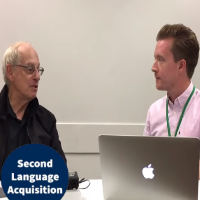
Stephen Krashen on Language Learning in the Polyglot Community
I'm here with dr. stephen krashen Stephen thank you for taking the time thank you I mean first of all I just like to say that as a I trained as a teacher went on to do my my master's in linguistics I spent a lot of time reading your work I'm sorry I made you suffer I didn't have a choice more to come though I'm
sorry it just keeps doing this keeps coming but it was highly influential on me and on many other people that I have worked with so on behalf of fair everybody that I've worked who doesn't want to thank you for your question that's a refreshing reaction thank you very much I appreciate this and we are
for little context for those of you watching we are hearing at any gathering in Montreal any places and we are at a how do you describe this it's a polyglot gathering which sounds rather rather intimidating but it's just a gathering of people that like languages and many of them are very good at it as well and
we've spent a little bit of time this weekend discussing the implications of they so-called polyglot movement of people who work who who learn lots of languages and what that means for people like yourself it's been a long time researching a second language acquisition so I'd like to discuss a few of those ideas today but one of the
things that struck me when I was listening to your talk the other day was that you have a background in music and as do i I I studied at the Guildhall School of Music in there in London Wow degree in piano really that yeah to play lots of Brahms well it was mostly jazz that I did so I'm like my oh my thing
was jazz so I did do classical music as a kid but I know I was um I was playing jazz most of the time you know there's a piano outside his peers all over the place on the street yeah yeah yeah I played yesterday they do it's great fun well I find I have to find it later no one paid any attention which is
wonderful right this is what buy it's great yeah what's your musical background my musical background is like everyone else middle class Jewish kid in the United States I grew up they gave me piano lessons when I was a little boy and they didn't at all then in college I got interested and I couldn't play anything outside of
C major you know with tiny little tunes and I started all over again got excited when I heard other people playing the piano so just like language analyzation in college just like a language acquisition I'm a late beginner and it was wonderful I changed my major to musicology music history and I decided I wanted to kind of catch up
with piano and I took a year off and went to Vienna and studied with my teachers teacher my teacher then was Malcolm Bilson who became very famous wonderful concert pianist and all that so I went off with his teacher how into Hoffa and it didn't work she was not impressed with anything I did it was constant discouragement etc so I gave up
after about five months so I kept practicing I spent the rest of the year there you know worked up the pathetic Sonata what you have to do and I'll then plate it for my friends but I had a great circle of friends and my German improved enormously and that changed everything I still play the piano I played yesterday on the school ok and I
love it I just don't practice anymore just it's a bit it's a time commitment isn't it music yeah Arthur Rubinstein said that he played the piano eight hours a day but only one hour it was practice that's very inspiring anyway so it's been since then it's been languages and a trip to Europe a couple of years
later they're listening to all the languages around me I got very excited about it and eventually changed my whole career two years in the Peace Corps Ethiopia and that was an Eric after that six months in Israel with my wife kibbutz Hebrew so I started to build myself up to a junior polyglot not like
you people but enough to appreciate what you're doing and how exciting it all is I'd like to pick up on the music but just to finish off the the chronology of your language is what other languages have you studied well German them is my best second language as a Vienna after that French here and there of course Spanish living in
Southern California and the amazing friendliness of Spanish speakers in California they're wonderful they don't correct you they're just happy to have a nice conversation it's great Hebrew from the kibbutz in Amharic from Israel from Ethiopia and now it's mandarin a couple of years of Mandarin class my Mandarin teacher hey you know
she's wonderful my first Mandarin teacher was Linda Lee a world-renowned Mandarin teacher and that was just the best introduction to tea PRS and Mandarin that I could have had it you define TVRs 40 PRS is teaching proficiency through reading and storytelling it's a storytelling method the good methods now are based on
interesting stories or you fall in love with the story you get so interested in the story that you forget it's in another language two methods do it tbrs invented by Blaine rate where this teachers and the students create the story together there's a lot of back and forth but students don't have to say
very much okay it's question and answer building the story another one which I'm also very enthusiastic about is my colleague Benito Mason Benito Mason dotnet for Blane stuff just Google TBR tbrs and it's telling stories and making them comprehensible with explanation occasional translation and drawings and
she realizes a great deal on Grimm's fairy tales and makes them just fascinating and interesting right that's very good it's wonderful one of the things that we've we found out that we have in common is a we've both both produced books or short stories yeah yourself in Mandarin myself in in a number of languages it's this the idea
of story is something that I find myself coming back to over and over again and so it's great to hear you mentioning that it's also great to see that you've studied so many languages yourself because that mean turning that in the in the language teaching profession there is a tendency for teachers to be more
lingual and not having gone through the experience it actually gets worse than that there's a tendency for some experts all right to be monolingual and I am regularly accused of being monolingual I think I'm just like they are well you heard it here first yeah yeah I have a strong feeling that if you're a language
teacher you have to be a language learner always I'm astonished the amount that that that people actually reject that oh my god yes you you really that's absolutely wonderful you said that not only that it is extremely helpful for people like me researchers to be at different levels like German and French
pretty comfortable Spanish kind of things we say in Mandarin mama who I'm kind of in the middle with Hebrew not quite as good with Mandarin I'm struggling which is great you've got to be in the acquirers mind all the time so I regard my language experiences as part of the research I've often thought from
myself wondering and I don't know whether it's a fair assumption to me but I've often found that a lot of the TEFL industry in particular goes in a certain direction which is constrained by the fact that the teachers tend to be more illegal and if that were not the case would be far more options open to
pedagogically to the teaching oh yeah I mean is that yeah you're absolutely you're absolutely right you're absolutely right I can't blame a lot of the teachers it's not easy if you're living say in an english-speaking country to be to acquire another language and even if you're abroad there's so much English around nearly
everywhere and there's a pressure on English papers English people to speak English all the time people want to speak English with you so that's a barrier but there are ways around it and it's up to us to come up with good ways like easy classes polyglots have programs have internet things books etc so we're working on it
yeah courses etc and just general discussion of approaches to learning which is what we've been talking about here at this this weekend and incidentally one of the things that I find striking about my colleagues in this in this field when people talk about the methodologies they used to acquire multiple languages travel and
learning the language in the country is actually something that people usually recommend against for various reasons that we could get into but certainly in the early stages you know the act would be early you know the at the acquisition of your the foundation of a language most most experienced language and as
accepted is best done in you you said it yourself and in the environments of comprehensible input not immersion because immersion make can pile on all kinds of pressures socially psychologically linguistically which get in the way of I'm much better off in my Mandarin class and working alone and going to China right now I'm not good
enough huh other languages sure I'm fine Spanish being in Mexico South America Spain I get better because I'm already intermediate sure yeah you can or you can already hold a conversation I can understand I can read things etc taking it back to the music people often ask me what I think is the connection if any
between languages and I never know how to answer I have my standard answer but let's put put it to you okay I'll take a risk and see if we come to the same conclusion not much there are studies that relate music to literacy development people who your kids take an instrument or they go to more concerts
they do better on reading tests when you look at the research carefully which I do all day long its miniscule it's like 2% of reading a lot of books I mean that that's really what counts doing lots and lots of reading getting exposure so the impact of music in the experimental research is very indirect people say
let's include songs in classes ok songs and classes are ok but the actual words of the songs are no better than studying a poem now here you're talking about music as a pedagogical activities right how about in cases like like ah hours when we have actually been through a period of musical training to rephrase
the question is you can you spend a lot of time studying music therefore your language no no no I think no sent you no no I don't see any direct connection I know that as a group I'm sure is this polyglot organization is very interested in music I know they're correlated the interest is but I don't know if it's
causal so I really don't i think the idea let me go back to pedagogy for a moment if you want to use music as a language teacher yes but discuss the song discuss what the words mean the history of the gossip that Gershwin and Ravel were buddies they would hang out and Harlem together and all that and do all that inflamed
the language and you get a lot of interest teach people to play ukulele or you know a little keyboard and all that that's wonderful it's often part of the problem isn't you know you can have a discussion about language learning let's just let's let's assume let's make an assumption that there is a connection
between experience with music proficiency in music and language learning the difficulties well what do you do with that once you grant that what are one of the implications for that and it's it's very difficult to take that and it's like it's like the arguments of well are you can you be too old to learn a language or is there such
thing as a natural talent in language learning but let's assume there is where does that then where does it get there's no change in the pedagogy yeah there's no changes like where's your device its comprehensible it but it's understanding messages that makes language acquisition work and music is not gonna make any big
difference to that I think anecdotally and so much of this is anecdotal one the two benefits that I often like articulate or music are firstly in the strength of my ear in terms of acquiring access to the sense that I feel that my ear is very much tuned to sounds perhaps more than people that haven't spent many
years with music the second thing is the act of especially with classical music when you're rehearsing music preparing for a recital there is a certain discipline that you develop for acquiring something new and rehearsing it until the point of being able to use a personality characteristic yet because
you're involved in it let me give you a crackpot theory of access okay I call this a conjecture conjecture is really a hypothesis but one you think might not be true so you can say oh it's just a conjecture I got this from my son mathematicians just call it a conjecture you'll be okay I think the perfect accent is inside you
and that we acquire really good accents very quickly after a couple hundred hours we've got it the perfect French accent is here I've got it I don't perform it because I feel silly it's not me evidence which is anecdotal but I think pretty good my accent in French is variable it depends on how I feel
I remember once so while ago was in Paris and I had a coffee with a local expert in sociolinguistics in sociology of language she spoke like 500 languages but none of them was English and we met at a coffee shop and we had a nice discussion my daughter at the time was going to a French school was with me
which is the young girl at the time and she would come over and listen going they have to read she said dad you were really good I've never heard you speak French so well but there was nobody watching we were deeply involved in the conversation the other person thought I was very smart he wasn't paying
attention to my friend chat center other times I'm told I speak French without a trace of a French accent at the University of Ottawa in the eighties I had a sabbatical and I was working with our team on an article we're writing in French and we were in the room and I had the board and I was doing the discussion
the door opened a stranger walked in I thought oh my gosh I'm probably making all these mistakes in my French disintegrated on the spot it was completely unconscious I couldn't stop it I think that's what dictates accent we know that a little bit of alcohol your studies improves your accent temporarily I might have experienced
that last night yeah exactly exactly so I think there's this output filter successful BIA what do you do about it nothing just relax and realized no accent teaching course has ever worked that I have seen there's no evidence that it gives you a permanent acquisition of a better accent yeah I mean Henry
Kissinger type figures exactly as the is the now let's look at look at Henry Kissinger and Arnold start something oh they're both similar if you listen to them carefully first of all they have acquired English completely yeah Arnold is very articulate phenomenal he's phenomenal Kissinger of course yeah
and if you listen hard to their accent you realized that when Arnold tried some of your speaks he's not using 100% the German sound system he's acquired most of English sound system just not quite all of it our standards are ridiculously high that's the problem yeah go down this rabbit hole but for the benefit of
people watching you might not be so familiar with your work could you give us a brief summary of your thesis sure we acquire language in one way I told this to the guy who fixed my coffee machine in the room yesterday so ready to do this okay yep that's great so we acquire language and only one way when we understand what people say and
when we understand what we read if you do that all the grammar and vocabulary you're ready to acquire is there and it's gradually little by little absorbed the ability to speak is the result of listening the result of reading study doesn't help you very much memorizing vocabulary rule the vocabulary studying
grammar getting your errors corrected trying to talk all those things are the result of language position so you want to get better in another language listen and read listen and read find things you're really interested in where you're excited to know what's gonna happen next a good book a good movie an interesting friend
and be patient it comes over time we are born to acquire language that's the way our brains are do in your own language learning how how do you to what extent do you walk the walk so to speak and how do you what's the what's the implication of that in terms how does it manifest itself in learning in my life yeah okay
I did a presentation on this in with my colleague Linda Lee last year I guess you missed it in Copenhagen anyway with international schools conference was called regression to skill building that even people like us forget the theory occasionally for the languages I'm already low intermediate in and higher
I'm fine with the theory when I read in Spanish when I read in French when I read in German I don't stop I don't look upwards I don't worry about grammar etc and even though I'm not in the country I keep reading and I'm gradually getting better it's very nice and comfortable and I find books that are so exciting I
forget they're in the other language I just can't put down I want to know what's gonna happen next me when it comes to Mandarin I sometimes forget and I go to the old classic thing I want to look up every word I want to make sure what I'm saying is absolutely correct what is this grammar role how does it
work what is this tone number two or tone number three the cure for this is compelling input the cure are interesting stories and interesting conversations then all that fades away so we've had so many years of grammar and formal study it's sometimes hard to get over it for people who are at a very beginner
level the obvious objection to they said well how can I begin to to where can I get input this is comprehensible when I myself met such a beginner stage how do you address that find stories take a class where there are lots of stories and if you need to repeat it I did a full Europe Mandarin with my teacher she
works in a school in the Midwest and because it's a fairly wealthy private school she can record all the lessons and she sends me the recordings the classes it wasn't like oh that stood steep ers she tells a story and the students help create the story etc and it's very personal like the students interests hobbies etc this basically
revolves around a good story okay and the students are characters in the story they all know I'm watching so sometimes I'm a character in the story it's nice so find a class like that find a class where you can get involved either tbrs just to google it or benito Mason's methods story listening which is
beginning to spread which is very good something where the teacher is saying things that are fascinating and interesting and don't worry about repeating it oh that was my point after the first year she said I'm failing you you're gonna take it all over again would she was right my comprehension wasn't good enough so I repeated and I
go back over the things again I become very patient with all this so I meant this was the genesis of you Mandarin show stories that you thought that was before with Linda Lee my very first teacher in 2007 I went to a conference in Colorado and my colleague Karen Rowan had organized it and she came to my dorm
room every morning at 7:30 and I'm a night person with coffee and she said get out of bed you're going to Linda's class I said no I'm not yes you are I went to Linda's class it was amazing it was the story method you know and she made it so exciting I had been to Taiwan many times I have friends there and
iacquire practically nothing because it was all incomprehensible her class the first two minutes I got more than I had three months back and forth that I want it was amazing classes are fabulous for beginners because you can get the input that you can't get from the outside world now with the internet the polyglots you
and your friends are helping solve this by putting things online this is what the computer is for yeah it's not the fancy programs and the publishers it's you guys who know what you're doing saying interesting things that's what's gonna help well let's talk about this then we so you've spent now two days
surrounded by some extremely prolific oh my goodness yes what are your headline thoughts at this stage my headline thoughts first of all we are a very strange group we being me and you and polyglots and I'm a junior polyglot so I think we're most people are like us or that we are fascinated by language and
nevertheless it I have learned an enormous amount I have listened to the experts now for two days they have confirmed for me that comprehensible input is the universal path this is right but they've added all these bits of advice and strategies and things that you guys do that I hadn't thought about Steve Kaufman was a person that you and
I both admire has said things like don't try to be perfect the other person you're talking to doesn't care if you make Romanichal mistakes try to communicate they're interested in what you're saying little things like this have been enormous ly helpful have patience if their speech is not emerging have faith in your brain go back to
listening go back to reading it's been extremely helpful it's been confirming and expanding I'm gradually building up in my notebook strategies that the polyglots use to get comprehensible input yeah what's very hopeful the good news is is the it's you'd be following channels like mine for a while we this is we talked about
this a day in day out there's no shortage of this bus experience for the world you guys are telling a few hundred thousand people I want everybody to not yeah walking under family I guess bro start somewhere right yes right and I mean the things that you've mentioned both in terms of my earlier question about
language acquisition and and what Steve has spoken about there are a few linguistic point I'd like to highlight that you raised in your in your presentation and I imagine that was created before you came here this weekend oh sorry in that sense it just really goes to reinforce what we're talking about when you've mentioned
comprehensible input over immersion you mentioned compelling input and one of the things that language learners will will say is they they go to the ends of the earth to find material to spend time with they are that they find enjoyable yes it's what it's almost against they won't start doing anything until they
found that piece of material exactly to just carry on for this list you mentioned patience and this isn't in I don't know this your talk will end up being on YouTube or not but um fine with me if they do that you know patience which I guess rate to the concept of time and the fact that time does so much of the work for you and
that you can't force the process you mentioned just now no forced production which is it we're not forcing you to speak through a behaviourist writer program and to go a level deeper we're talking about acquisition rather than an approach of skill building yeah deliberate skills of learning yeah and then finally it's the idea of the
question do we have to know every word is it necessary to understand everything that's being said and and so this is the idea of gradual acquisition and you know in terms of reading the graded readers when I read an on introduction to my to my series my basic point was you don't have to understand every word you there
were gonna be lots of words you don't understand ittsan tolerate a little noise you need to develop a tolerance for ambiguity such that you can the only goal for me the only goal is something like reading is to get to the end of the chapter that you're reading find out who did it find out who did it and then when
you get to the end of a chapter get to the book it is the act of completing the material that you're consuming that is the bearer of the treasure and the gifts of vanity and you'll see all those words again don't worry they'll come back they'll come back but but but moreover is the ability to handle ambiguity and
unknown a certain amount of tolerance or noise tolerance of vagueness not extremely well I can handle some steve says he can he can handle 20% noise which is a lot yeah I think we vary but we all can handle some of it sure I guess so in terms of the the implication of this is that what goes to show the importance of finding the right
material doesn't it because you need to have that everything the comprehensible input but not it's everything so what's the balance Steve says 20% for him for him for me I'd probably put him more like ten five ten percent I mean to comfortably yeah what a reading theory will say you should be reading a 98%
comprehending the studies range from 90 to 98 percent 95 percent depends on the text depends on you but a little bit of it has to be that way because there's a lot of stuff that we hear that we're not going to acquire for another two years take for example English certain grammatical items are there all the time
and they're very late acquired like the third person singular ending he goes that can take six months to a year for children first language second language sometimes it doesn't come ever some dialects don't have it and the beginner is gonna hear that all the time you can ignore it yeah wait till it's time has come well especially
as redundant most of these things are redundant that's the point yes thank you most of these things don't matter yeah all the endings in German you'll get them what and again it only becomes an issue if you are being obliged to produce from the beginning based on some series it has to be correct yes that's
the problem most pedagogy is like taking the theory and turning it backwards my friend Steve Sternfeld said it's like people see the light and then blind it turn the other way go back to the old way hmm anything surprised you this weekend actually no that's what surprised me okay I am thrilled that there's so much agreement
and that I'm learning so much that's been amazing I was expecting a scoop that no surprise really really I'm surprised I'm learning so much pleasant surprise that's been good there's a goldmine in your work what's something you've changed your mind about in Austin it's actually the other way around the
hypotheses I came up with were born around 1975 76 the basics have not changed there's been development for example and and that's amazing the research continues to support acquisition learning the limited role of grammar etc the exciting developments over time the role of writing we now think writing does not cause language
acquisition that's the result but writing makes you smarter when you write something down you reread it you revise it you come up with better ideas method of organizing your thoughts absolutely it's fabulous the more people write the smarter they get the more they try to solve problems so that's helped
the idea of the effect we said there was this filter I still think there is that if you're an anxious nervous fear but doesn't quite penetrate well we spend that to say compelling input will lower this filter the idea of compelling is new the applications of the theory it started with adult second language acquisition then to my
amazement it worked for child's second language in every three four years now I'm convinced it works for language acquisition in general it laid the foundation for successful bilingual programs and a couple years ago I started looking at research and animal language and wrote a paper on it a couple of papers and it fits fairly well
it's something that could guide the research only one person in the whole animal language literature is aware of these hypothesis I mean Pepperberg worked with a parrot and my goal is to make them aware of it so they can test what they're doing a lot of it is very very consistent so it's been expanding
scientists did you ask them what's the you can unlock one secret for the universe what would it be in it and then the answer is often what's the nature of dark matter what's your equivalent answer in the air area there are two questions and we have tentative answers to both how do we acquire language by
understanding it how do we get smart by trying to solve problems you don't get smart by study smart people never study they try to solve problems and like my favorite example is Linus Pauling who knew more about chemistry than anyone on the planet had all was involved in most of the major discoveries 60 years of
trying to solve problems he didn't get up in the morning and review the periodic table so those are the two things geniuses are people who have found what they want to study that's the other part find your path were all different Mark Twain said the two most important days of your life the day you're born the day you discover why
polyglot seer have discovered why what they're supposed to be doing find your path read a lot and it read for pleasure that helps you find your path gives you knowledge and then try to solve problems in it you know that's the key to getting very smart yeah those to me of the major things comprehensible input
problem-solving find your path it is uh you know I'm into a number of these events it still amazes me how this will the energy in the areas or things are wonderful people the panel no but it's in the knee related language learning you can just I mean you go casually said it you know you find something you're
passionate about but that is what it that's yeah that's the thing I mean let's not gloss over this that I mean when you're when you develop that passion for language this should be nothing stopping you not finding good material can be a pain in the backside but um see what you can look at it this way people like the polyglots people
like you have done all three of the things I've mentioned here you know how to acquire language and you're doing it and you love it you're trying to solve problems you're constantly working on the theory as I am you're working on it from inside out I'm from the outside looking in so we're all doing trying to
solve the problem and we are following our paths all three things so of course we're happy and we're all getting smarter all the time my final question to you is about the what we've seen here and then the the poly low community people that learn languages in a self-directed way how does what people here do fit into the overall research
not yet not much how can I mean what well held relevant times what can it be the only thing that's words tested the theory of course these are all case histories and if there's a single polyglot who did not acquire language through comprehensible input I'm in big trouble the whole theories in trouble so
this is a constant testing of the theory it's as well a constant exercise in the application how to get comprehensible input this should be hot stuff for the researchers I did one article on Lum Cocteau polyglot I met I've included her a couple other places but people like me need to be examining people like you
quoting you thinking what you're doing watching your things and talking about it with other people making in part of our the second language acquisition research community has done two things with polygons mostly they don't know about it they don't know you exist second you said yourself you weren't aware of the
community no i wasn't until Steve got me involved so this is great second when they do find out about you this is what happened to me in Hungary I mentioned that I've been hanging out with one cop though this great polio so oh she has a different brain he's got a talent she's telling me I'm telling him
no the hypothesis and everybody here agrees with it no it's knowing how to do it and doing a lot of it staying with it and loving it yeah so anybody can do it yeah and you find these polyglots who who speak far more languages I do and you ask them how long it took them to learn Mandarin the answer still work
another yeah it's been 10 years and my friend Vlad said you speaks phenomenal Chinese it you know related last year an event you know I've been learning Chinese but 9 or 10 years and just last month I felt like I really you've got someone you know gosh that's beautiful oh that that's the kind of stuff I need
to quote patients patients it comes but you don't have to be perfect mom Cocteau said language is one thing that knowing a little bit is good if you only know a little bit of science you can make some bad mistakes as the president of the United States is showing us but in language anything you know is good you
can use any of it I know your real goal in life which is to get more Twitter followers than Justin Bieber that's true yes you can taste as much so for people watching how can they have an ideal Twitter whatever s crashing k-ras h en i have a website which has my articles wwws d crashing calm d is my middle name
David please feel free to download my books which my older books are on the website and lots of articles don't ask permission it's one available for free it's all free weddings bar mitzvahs you can give a deli friends if you're a teacher you give your students it's fine and I'm also on Facebook so these are
ways of getting work around wonderful will link to all of these in the description of the video anyone listed is on the podcast but this is the show notes I'll make sure to link to everything that dr. kreshnik mentioned today thank you so much for taking the time thanks Ally very pleasure for you next time all right
