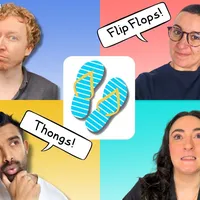
Today we have one British person, one
Canadian,
one American, and one Australian.
We're going to look at common objects,
and we're going to find out what do we
call these objects. What does a British
person call the object? What does a
Canadian call it? What does an American
call it? And finally, what does an
Australian call this object? If you want
more videos like this where you can
learn by listening, check out our
website englishponge.com.
We have more than 300 videos where you
can learn and listen to English.
» Okay, Justine, are you ready?
» Hey, James, I'm ready.
» Alia.
» Hey, James. Hey, Justine. Yes, I am
ready.
» So, let's take a look at the first
object here.
Justine the Canadian. What is this?
» I would call this a delivery van.
» Alia, what do you call it?
» Uh, I would just call this a truck.
» Right. That's what I would that's what I
thought that Justine would have said,
but a delivery van. Okay. In the UK, we
do not call this a truck. We call it a
lorry.
» So,
» so there you go.
» Yeah, a truck. It someone could also
call it a truck here as well, but
usually when they have a big white box
on the back, it's usually a delivery van
or lots of times we call it a box truck
depending on the use. Yeah. Yeah, we
would call it a box truck, too. Um, but
almost always we just use the general
term truck, but yeah, box truck is
right, too, cuz it's the shape of a box.
» I would just call this a truck. And it
doesn't really matter um what size it
is. Um these would just be called
trucks. And I don't really know what um
people would call it in other parts of
the world. Um, but uh I would just call
it a truck.
» Um, let's move on to the next uh
picture.
» So, here we go. Alia, what is this?
» Uh, this is a sweater.
» Uhhuh. Uh, Justine.
» Yeah, same with us. It's a sweater.
» Now, do you guys know what it is in the
UK?
» Yep.
» Uh,
» it's a jumper.
That was a really good British accent,
Justine. Really good.
Yeah, it's a jumper. That's right. We
call it a jumper. It has nothing to do
with jumping. Um, to be honest, I don't
really know why it's called a jumper.
Um, a sweater kind of makes sense
because I guess you sweat more when
you're wearing it.
» Could that be why?
» Yeah. I don't really know why it's
called that either. Yeah. So, this one
um could be called a few different
things depending on how specific you
want it to be, but in general, I would
just simply call it a jumper. And if I
wanted to be a bit more specific,
because it is a um knitted jumper, you
might call it a a knitted jumper or a
knitted sweater. Um a sweater um
probably is more appropriate for this.
um piece of clothing. But um pretty much
anything that you kind of wear for
warmth over your t-shirt, like a
secondary layer in Australia, um you
could get away with calling a jumper.
» Now, this in the UK, this would be
called this would be called a dummy in
the UK.
» Yeah, this would be a dummy. Um Alia, is
it called a pacifier in America or is
that wrong?
» Yeah. Yeah. Pacifier is correct.
» Okay. And Justine,
» we we also call it a pacifier or a paci,
but most people will call it a soother
in Canada.
» Why do you think it's called a
» soother here?
» Because it soothes the baby. And same
with pacifier. It pacifies the baby to
want to suck on something if their mom
is not around. And so it's a pacifier or
a sootheer.
» We've got the standard word for it. Um,
which would be pacifier. Um, and I know
that would probably be the word that you
would hear in other forms of English as
well. But here in Australia, we have
another word for it and it is dummy. Um,
so if you saw um a baby with with this
thing in their mouth, you could call it
a dummy.
» So Alia, what are these? Or what is
this?
» Yeah, this is a picture of candy.
» Yeah, in Canada we call it candy as
well.
» In the UK, these are this is not candy.
These these are sweets. That's what we
call them. Yeah. Um, you probably knew
that one.
» Yeah, some people some people call them
sweets here. Um, if they are
maybe their relatives are more recently
immigrated. They're they haven't maybe
been here for hundreds of years. So,
it's not uncommon to hear sweets here as
well.
» Oh, that's interesting.
For me, I would say sweets are like a
broader category. Like sweets include
candy and dessert, other types of
dessert for example. So
» like cake and pastries,
» pastries, cake, pie, uh those types of
things. I But this specifically is is
candy because each one here is a type of
candy like a chocolate or candy cane,
lollipop, you know, so on. So
» like sweets is is true, but it's to me
it's just one type.
» So wait, is does
» is chocolate candy in America?
» Yes.
I would say chocolate is a type of
candy.
» Mhm.
» I had always thought that candy was was
just the the sweets and the chocolate
was a separate thing.
» Mhm. Yeah. Here's another another
different word. In in the USA they call
like candy bars are to us we call them
chocolate bars. M
» so in the USA I think there's even a a
more stronger association with chocolate
being candy
» in Canada it's not if we if someone says
do you want a candy they're never going
to be handing you a chocolate it's
always going to be some sort of like
» sweet hard like candy that's just like a
one piece of candy
» um but to us candy is not chocolate
» that's so weird So, how is chocolate and
candy? How are How are they both candy?
That's so weird. Do you have You don't
need two different names for the two
different things. One of them is
chocolate and the other one is the
sugary uh chewy stuff. But use the same
word for both of
» those things.
» I don't know. I think chocolate is
sugary and chewy, too.
» But it's it's not But it's not so chewy,
though, is it? It's more It's more like
it snaps off.
» Uhhuh. Yeah. Well, I guess because you
can you can cut chocolate into smaller
pieces like you know if you um get a box
of chocolate um I would say box of
chocolate or box of candy
pretty interchangeably and I would only
say chocolate to specify it's a box of
chocolate candies. You know what I mean?
» Okay,
» easy one. We would just refer to these
or at least I would just refer to these
as lollies. Um, I guess a more technical
word for it could be confectionary. Um,
and I know some people might call them
sweets. Um, potentially in the UK these
are referred to as sweets. Um, but yeah,
I would call these lollies.
» Um, so Justine, what do we have here?
Um,
I think
uh older people would call this an
armoir, a French word.
Um,
but
I don't know. I can't think of what the
word what the common word would be. I
have to listen to both of you first to
remember what we call it here.
» You can't Don't Justine, you have one of
these in your house, do you not?
We would just call it a cupboard, but
it's not really specific to clothing.
Like I think this you would put clothes
in.
» Huh. Alia,
» right?
» Uh yeah, I would call this a dresser. Um
it doesn't have to be this shape. I
think this shape specifically I would
say is also an armoire. Um, yeah,
» but you could have, um, another dresser
that is just, you know, horizontal
shelves. That's what I have, a dresser
with like five horizontal shelves, like
the one you see on the bottom. But, and
then this top has a section of
cupboards, like that word that you used,
cupboards, because they're like,
» I don't know, kind of deeper. Yeah.
» And you open it like um the the the
doors are vertical. I don't know. It's
all it's I guess it's not it doesn't
really matter so much, but I think this
specific shape I would say armoire. Um
and
» yeah, a dresser is shorter and wider and
it a dresser has all drawers.
» Yeah.
» Yeah. Yeah.
» But this is What about you?
» This is supposed to be where clothes go.
Correct. Am I correct or no?
» Yeah. Yeah. Yeah. Like behind the
cupboard there's like a bar and then you
can hang hangers on the bar to put your
shirts and
» so so of course this is a wardrobe.
That's what this is.
» This is clearly okay.
» This is definitely a wardrobe. I've
never heard this word ammoir before. I'm
really confused about that. Okay.
I think if you said wardrobe, people
would understand that you meant this,
but I don't think it's a really common
word here. I think most people would say
cupboard or armoire for this specific
shape, the vertical with the cupboards.
» Mhm.
» Yeah.
» Yeah. I mean, the only reason I think I
knew you would say wardrobe is because,
of course, the classic book, The Lion,
The Witch, and the Wardrobe, uh, by CS
Lewis, which obviously if you've seen
the seen the movie or
» or or read the book, you know that it's
like this type of piece of furniture
where,
» uh, it's not built into the wall, right?
It's a separate piece of furniture, um,
that you
» you enter and then,
» yeah, the lion, the witch in the
wardrobe is classic. So,
» and you end up in Nania. Yeah, exactly.
Um,
» yeah,
» I thought that you called this a closet.
Is that not Is that not correct?
» No, a closet is when it's built into the
house.
» Oh, I had no idea that there was I don't
think we have that here. We Some people
do, but usually we most houses in the UK
don't have a closet built in.
» Mhm.
» Yeah. We only have wardrobes. My closet
is behind me. Those the white doors at
the back. I don't know if you can see
them. I'll move my camera a little bit.
That's my closet. It's a really really
big closet. That's not very common. Um,
usually bedrooms have a small closet
with one like it's called a biffold
door. It kind of slides and opens and
then it's about the same size as a
wardrobe, but it's built into the
bedroom. um so that it's part of the you
know the architecture of the house.
» I get the sense that houses in North
America are just have more space in
general. Like I don't know but like
» in the UK our house like we don't have a
lot of space like we don't have an
entire room for clothes. Like
» that's there's just no room for that. I
guess because our houses are just so
old.
» Um
» whenever I see people That's right.
» I see like videos of Americans on
YouTube and they have like these massive
kitchens. There's loads of space. I'm
like, this is so annoying. Like,
everything's so cramped here in the UK.
There's just no space.
» A cupboard. This is a cupboard. Um, the
bottom part uh you could maybe be more
specific and say are the drawers and the
cupboard is uh on top. Um, but I would
just in general call this whole thing a
cupboard. Alia, what is this that we're
looking at now?
» This is a parking lot.
» Yeah, I thought I thought that would be
the case. Uh Justine.
» Yeah, same here.
» So, do you guys know what it's called in
the UK?
» Car park.
» Correct. That's right. This is This is a
car park. Um I think that's quite a
common one, right? I think I knew I
already knew that you guys were going to
say parking lot. I've heard that in
movies and stuff. So
» Mhm. Mhm.
» So this one is a car park. Um I know
this could also be referred to as a
parking lot in in different um forms of
English. I think in American English for
sure um people might call this a parking
lot, but uh in Australia you just refer
to these as car parks. Let's go on to
the next image. Uh,
this is of course the bit at the back of
a car. So, Justine, what is this
» to us? It's the trunk.
» And Alia?
» Same. It's a trunk.
» And do you know what it is in the UK?
» It's a boot. Mhm.
» Yeah. This is a boot. Not the kind of
boot that you put on your foot, but
that's what we call it. This is the
boot. This you'd call a a boot. Um I
know some people may refer to it as a
trunk, but that is probably more
American. I think here uh in Australia
you would just call it um the boot. Um
and the front of the car for those
interested is called the bonnet.
» Look at this vegetable.
What kind of vegetable is this, Alia?
» Uh it looks to me like it's a cucumber
or zucchini. So this is a corette
actually in in the UK. Now when I
traveled to Australia I do I remember
seeing zucchini and being like what's
that? What is that? I've never heard of
that before. So
» it's a very funny looking word.
» Yeah. Right. It's like what what the
hell is that? And it's a it's a corette.
That's what it is.
» We call these sugis.
Um
I think I have heard people uh call
these corettes um or cores. I don't know
exactly in um other places um in other
parts of the world. Um and even maybe in
Australia some people call these
corettes. Um I call them zucchinis. Um
and that's what I grew up hearing. Um,
but I wouldn't be surprised if some
other people in Australia call them uh
corettes.
» Justine, what are these?
» We call them French fries.
» Okay. So, you would go to the shop and
you would ask for French fries or would
you ask for fries?
» You could ask for fries, too. Yeah,
that's probably more common, actually.
Probably most people just say fries,
» Alia.
Yeah, exact same answer. French fries or
fries?
» Now, to me, these are not, if I look at
this picture, it is tricky to say, but
to me, these are not fries. These are
chips.
» These are chips because they are quite
thick, right? There's actually quite
they're quite thick. Whereas fries for
us are really thin. They're like really
skinny
» chips.
» Yeah. All I know is that basically in
the UK, if they're really like fast food
but also really thin, then they're
fries. But if they're nice and thick, if
they're thick, then they're chips and
they're not fries anymore.
» These ones are chips. Uh you could also
call them fries. Um,
fries to me would be the thinner ones,
but in Australia you could get away with
saying chips for absolutely everything
um that is made out of potato basically.
Um, even the the ones that come in um
plastic bags um or packets, sorry. Um
that in England I know are called
crisps, the dry ones. Um we call them
chips here as well. So, um whether you
get chips from McDonald's or um uh KFC
or wherever you go, um wherever you get
um fried potato, I guess uh we call them
chips and uh you won't go wrong calling
them chips in Australia.
» Alia, what are these in this person's on
this person's teeth? What are these?
» Uh they're braces. Something that I had
a lot of experience with. I I wore
braces for 4 and a half years. Probably
the most painful thing that ever
happened to me.
» Well, your teeth are very nice, so thank
goodness.
» At least on the top, they're still
pretty straight.
» Okay.
» Yeah, we call them braces as well.
» Okay. We call them braces also. I
thought there would be something
different with the swap. Oh,
» in in some uh well, I know in Spanish
they call them brackets. So, I thought
maybe it might be a chance that in the
UK you would call them brackets as well.
» No, we'll find out what they're called
in Australia,
» curious.
» Braces. I don't really know any other
word for these. Um
uh I just know them as braces. Uh, I
fortunately never had to use them, but
yes, I know they are called braces.
» What are these, Justin?
» These are coveralls.
» Oh, coveralls. Yeah.
» Yeah.
» Okay. Alia, what are these?
» I'd say overalls.
» Yeah, that's probably more correct.
Coveralls are the ones that are like the
full suit that cover your whole body,
» but overalls go over your shoulders. So,
you're right. They're overalls.
» These are dungarees.
» Oh, okay. We have work pants that are
called duneries, but we would never call
these dunes.
» I'm pretty sure these are dungarees. I
don't think I've ever worn these before
in my life, but yeah. These are
definitely dungarees.
» Pretty sure.
» So, what if they're a little bit more
stylish? Like sometimes
uh women will wear a kind of a dress
that looks like this. It's shorts, but
it is a little bit more like flowy. And
that's what we call a jumper.
We I um I may be out of my depth here in
terms of like fashion,
» right? Fashion.
» Uh I it could be the case that we call
them dungarees if they are like that
» and maybe they are overalls. If like
workers
» use them perhaps like if you're
» work at a car as a car mechanic or
something,
» you might call them overalls. Um, what
what did you say you you call them if
they're fashion items?
» Jumpers.
» Jumpers.
» I would call these overalls. I feel like
somewhere in Australia or
I don't know, there probably is some
kind of slang term for these. Um,
especially amongst sort of farmers, but
I just know them as overalls.
» Alia, what are these?
These are flipflops.
» Mhm. Yeah. Justine,
» when I was growing up, everybody here
called these thongs, but now everybody
calls them flipflops because thongs are
a different kind of underwear.
» Yeah, in the UK these are flip-flops,
but I know that in Australia they are
called thongs.
» Okay.
And they they did not stop calling them.
They still call them.
» Yeah. Yeah. They don't have the
embarrassment of the double meaning of
the words like the rest of us prudes.
» Mhm.
» Australians Australians just don't care.
They don't give a damn.
» That's right. Good for them.
» I guess I guess as an Australian, you
could be wearing a pair of thongs and a
pair and a thong.
» That's right. Yeah, you really could.
It's a pretty weird combination of
clothing, but
» somebody probably did it once.
» Anything goes on the beach.
» Yeah, these days the style of bathing
suits is like very thonglike
these days. A lot of uh
» a lot of
butt cheeks out.
» Mhm.
I I will ask Nepuna if any if he has
ever known anyone who wore a pair of
thongs and a thong at the same time.
» Maybe he has.
» Maybe he has. We should We should ask
him. There is definitely a very distinct
Australian word for this. And I don't
really know if any other countries um
use this word for uh this image um and
this object, but we call these thongs.
Now, you want to be very careful saying
thongs um in in other parts of the world
because um
that refers to another piece of clothing
which uh we can leave for another video.
But these um are called thongs. Um or
some people might call them flip-flops.
Um, but a very Australian way of
referring to these are thongs. And um,
because it gets so hot here in summer
especially, um, you're going to see a
lot of people uh, dayto-day just walking
around wearing these.
» Let's go on to the next question. Uh,
what is this? Uh, Alia.
» Oh, uh,
hm. Well,
here's the thing. So, with it attached
to the car,
I'm actually not sure if it would be
different. Uh, I would say an RV, which
I think stands for like residential
vehicle. Um, or maybe a camper. Um, but
I think yeah, I think maybe camper is
right because RV would be like when the
whole vehicle is
is uh is like for that that purpose of
hauling like basically a room with you
on a on a long drive.
» Yeah. So, it actually stands for
recreational vehicle.
» And the ones that are all connected,
like with the the motor, like the drive
part being all in the same like
building, those are called motor homes.
» Mhm.
» And the ones that you drag behind are
called campers or RVs or a travel
trailer. There's a lot of different
names.
» Okay. Yeah, that makes sense. That makes
sense why I was not exactly sure, too.
If there's so many So many names.
» Yeah.
» What about in the UK?
» Well, the one I know for sure the one
that is pulled along by a car is called
a caravan.
» Yes. That's called a caravan.
» Okay.
» As for the one that you drive, like it's
all one thing. That's called a motor
home, I believe.
» Mhm.
» Okay.
» This one I just call a caravan. Um,
it looks like it's
um
a type of caravan that attaches to the
back of the car. Now, if it if it was
just the full
um van um that you could drive itself,
people would probably just call it a
van. Um but the ones that attach to the
back of your car, um yeah, you'd call
them caravans.
» Alia, what are these?
Ah, those are bangs,
» right? Yeah, Justin,
» they're bangs here in Canada, too.
» Yeah. The long for the longest time, I
heard people talk about bang bangs on TV
in America, and I was like, what are
they talking about? I could not
understand what bangs. Um, this is a
fringe.
» Yeah,
» that's what it is.
» Oh. Uhhuh.
» Right. Is it the same? Am I wrong? Is it
the same thing? This is This is
» It's the same thing. Yeah. We
we never call it fringe here and most
people would probably not even know what
you're talking about. Whereas, you know,
a lot of words like people would
probably know what you meant when you
say caravan or chips or, you know, a
jumper. But the fringe is something that
like hardly anybody knows unless you've
watched British TV shows with your mom
for 20 years.
» Are you referring to anyone in
particular?
That's interesting to me. Like fringe.
Um I would I would get what you mean,
but like you know how it's kind of
choppy. This in this image the the edge
of the bang is like kind of choppy. Um
that to me is what like fringe implies.
Cuz I have bangs and I'm showing you in
my video now. Um I have long bangs but
they're not like choppy at the bottom.
They're kind of smooth. Um, and so to
me, like they're not fringy. There's no
like fringe, but I still have bangs. You
know what I mean?
» Okay.
» The thing is I don't understand why you
refer to this as as a plural as like
many things. Like to me, this is one
thing. It is a a fringe.
» Yeah.
» Ah, that's a good point. I guess um
well, some styles they go to they go to
both sides. my bangs. There's one on the
left and one on the right. Whereas in
your right picture, there's one.
» Yeah, there's side bangs. But yeah, I
guess that would still be plural even
though Well, maybe cuz one like there's
a there's a small bang going to to one
side and there's like a big bang going
to the other side.
» I think you're overthinking this. Oh
yeah. I think in in the North America,
our word just doesn't make sense.
» James wins.
» Ah, fair enough. Fair enough.
» The British win again. Yes.
» I've never I I would Yeah. I in the UK,
I had never heard of bangs before. And
then when I heard them on TV, I was just
like, what? What are these people
talking about bangs? There's a lot of
American words that when I was growing
up just confused me so much. line when
people talked about their pants.
» I was like, "What? What? Those are
trousers. What do you mean pants?" You
know? I remember watching
» Why are you being so rude talking about
your pants?
» I was so And I would watch Friends and
there would be an episode of Ross and
his like leather pants or whatever.
Where where are these where are the
pants? The whole episode only had
trousers in them.
» Yeah.
» So, like when I was watching as like a
12 or 13 year old, I was so confused.
Like I did not understand what I was
missing.
» I think it's pointing at specifically
this part um of of the hair. And I would
call this just a fringe. Um
I'm not too educated on ladies
hairstyles, but I guess uh it could also
be referring to to bangs, I guess. Um,
but please please don't have a go at me
in the comments. Um, uh, I would just
call these a fringe.
» Alia, what is this?
» Uh, this is an outlet.
» Just an outlet. That's it.
» Um,
I guess you could say electric outlet.
» Okay. Yeah. I thought it was going to be
power
» or a power outlet or
» power outlet. Yeah.
» Or a plug.
» Justine. This is just a plug.
» Well, same thing. Like we could call it
a power outlet, an electrical outlet, a
plug.
» Now, this this is a plug socket
» is what it is.
» Yeah, that's right.
» Do you use the correct word?
» Yeah, socket makes sense.
So just but the thing is Justine would
you look at this and say it is a plug?
» Uh no,
not necessarily. But like um say when
you're if you need to install a new one,
we would well that's cuz what I'm doing
right now
I'm I'm installing some plugs in my
basement. Um so that's what I would say.
about in like daily use. Um, you would
say it's an outlet.
» I want to take this opportunity to say
that I think to be honest, I really like
the British plug socket with the three
pins. I don't know if you guys have ever
used this. I really do not like the ones
that you guys have in in America with
the two pins,
» just two things. I find that like fall
out the wall so easily and it seems like
you could get like shocked easier. Do
you know what I mean? The UK ones are so
big though. They're like gigantic.
And the in most plugs now do have three.
They have two uh vertical ones and then
one round one that's the ground. And so
lots of appliances have three plugs now.
» Yeah. Yeah. Agreed. Three uh prronged
» prongs is definitely more secure. I I
agree with that. I I whenever I get
something that only has the two, I'm
like, h, this
» feels cheap, you know? It doesn't feel
like it's as uh sturdy. And like you
said, Yeah. like more more risk of
getting shocked.
» And the other thing in the UK is we have
the switch. Yes. Like in this picture
there, you can turn the power on and off
» feature.
» Yeah. Mhm. Nice. Yeah. Nice feature. So
before I ever in the UK before you plug
something in or you unplug it, you turn
the switch off first before you do it.
And I had always been taught that to
» to try and plug something in with the
switch on. That's dangerous. You could
get an electric shock if you just jam it
in there. You have to turn off the
switch.
» We're just jamming things in left and
right.
» That's right. It's not good. You
shouldn't be jamming things willy-nilly.
» That's right.
Um,
» you should ask for consent first.
» Exactly.
» That's right. Very important lessons
here at English Sponge.
» And lucky last number 15, a PowerPoint.
Very simple. We call this a PowerPoint.
In Australia, the PowerPoints don't look
like this. Um, there's a different
configuration,
but we call these PowerPoints. Thank you
for watching this video. If you do like
these kind of group videos, be sure to
check out this playlist here where you
can find lots of other group videos. Say
goodbye, Justine and Alia.
» Thanks for having me. Bye. This was a
lot of fun.
» Bye, guys. Thank you.