Nick: Today Wendy and I are coming to you from Serbia, and we're here to talk about the capital of Serbia, which is Belgrade. And Wendy, you've been here now, four times.
Wendy: Yeah, four times.
Nick: Why do we keep coming back to Belgrade? I've been here three times, so one less than you, but still, three times.
Wendy: Yeah, it is pretty unusual. There aren't that many countries I've been to four times. I tend to want to visit new places that I haven't been to, so, umm, this is pretty atypical. The first time was 12 years ago now, and it … I was visiting a friend, a Serbian friend of mine, whose family lives here. Uhh, the second time was a wedding of that Serbian friend, uhh, who got married to another friend of ours, an American. And then the next one was also a wedding, uhh, and it was the wedding of yet another friend who had met his bride at the first wedding. Uhh, so he was another American friend, uhh, he met a Montenegrin, uhh, who was also a guest at the wedding, and they had a long-distance relationship for I guess, a couple of years, and then they got married, so we came back for that.
And now we're here yet again, uhh, for just a short break, a five-day trip. Umm, this one, to be honest, uhh, it was mostly because there was a cheap flight available to Belgrade. We were just looking for a place where we could go for a quick, kind of, umm, five-day holiday. I had a couple of days off of work and, uhh, Belgrade was an option so we decided we would come back and see a bit more of it because when we were here for the weddings, we didn't really have time to do much sightseeing. You know, we were hanging out with friends, which was great, it was a lot of fun, umm, but, yeah, even after three times in Serbia I still felt like I hadn't really seen that much of Serbia so we thought it would be good to come back and do, kind of, the more typical tourist kind of trip.
Nick: Yeah, for sure, and we wanted to … originally we were thinking about travelling elsewhere in Serbia but we just decided to stay around Belgrade. So now that we have this new perspective as well, uhh, what do you think of Belgrade?
Wendy: Yeah, it's an interesting city. Umm, I wouldn't say that it's a beautiful city, at least, you know, large parts of it are not beautiful. There's a lot of, you know, umm, communist architecture that's just very practical and lots of big, umm, rectangular concrete buildings, umm, that, yeah, are really not very attractive. But, uhh, it does have its charms, uhh, there's one street in particular called Skardalija, umm, which is a very traditional street with cobblestones paving the ground and lots of old traditional buildings which are mostly now restaurants and bars, or kafanas, is the Serbian name for these kind of pub or, you know, restaurant slash bar places where you can go to get a drink at night and that's a really beautiful area and a fun place to hang out.
Nick: And I think the locals are very proud of that street and that area as well. I remember when we were here for weddings, they would take us there, and speak about it in a way that showed that they were proud of it. And I think because Belgrade is not really a huge foreign tourist city yet, umm, that area, even .. you know, it's quite … locals go there as well. It hasn't just been given over to foreign tourism so I think people who live here are happy to be able to go there and enjoy the atmosphere there as well.
Wendy: Yeah, yeah, definitely.
Nick: And, yeah, it is quite interesting to see the different contrast architecturally in the city. We saw a Turkish mosque the other day, but there's really almost nothing left from the Turkish or from the Otttoman period. And we were told that the city has been destroyed about 40 times throughout the course of its history which is quite extraordinary. But because of that, there aren't a huge number of old historical buildings there. It's quite interesting that even that mosque which is I think about 250 years old is the oldest religious building in the … in the city. There aren't any churches that are older than that even though the tradition has been that it's been a Christian area for many many centuries.
Wendy: Yeah.
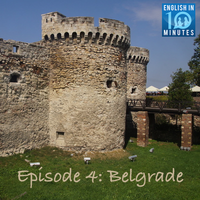
Nick: And so the oldest structure that they have in the city is this fortress, which is a really nice area. I mean there's not a huge amount of the fortress, or the interior of the fortress, left, and now it's kind of a park, and it's a public park, and it's free for everyone to enter. It's open 24 hours a day and so I think, you know, as well as the tourists who come here and want to see this place, I think the locals like to go there as well, to have picnics and just to walk around the park and things like that. So I think that's really nice and they're very proud people in general and they're proud of their history and their identity and things like that so I think the city does a good job of bringing that out in the local people.
Wendy: Yeah, yeah, I would agree with that. And also from that fortress, from the Kalemegdan fortress, you have a beautiful view out over the whole city and, uhh, it's right at the confluence of the two rivers, the Danube and the Sava, so where those two rivers meet is just below the fortress. So, umm, yeah, that perhaps embodies the sense of pride and, you know, being able to look out over the whole thing and be proud of it. Yeah, that's probably another reason they like it.
Nick: Because of those … because of the two rivers that are there, we were told by a tour guide that Belgrade is the third best situated city in the whole word after Istanbul, which is famously sited between Europe and Asia, and also Rio de Janeiro which is also beautifully situated with lots of mountains and a beautiful bay and harbour area and things like that. So (I'm) not quite sure that Belgrade is really number three, but certainly maybe people from Serbia, people from Belgrade think that, and, umm, certainly it is a really strategic location on the Danube and on the Sava. And the Danube is obviously a very long river that goes throughout large parts of Europe, but the Sava is more of a Serbian river, if you like, and they're, I think, proud of that too. And our friends Paul and Marija have a baby boy and they named him Sava…
Wendy: Right.
Nick: …after the … well not exactly after the river but after the saint for whom the river is named for. And so that's also a big part of Serbian tradition and Serbian history.
Wendy: And also in modern times the Sava river still plays a very important function in the city. Umm, there are these barges, uhh, so they're kind of like houseboats, umm, and now they've been turned into - again - bars and restaurants and places where you can go out and have fun, which is a big part of Serbian culture too. You know, they really like music and dancing and drinking and, uhh, so, at least in the summer time the boats on the Sava river is really the happening place in the city.
Nick: Yeah they definitely like drinking for sure. Even when we were on a walking tour a couple of days ago, even at 11 o'clock in the morning we were given shots of rakia which is the local drink that they like here.
Wendy: Yeah and that's another thing that they're very proud of is the rakia, because, uhh, a lot of times it's homemade, you know, people are just making it in the bathrooms of their homes, you know, and some of it is produced on a more … on a larger scale as well, but a lot of it is just homemade stuff. And so for example last night we went to a kafana on Skardalija and they had a whole list of different rakias, uhh, because they can be made from different fruits. It's basically a fruit brandy, so the plum version is the most common one because there are lots of plums in Serbia, but you can make it from different fruits as well so we asked the waiter, ‘Which one do you recommend?' and he said, ‘Well, you know, the plum is the most famous one but here in this restaurant I recommend the one from quince, because it's made by my grandfather, and it's totally homemade, there are no additives, there's no added sugar or anything, it's just pure homemade rakia and you're gonna love it.' So there's a lot of pride in that also.
Nick: Yeah and he came back to us after to make sure that we enjoyed it. And, uhh, yeah, you could see for sure that he was proud of it. So yeah, it's a … they're a very interesting people in that way. It's very, uhh, nice to talk to people who are proud of where they come from and who they are.
Wendy: Umm-hmm.
Nick: OK, so that's it from Belgrade for now. Maybe we'll be back again another time.
Wendy: Yeah, well, uhh, it seems to be the trend.
