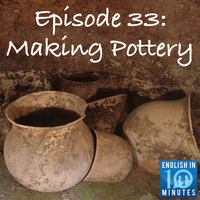
Episode 33: Making Pottery
Nick: Today I'm talking to my friend Caitriana about the job that she used to do, which was to be a potter, which is someone who makes pottery. Uhh, so Caitriana, how did you get into this work?
Caitriana: Actually, it's quite a long story.
Nick: Well, we have 10 minutes, so do the best you can.
Caitriana: OK, uhh, well first of all, my grandmother was a potter, umm, but she was more of a sculptor actually. Umm, she didn't make pots as such, although she worked with some extremely famous potters and actually had an affair with one of them, umm…
Nick: Ah, who knew the world of pottery was, uhh, so scandalous!
Caitriana: It wasn't scandalous but, you know, in those days it was maybe something a little bit different. Anyways, umm, yeah, my grandmother, uhh, worked with clay. She had a little, itty bitty kiln in her kitchen. And, uhh, so that was my first introduction to, uhh, to that kind of work. And then, umm, actually I studied, umm, development studies and, uhh, in that context I had to write a dissertation and I was looking at social change and, umm, what I did was to, uhh, make parallels between, uhh, social change or get ideas about social change in a country through art. And so I, uhh, visited, uhh, Senegal, umm, to do some research, and I met up with a lot of people and that really changed my, uhh, my perspective on life and, umm, development as a profession. Umm, the actual fact of studying development made me, uhh, change my, uhh, my views on that as a profession, alone. And so when I finished university it seemed actually quite natural that I should go into, umm, a manual line of work which had, umm, a creative, uhh, aspect to it.
Nick: That's quite interesting because I think in the western world, I think this kind of work is not really encouraged when you're at the student level. Umm, or certainly that was my experience, that if you said, ‘Oh, this is what I want to do,' people would say, ‘No, you've got and go and get an office job and do this kind of stuff,' and did you find, when you went to Senegal for example, that being creative was more valued that maybe we value it? Caitriana: Not at all. I think that, uhh … well, given that, uhh, that I was … I stayed mainly in the capital. The view of artistic work was actually, like, an extreme view of, uhh, western, uhh, perspective on, uhh, artist's work when you consider it as a possible, umm, professional path, uhh, for someone that you were close to or get worried about them. Actually in Senegal, I mean, basically if you're an artist you're a tramp, not far from it. I mean there are some, of course there are some, uhh, there are some traditional, uhh, positions in society, uhh, where you're very closely involved with, umm, making things, umm, and … but I think the most … the closest you get, traditionally, to an artistic, umm, product or production is via singing and music. Umm, but that has a function within society which is traditional, which is very controlled and very coded and, uhh, and all of that. And the rest of the work is actually craftsmanship so it's actually quite demeaning, rather than, umm, something that, uhh, could be associated to anything more positive, actually.
Nick: And does that make you sad that this is not valued the way it could or should be?
Caitriana: I don't know if sad's the word, uhh, but I do think that it's a bit unfortunate. Well I would tend to think that it's a shame that people have forgotten that everything that we use in this world and everything that we have is only the result of human work and, uhh, and we've forgotten that because we use machines. But those machines are also activated by a person and even if they haven't actually, you know, modelled the plastic or the metal in order to make this machine, there is some relation between work and, uhh, any kind of object that we use and that we have.
Nick: And if you look back thinking about pottery specifically, if you look back to ancient civilisations, and I'm thinking about Rome and Greece that I know reasonably well, we know a huge amount of what we know because of pottery.
Caitriana: Hmm, yeah, we do.
Nick: And because of remains of pottery. And so obviously the people who were making it didn't know the impact that would have for us thousands of years later when we study their civilisation, but it's super important, and it seems to have lost that a little bit, perhaps.
Caitriana: Clearly. And I don't know exactly what the remains of pottery would say about, uhh, about today's society or, umm, reality, basically.
Nick: OK. So let's go back to what it is and how you do it, because it's perhaps a fairly complicated process to explain.
Caitriana: It is.
Nick: Umm, so you start with clay…
Caitriana: You start with clay, which is wet and malleable that you can, uhh, get into shape with a variety of different techniques. I used to throw it on a wheel. So, umm, if you have seen the film Ghost, there's a really lovely scene that I got used to hearing about on a very regular basis. Umm, anyways, so you put the clay on a wheel and you use the, uhh, what is it? centrifuge force - or, yeah, centrifuge force, or is it centripede, I never remember - to get it into shape by pressing it and getting it up and then mounting walls that are meant to be symmetrical, basically. Umm, so at that point, your clay is still, uhh … can still change shape a lot and it's really mushy and not hard, basically. So you have, umm … you put it into shape, and then you have a drying period that you have to control, because if it dries too fast, umm, and the clay isn't evenly spread in the shape, umm, it'll break while it's drying. Umm, also there's a second, uhh, phase, there's a second part of the process where you have to, kind of, finish it off and scrape off all the extra bits of clay, because when you actually put it into shape initially, because it isn't … because it's still soft, you have to keep that in mind in the way that you make it. So the bottom will probably be stronger than you would like it to be in its finished form, so you have to remove a lot of the clay that, uhh, when it starts drying. Once it's dried completely, you do have to make sure it's completely dried, you can put it into a kiln, which is like a huge oven, that you can heat up to … mine used to heat up to, I think it was, 1200 or 1300 degrees, basically.
Nick: Wow, that's really hot. Celsius?
Caitriana: Celsius.
Nick: So that's … I mean, a standard oven for cooking in your kitchen goes up to about 250, a pizza oven goes up to about 450-500, so you're even double … uhh, more than double a pizza oven.
Caitriana: Yeah.
Nick: That's crazy hot.
Caitriana: Yeah, it's amazing. There are loads of things, I mean, I, umm, I had the experience of firing pieces with wood so that's like, you're loading wood into this huge, huge oven, umm, huge kiln for all night, basically. And, umm, there are little, like, cones that you have of ceramic material that will fall at certain temperatures so that you know where you are in your rise of temperature. Because each temperature has an impact on how far the fusion goes, basically, and depending on what kind of clay you have, you might just take it out of the kiln and it'll just have become like a hardened, umm, puddle of clay if you heat it up too much, basically. So, uhh, they're amazing … it's a wealth of knowledge. It's just, it blows your mind. If I start talking about it I can go on for probably a few hours.
Nick: OK, well we might have to leave it there but thank you very much for taking us into this world of pottery.
Caitriana: You're very welcome, it was a pleasure.
