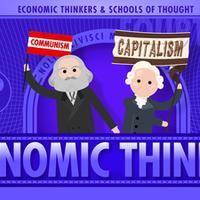
Economic Schools of Thought. Part 2/2.
● Hayekian economics (5:40)
Adriene: But as Socialism and Keynesian economics expanded, other groups continued to forcefully push for private property and free markets. The most vocal was often the Austrian school of economics, they also have a very vocal fanbase in our comments section. Friedrich Hayek and Ludwig Vunmises, who were unsurprisingly from Austria, argued that heavy state involvement has never produced the results it promised, and that regulation and government tinkering is actually a problem, not a solution. Rejecting nearly all forms of fiscal and monetary policy, the Austrian school today argues the economy's just to complicated to manipulate. This backlash against government intervention was carried forward in the US by Milton Friedman. Like the Austrians, Friedman advocated privatization of many functions that had been assumed by government, famously proposing school vouchers and deregulation of the economy. He also concluded that the depression could be blamed on botched monetary policy rather than some inherent fault of capitalism.
The theories of Friedman and his followers at the University of Chicago came to be called the Chicago School of economics. Friedman's views got a huge boost in the 1970's. At that time, inflation soared while output stagnated. Remember stagflation? A combination that Keynesian economics had trouble reconciling. Some macroeconomists drew on the insights of the Chicago school to claim that these events disprove Keynesian economics.
Building on the ideas of Friedman, another idea of economics gained traction: monetarism. Whoo, Stan, so many -isms. Monetarists focused on price stability and argue the money supply should be increased slowly and predictably to allow for steady growth. At about the same time, another theory called supply-side economics, or sometimes called trickle-down economics entered the mainstream. Supply side economics advocated deregulation and cutting taxes, especially corporate taxes.
● Modern economics (7:37)
Mainstream economics today takes ideas from both classical economics, including monetarism, and Keynesian economics. This unified theory is sometimes called the New Neoclassical Synthesis. And yeah, economists are bad at naming things, too. But debates about how and when to implement policies continue. And remember, these are more than just intellectual classroom spats, these policies affect millions of people.
The different reactions to the global recession in 2008 are a good example of this. Some economists suggested using Keynesian policies, namely deficit spending. Other economists suggested the more classical approach of reigning in excess spending to reduce budget deficits, something called austerity.
Believe it or not, economists are still fighting about which of these policies is the right approach and when to use them. We can all agree that Keynes was right about at least one thing, when he said, "Ideas shape the course of history." So where are all these economic theories and ideologies gonna take us in the future? Most countries that once supported strict Communism like China and Cuba have moved toward Capitalism. The only country that's really sticking with it's North Korea, but they're too isolated to be a real test case for an economics system. But this doesn't mean that Marxism is dead. Many capitalist countries have adapted socialist looking programs. It appears the world's economies are converging towards the middle. But in the end, it turns out it's just really hard to predict the future, especially when we're talking about something as complex as the world economy. Remember Malthus's belief that we're all gonna starve? Well like Malthus, we don't know what kind of changes humanity's gonna face in the future. If history has proven anything about economic thought, it's that we should expect surprises that will upset our current economic models, just like Malthus couldn't imagine that we'd all be alive today. [endscreen]
Thanks for watching, we'll see you next week. ● Credits (9:30)
CrashCourse Economics is made with the help of these nice people; feel free to comment on how great they are, too. CrashCourse is made possible by your support at Patreon. You can help keep CrashCourse free for everyone forever and get great rewards at Patreon.com. Thanks for watching. We're glad Malthus was wrong, and that you're alive
