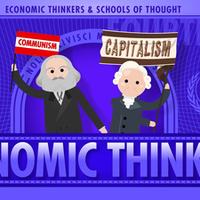
Economic Schools of Thought. Part 1/2.
● Introduction (00:00)
Adriene: Welcome to Crash Course: Economics, I'm Adriene Hill.
Jacob: And I'm Jacob Clifford.
Adriene: Now, believe it or not, we actually read many of your comments on YouTube.
Jacob: First!
Adriene: Some are productive and others, not so much.
Jacob: This guy looks like Mark Cuban, but not as attractive...or rich.
Adriene: We've noticed some people are disappointed we haven't covered the different economic ideologies.
Jacob: You're ignoring the Austrian School.
What's this Keynesian trash? Adriene: Well, guess what?
Today, we're going to talk about other schools of economic thought. [Intro Plays]
● History of Economic Theories (0:32)
Jacob: To understand these economic theories, we're gonna have to jump into a little bit of history.
In 1798, a British economist named Thomas Malthus argued that population growth would outpace food production, so eventually humans would run out of food and starve. You wonder why some people call economics the dismal science. Well, Malthus was wrong. Dismally wrong. The world population has grown from one billion in his time to over seven billion today.
And it turns out that the famines we have seen are largely man-made disasters that have very little to do with our ability to produce food. But Malthus was writing at the beginning of the Industrial Revolution. He didn't factor in advancements in technology, agriculture production or transportation. So with the information he had, he was kinda right, but he was still wrong. Economic theories are constantly being proven, disproven and revised.
The problem is, when these theories are wrong, millions of people can be adversely affected. Take Malthus. Some scholars combined his ideas with those of Charles Darwin and concluded that giving assistance to poor people and social programs like welfare are actually immoral. This is called Social Darwinism and it's completely wrong. Now, economics is not an exact science.
It aims to draw conclusions about human behavior without the benefits of labs or perfect control groups. Economic theories reflect different attitudes about human nature and those are likely to change over time. Let's go to the Thought Bubble. ● Thought Bubble (1:44)
Adriene: The founder of modern economics was a Scottish philosopher named Adam Smith.
In 1776, his book The Wealth of Nations, was published. It was an organized discussion about production, markets and economic theory, and it was tremendously influential. Smith introduced the idea that a person following their own self-interest could end up serving the common good. He also advocated free trade. Many countries at the time had heavy tariffs which protected their domestic manufacturers at the expense of trade. A generation later, British economist David Ricardo expanded on Smith's ideas by introducing the theory of comparative advantage: the idea that two people or countries can both benefit from trade, even if one of them can produce more of everything.
When both focus on what they're best at and then trade, everyone benefits. Anyway, the field of economics grew, advancing ideas like private property and free markets.
And then along comes The Communist Manifesto in 1848. Rather than examining individual behavior, German philosophers Karl Marx and Friedrich Engels looked at economic classes and argued that history was explained by the conflict between workers and property owners. This process would inevitably lead workers to overthrow their bosses, ushering in a new stateless and classless system, called communism. Marx followed this up with Das Kapital.
Political movements spawned by Marxist economics challenged Adam Smith's view that individual self-interest serves the common good. The end result was two main camps: free market capitalism, supporting private property, and communism, advocating collective ownership of the means of production. Thanks, Thought Bubble. ● Classical Economics (3:25)
Despite Marx's challenge, market-based economic theory continued to dominate through the end of the 19th century, with contributions from French, British, and American economics.
This body of thought is called Classical Economics, and it was embodied in a book called Principles of Economics, published in 1890 by English Economist Alfred Marshall. Marshall organized and defined concepts we still use today, like supply and demand and marginal utility, which we're gonna get to soon. But as capitalism was expanding around the world, Marxist movements were too.
By the early 20th century, this battle for hearts and minds, along with political and social unrest in Europe, led to the establishment of the Soviet Union in 1922. Jacob: As Communism was maturing in the Soviet Union, the Great Depression crushed the market economies of the world's richest countries, it also dealt a devastating blow to Classical Economics.
The theories of Smith and Marshall didn't have much to say about how something like this could happen, or how to fix it. The British economist John Maynard Keynes proposed new answers in his 1936 book A General Theory of Money, Interest, and Employment, which basically launched the field of macroeconomics. ● Keynesian Economics (4:32)
Along with John Hicks, James argued that market economies don't self-correct quickly because prices and wages take time to adjust.
They claimed that during recessions, it is necessary for the government to get involved by using monetary and fiscal policy to increase output and decrease unemployment. Keynes wasn't supporting Communism, but his views directly challenged classical economists who saw government intervention as universally harmful for the economy. Now eventually Keynesian Economics became part of mainstream economic theory. See? I told you, economic theory changes over time, and all it took in this case was a catastrophic global depression. Keynes's ideas, combined with the ever-present Marxist critique, opened the door to more and more government involvement.
Since the Great Depression, many nations have pursued a political and economic ideology called Socialism, although Socialist ideas and policies have been around since the 19th century. In most cases, these economies allow for private properties and markets, but also have government ownership of industry, significant regulation, and big public programs like universal healthcare. In Scandinavian countries like Norway and Sweden, they love these socialist policies. Now the US has rejected many of these socialist ideas, but the US government, or at least economists that advise politicians, are clearly in favor of Keynesian economic policies when the economy's in trouble.
