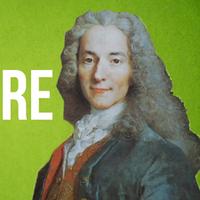
16. LITERATURE – Voltaire. Part 2/2.
You might think this sounds like a bit of a confidence trick – Voltaire certainly did – but this idea did find widespread acceptance in the eighteenth century.
Candide's great mission was to put this philosophy to the test. Ejected from his comfortable home in an obscure German castle after trying to seduce the Baron's beautiful daughter Cunégonde, Voltaire's hero Candide undergoes many trials and tribulations: conscripted into the army, he fights in a war, then deserts, only to find himself a witness to an earthquake in Lisbon [– a reference to a recent event in which some 40,000 people had perished]. Candide is repeatedly brought face to face with evil in its most extreme forms – moral evil, in the case of the earthquake, where man is not apparently to blame; and most of all human evil, such as the war, where man is very definitely to blame. Pangloss's breezy Optimism is clearly an inadequate response to enormities of evil on this scale. Eventually, even Candide comes to realise this. To quote from the book:
"And sometimes Pangloss would say to Candide: ‘All events form a chain in the best of all possible worlds. For in the end, if you had not been given a good kick up the backside and chased out of a beautiful castle for loving Miss Cunégonde, and if you hadn't been subjected to the Inquisition, and if you hadn't wandered about America on foot, and if you hadn't dealt the Baron a good blow with your sword, and if you hadn't lost all your sheep from that fine country of El Dorado, you wouldn't be here now eating candied citron and pistachio nuts. ' ‘That is well put,' replied Candide, ‘but we must cultivate our garden. ' " After 1760, Voltaire took up residence in the château at Ferney, just outside Geneva.
By now he was the most famous living writer in Europe, and he became widely known as the ‘patriarch of Ferney'. He took up a number of public causes. In 1761, a Protestant merchant Jean Calas was accused of murdering his son and sentenced by the judges of Toulouse to be tortured and then broken on the wheel. The legal processes were - to say the least - irregular, and the suspicion grew that the judges in this Catholic city had acted with excessive zeal out of religious bigotry. Voltaire became involved in the case, and mounted an energetic campaign to rehabilitate Calas' memory and to help the members of his family, who had been left destitute. He wrote letters to those in authority and published a stream of pamphlets, culminating in 1763 in his "Traité sur la tolérance" (‘Treatise on Toleration'), which begins with the historical facts of the Calas case and broadens out into a history of religious intolerance in European culture. Voltaire's writings had enormous impact on public opinion, and eventually the judges in Paris quashed the judgment of the Toulouse court. Too late to save Calas, but a huge victory for Voltaire, who had learned an important lesson about how change could be brought about through the pressure of public opinion. ‘Opinion rules the world,' he wrote in 1764, ‘but in the long run it is the philosophers who shape this opinion. ' Voltaire said of himself that he ‘wrote to act', and he wanted his writings to change the way people thought and behaved. In leading his crusades against fanaticism, he even invented a campaign slogan, "Écrasez l'Infâme! ", which translates roughly as ‘Crush the despicable! '. "L'Infâme" stands here for everything that Voltaire hates, everything that he had spent his life fighting: superstition, intolerance, irrational behaviour of every kind. And we should never forget that he was a brilliant writer, one of the greatest stylist the French language has ever known.
The power of his ideas had a lot to do with the power of his expression: many writers made fun of miracles, no one did it so hilariously as Voltaire. Always, Voltaire has an ear for the telling phrase: ‘If God had not existed, it would have been necessary to invent him' – it's a good line, even in English, and better still in the original French, where it is more memorable because it is a classical alexandrine line in 12 syllables: "Si Dieu n'existait pas, il faudrait l'inventer. Voltaire's legacy in our present debates about religious toleration remains potent. Hardly a week passes without an article in the press quoting ‘I disapprove of what you say, but I will defend to the death your right to say it.' This rallying cry of tolerant multiculturalism is so potent, that if Voltaire hadn't said it, we would have had to invent it. Which is what happened – the expression was invented, by an Englishwoman in 1906. No matter – it expresses a truth which is fundamentally important to our culture, so we have adopted the phrase and decided that Voltaire said it. Voltaire's name has become synonymous with a set of liberal values: freedom of speech, rejection of bigotry and superstition, belief in reason and tolerance. It is a unique, and nowadays extremely precious legacy.
[Written by Professor Nicholas Cronk.
Director of the Voltaire Foundation]
