Sleep is your superpower
Thank you very much.
Well, I would like
to start with testicles.
(Laughter)
Men who sleep five hours a night
have significantly smaller testicles
than those who sleep seven hours or more.
(Laughter)
In addition, men who routinely sleep
just four to five hours a night
will have a level of testosterone
which is that of someone
10 years their senior.
So a lack of sleep
will age a man by a decade
in terms of that critical
aspect of wellness.
And we see equivalent impairments
in female reproductive health
caused by a lack of sleep.
This is the best news
that I have for you today.
(Laughter)
From this point, it may only get worse.
Not only will I tell you
about the wonderfully good things
that happen when you get sleep,
but the alarmingly bad things
that happen when you don't get enough,
both for your brain and for your body.
Let me start with the brain
and the functions of learning and memory,
because what we've discovered
over the past 10 or so years
is that you need sleep after learning
to essentially hit the save button
on those new memories
so that you don't forget.
But recently, we discovered
that you also need sleep before learning
to actually prepare your brain,
almost like a dry sponge
ready to initially soak up
new information.
And without sleep,
the memory circuits of the brain
essentially become
waterlogged, as it were,
and you can't absorb new memories.
So let me show you the data.
Here in this study, we decided
to test the hypothesis
that pulling the all-nighter
was a good idea.
So we took a group of individuals
and we assigned them
to one of two experimental groups:
a sleep group
and a sleep deprivation group.
Now the sleep group, they're going to get
a full eight hours of slumber,
but the deprivation group,
we're going to keep them awake
in the laboratory, under full supervision.
There's no naps or caffeine, by the way,
so it's miserable for everyone involved.
And then the next day,
we're going to place those participants
inside an MRI scanner
and we're going to have them
try and learn a whole list of new facts
as we're taking snapshots
of brain activity.
And then we're going to test them
to see how effective
that learning has been.
And that's what you're looking at
here on the vertical axis.
And when you put
those two groups head to head,
what you find is a quite significant,
40-percent deficit
in the ability of the brain
to make new memories without sleep.
I think this should be concerning,
considering what we know
is happening to sleep
in our education populations right now.
In fact, to put that in context,
it would be the difference
in a child acing an exam
versus failing it miserably -- 40 percent.
And we've gone on to discover
what goes wrong within your brain
to produce these types
of learning disabilities.
And there's a structure that sits
on the left and the right side
of your brain, called the hippocampus.
And you can think of the hippocampus
almost like the informational
inbox of your brain.
It's very good at receiving
new memory files
and then holding on to them.
And when you look at this structure
in those people who'd had
a full night of sleep,
we saw lots of healthy
learning-related activity.
Yet in those people
who were sleep-deprived,
we actually couldn't find
any significant signal whatsoever.
So it's almost as though sleep deprivation
had shut down your memory inbox,
and any new incoming files --
they were just being bounced.
You couldn't effectively
commit new experiences to memory.
So that's the bad that can happen
if I were to take sleep away from you,
but let me just come back
to that control group for a second.
Do you remember those folks
that got a full eight hours of sleep?
Well, we can ask
a very different question:
What is it about the physiological
quality of your sleep
when you do get it
that restores and enhances
your memory and learning ability
each and every day?
And by placing electrodes
all over the head,
what we've discovered
is that there are big, powerful brainwaves
that happen during
the very deepest stages of sleep
that have riding on top of them
these spectacular bursts
of electrical activity
that we call sleep spindles.
And it's the combined quality
of these deep-sleep brainwaves
that acts like a file-transfer
mechanism at night,
shifting memories from a short-term
vulnerable reservoir
to a more permanent long-term
storage site within the brain,
and therefore protecting them,
making them safe.
And it is important that we understand
what during sleep actually transacts
these memory benefits,
because there are real medical
and societal implications.
And let me just tell you about one area
that we've moved this work
out into, clinically,
which is the context of aging
and dementia.
Because it's of course no secret
that, as we get older,
our learning and memory abilities
begin to fade and decline.
But what we've also discovered
is that a physiological signature of aging
is that your sleep gets worse,
especially that deep quality of sleep
that I was just discussing.
And only last year,
we finally published evidence
that these two things,
they're not simply co-occurring,
they are significantly interrelated.
And it suggests
that the disruption of deep sleep
is an underappreciated factor
that is contributing
to cognitive decline or memory decline
in aging, and most recently
we've discovered,
in Alzheimer's disease as well.
Now, I know this is remarkably
depressing news.
It's in the mail. It's coming at you.
But there's a potential
silver lining here.
Unlike many of the other factors
that we know are associated with aging,
for example changes
in the physical structure of the brain,
that's fiendishly difficult to treat.
But that sleep is a missing piece
in the explanatory puzzle
of aging and Alzheimer's is exciting
because we may be able
to do something about it.
And one way that we are
approaching this at my sleep center
is not by using
sleeping pills, by the way.
Unfortunately, they are blunt instruments
that do not produce naturalistic sleep.
Instead, we're actually developing
a method based on this.
It's called direct current
brain stimulation.
You insert a small amount
of voltage into the brain,
so small you typically don't feel it,
but it has a measurable impact.
Now if you apply this stimulation
during sleep in young, healthy adults,
as if you're sort of singing in time
with those deep-sleep brainwaves,
not only can you amplify
the size of those deep-sleep brainwaves,
but in doing so, we can almost
double the amount of memory benefit
that you get from sleep.
The question now
is whether we can translate
this same affordable,
potentially portable piece of technology
into older adults and those with dementia.
Can we restore back
some healthy quality of deep sleep,
and in doing so, can we salvage
aspects of their learning
and memory function?
That is my real hope now.
That's one of our moon-shot
goals, as it were.
So that's an example
of sleep for your brain,
but sleep is just
as essential for your body.
We've already spoken about sleep loss
and your reproductive system.
Or I could tell you about sleep loss
and your cardiovascular system,
and that all it takes is one hour.
Because there is a global experiment
performed on 1.6 billion people
across 70 countries twice a year,
and it's called daylight saving time.
Now, in the spring,
when we lose one hour of sleep,
we see a subsequent 24-percent increase
in heart attacks that following day.
In the autumn,
when we gain an hour of sleep,
we see a 21-percent
reduction in heart attacks.
Isn't that incredible?
And you see exactly the same profile
for car crashes, road traffic accidents,
even suicide rates.
But as a deeper dive,
I want to focus on this:
sleep loss and your immune system.
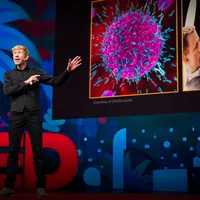
And here, I'll introduce these delightful
blue elements in the image.
They are called natural killer cells,
and you can think of natural killer cells
almost like the secret service agents
of your immune system.
They are very good at identifying
dangerous, unwanted elements
and eliminating them.
In fact, what they're doing here
is destroying a cancerous tumor mass.
So what you wish for
is a virile set of these immune assassins
at all times,
and tragically, that's what you don't have
if you're not sleeping enough.
So here in this experiment,
you're not going to have your sleep
deprived for an entire night,
you're simply going to have your sleep
restricted to four hours
for one single night,
and then we're going to look to see
what's the percent reduction
in immune cell activity that you suffer.
And it's not small -- it's not 10 percent,
it's not 20 percent.
There was a 70-percent drop
in natural killer cell activity.
That's a concerning state
of immune deficiency,
and you can perhaps understand
why we're now finding
significant links between
short sleep duration
and your risk for the development
of numerous forms of cancer.
Currently, that list includes
cancer of the bowel,
cancer of the prostate
and cancer of the breast.
In fact, the link between a lack of sleep
and cancer is now so strong
that the World Health Organization
has classified any form
of nighttime shift work
as a probable carcinogen,
because of a disruption
of your sleep-wake rhythms.
So you may have heard of that old maxim
that you can sleep when you're dead.
Well, I'm being quite serious now --
it is mortally unwise advice.
We know this from epidemiological studies
across millions of individuals.
There's a simple truth:
the shorter your sleep,
the shorter your life.
Short sleep predicts all-cause mortality.
And if increasing your risk
for the development of cancer
or even Alzheimer's disease
were not sufficiently disquieting,
we have since discovered
that a lack of sleep will even erode
the very fabric of biological life itself,
your DNA genetic code.
So here in this study,
they took a group of healthy adults
and they limited them
to six hours of sleep a night
for one week,
and then they measured the change
in their gene activity profile
relative to when those same individuals
were getting a full eight hours
of sleep a night.
And there were two critical findings.
First, a sizable and significant 711 genes
were distorted in their activity,
caused by a lack of sleep.
The second result
was that about half of those genes
were actually increased in their activity.
The other half were decreased.
Now those genes that were switched off
by a lack of sleep
were genes associated
with your immune system,
so once again, you can see
that immune deficiency.
In contrast, those genes
that were actually upregulated
or increased by way of a lack of sleep,
were genes associated
with the promotion of tumors,
genes associated with long-term
chronic inflammation within the body,
and genes associated with stress,
and, as a consequence,
cardiovascular disease.
There is simply no aspect of your wellness
that can retreat at the sign
of sleep deprivation
and get away unscathed.
It's rather like a broken
water pipe in your home.
Sleep loss will leak down
into every nook and cranny
of your physiology,
even tampering with
the very DNA nucleic alphabet
that spells out
your daily health narrative.
And at this point, you may be thinking,
"Oh my goodness,
how do I start to get better sleep?
What are you tips for good sleep?"
Well, beyond avoiding
the damaging and harmful impact
of alcohol and caffeine on sleep,
and if you're struggling
with sleep at night,
avoiding naps during the day,
I have two pieces of advice for you.
The first is regularity.
Go to bed at the same time,