Chapter One. How it Began
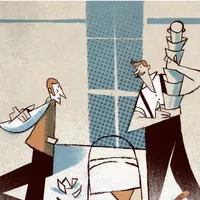
The four of us were in my room. George, Harris and I were sitting, discussing our health; Montmorency was lying on the floor.
We all had some health problem or other. For me it was my liver. I knew this because I had all the symptoms.
I don't often read about an illness without then finding I have the symptoms.
Once I went to the British Museum. I wanted to read about a health problem that I thought I had. Without thinking, I then started turning the pages. I read about various other illnesses. To my horror, I had them all: some only a little, some more seriously. Now I wanted to know every illness I had. I turned back to the beginning of the book and read through in alphabetical order. There was only one I didn't have. At first I was a little disappointed that I didn't have that one too. Then I began to worry. How long did I have to live? I felt my pulse; it was very fast. Then I tried to check my heart but I couldn't find it. I felt my front, sides and back but I could find nothing. It clearly wasn't beating. I tried to examine my tongue and closed one eye to see it better. The result: I was now sure that I was seriously ill. I entered the museum happy and healthy; I left a sick man.
I went to see my doctor who's a friend of mine. He gets a lot of practice, thanks to me.
‘What's the matter this time, J.?' he asked.
‘Nearly everything, my friend. Nearly everything,' I told him sadly. ‘I'm sure I don't have long to live.'
He examined me and looked in my ears, eyes and throat. Then he wrote a prescription. I put it in my pocket without looking at it and went straight to the chemist's. He looked at the prescription and gave it back to me. I was very surprised.
‘I can't help you. I don't sell food and this isn't a hotel,' he said. I read the prescription: steak and beer every six hours, a long walk every morning, bed at 11 p.m. and the advice not to read things I didn't understand.
Returning to my liver problems, I had all the symptoms. And I had one more than the others: I didn't enjoy working. I've always had this condition. When I was a child my parents and teachers didn't know I was ill; they thought I was lazy. They hit me around the head to cure me. It's strange but it often worked. Doctors have learnt more over the years and we now know it's an illness.
We spent half an hour or more describing our health problems. I told George and Harris how I felt in the morning. Harris described how he felt when he went to bed. George decided to show us how he felt during the night. It was a very fine show. Personally I don't think there's anything wrong with George; he imagines it.
Then Mrs Poppets came in.
‘Are you ready to eat?' she asked. We smiled sadly. We weren't very hungry but we knew we must try. We sat down at the table and did our best to eat something. After half an hour or more I lost interest in my food. I didn't want any cheese. Clearly I wasn't myself.
Afterwards, we filled our glasses, took out our pipes and returned to our talks.
‘What we need is a rest,' said Harris.
‘And a change,' added George. I agreed.
‘What about going to a nice quiet place in the countryside?' I asked.
‘A nice quiet place in the countryside? Boring!' Harris said. ‘That's for old people!' He preferred the idea of a sea trip. I was against it. I remember my sister's husband went on a trip from London to Liverpool. When he arrived in Liverpool he immediately sold the return part of his ticket.
Then another fellow I knew went on a trip for a week around the coast. He paid for all his meals at the start. However, he was too sick to eat until the last day. No, the sea is fine for a month or more but not for a week. I was worried about George. Maybe he could be sick. George was against a sea trip too. Not for himself, of course. He was worried about Harris and me.
‘I don't get seasick,' Harris said, ‘and I don't understand people who do.'
‘Let's go up the river,' George said. ‘The fresh air and work will be good for us. We'll sleep well too.'
‘Anything that makes you want to sleep more is a bad idea. It could be dangerous. There are only twenty-four hours in a day, after all. How can you possibly sleep more, George?' Harris said.
However, Harris thought a river trip was a good idea and so did I. We were both surprised that the idea was George's. He doesn't normally have good ideas. The only one who wasn't happy about it was Montmorency. But we were three against one and so it was agreed.
We took out a map and planned our trip. We decided to leave on the Saturday. Harris and I agreed to collect the boat in the morning and take it up the river to Chertsey to meet George. George works – or perhaps it's better to say sleeps – at the bank every day during the week from ten to four o'clock. On Saturdays he finishes at two o'clock.
Next we discussed camping. George and I both thought camping an excellent idea. We could see the scene clearly. The moon is in the sky, the three of us are smoking our pipes and chatting after a pleasant meal. Afterwards we go to bed and sleep under the stars.
‘What if it rains?' Harris asked. There's no poetry in Harris. However, his question came at the right moment. Camping in the rain isn't nice.
It's raining hard; you're wet and there's water in the boat too. You find a place to camp. Two of you try to put up the tent but it's more difficult in the rain. The tent is heavier and the grass very wet. You finally put up your end. Then your friend pulls his end and the tent falls down. You shout at him and pull at the tent. He shouts too and pulls back. The third man then returns from the boat.
‘What are you two fools doing?' he asks. ‘Come on, I'll help you.'
At last the tent is up. You have a wet supper: rainwater in everything. Your pipes are too wet to smoke. You go to bed, cold and wet. During the night you dream an elephant is sitting on you. You wake up and know something is wrong. You hear your friends shout. The tent has fallen on you all. In the morning you all have a cold and are angry.
We decided to camp when the weather was good. When it was wet we planned to sleep in hotels or pubs. Now we only needed to decide what to take with us. However, Harris was bored. He wanted to stop for the night. George and I agreed.
The next evening we met again. Harris wanted to make a list. Then he told George and me to get a pen and paper and write everything down. He's always ready to offer to do a job when other people do all the work.
He's like my old Uncle Podger. When he did a job around the house all the family worked. For example, I remember one time when he put up a picture on the wall. Uncle Podger took off his jacket and gave it to his wife to hold. Then he started work. He sent everybody to get the things he needed. One of the boys went to get the hammer. Another got a chair for Uncle Podger to stand on. The girl got a ruler and a pencil. Finally, with all the family watching, Uncle Podger climbed onto the chair.
‘Pass me the picture, Tom!' he said. ‘Be careful now!' He held the picture against the wall to decide the right place.
‘Pass me the hammer, Arthur!' He took it, hit his finger and fell off the chair. Hours later the picture was on the wall (badly) and all the family were exhausted except Uncle Podger. He stood and looked happily at his work.
Yes, Harris will be exactly like him when he's older! We started to make a list of things to take. It very quickly became too long. Then George said:
‘We're doing this all wrong. We shouldn't think about the things we'd like to take with us. We should think about the things we can't leave at home.'
He was right, of course. And not only about our trip on the river. So many of us have too many things. All we really need are a few simple things and good friends.
‘We won't take a tent,' he said, ‘we can cover the boat. It'll be easier and more comfortable too.' It was a good idea and Harris and I agreed.
‘We'll all need a rug. Then we should take a lamp, some soap, toothbrushes, a hairbrush and towels for swimming.'
People always make plans to swim when they go to the sea or go on the river. When I'm in London I like the idea of swimming in the sea before breakfast. I like it less when I'm actually there. My bed seems so warm and comfortable. I prefer to stay in it until breakfast time. However, I sometimes get up at six o'clock and go down to the beach. I'm always disappointed. It's windy and cold and the sea is far away. When I finally get into the water it's very cold. The sea pulls me out. I think I'm going to die and try hard to swim back. Then, when I'm sure it's the end, my feet feel the bottom. The water is only two feet deep! No, I think the idea of a morning swim is a lot nicer when you're far away.
We talked about swimming on our trip.
‘There's nothing better than waking up and jumping into the river for a swim,' George said.
‘Yes. And you really enjoy breakfast afterwards,' Harris added.
‘I don't think it's possible for you to enjoy it more. You always eat a lot,' said George.
‘But think George! It's much better for us to have Harris clean and fresh. The cost of extra food is a small price to pay,' I said. He thought for a moment and quickly agreed. In the end we decided to take three towels – one each.
We then started to discuss clothes.
‘Two suits each will be enough,' George said. ‘We can wash them in the river.'
‘Have you ever washed your clothes in the river?' we asked.
‘Not exactly,' he said, ‘but I know some fellows who have done it. It's not hard.'
Harris and I were fools: we believed him. We learned our mistake later, when it was too late.
