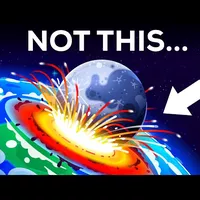
What Happens if the Moon Crashes into Earth?
Today we are answering an age-old very scientific and important question:
What if the moon crashes into earth? It's more interesting and weird than you probably think.
Let's start with the basics: Why isn't the Moon on its way to crash into us already?
We know that earth's gravity pulls everything towards it, including the Moon, but somehow,
it stays up, as if suspended by some opposite force. But there is no other force countering
gravity - instead, the trick to staying up is a ‘sideways' motion that we call an orbit.
You see orbits every day: when you throw a ball it makes a tiny little orbit.
The only difference between that ball's orbit and the moon's is that the ball
eventually hits the ground. Basically, the reason is speed.
If you could throw your ball fast enough, it would bend around the world and come back to you.
If there was no air slowing it down, it could orbit forever. And this is what the moon does:
Falling sideways around earth, very fast, with no air slowing it down. Orbiting earth every 27 days,
at 3600 km/h. So for the moon to just stop in its orbit and plummet to the earth would
break more laws of physics than we have time to explain. So how do we crash it into earth?
In a nutshell, to change an object's orbit, you need to change its speed,
which changes where gravity takes it. But even small changes require enormous forces,
which is why all the large objects in the solar system are so stable nowadays.
According to science, the moon is big and very massive. Even igniting billions of rocket engines
all over its surface would barely move the Moon. It looks like nothing short of magic will make
the moon fall. So we'll use a magic spell that slows down the moon so much
that it changes its orbit and spirals towards earth. To get the most from the experience,
the moon will take exactly one year before it hits earth. Ready? 3. 2. 1. *Magic
Month 1
For the first few days, nothing really changes. The moon gets a tiny bit brighter
and scientists get confused, but the rest of us don't notice anything different.
The only noticeable real effect of the moon on the earth are the tides.
Tides exist because while earth pulls on the moon, the moon's gravity pulls back on the earth.
Since the strength of gravity gets weaker with distance, different parts of the earth
feel a slightly different pull. Which causes the earth, especially the oceans,
to bulge when the moon is above them, and contract a little on the sides when it's
not. As earth rotates every day underneath the moon, the moon's influence fluctuates,
causing the water-level of the oceans to rise and fall by about half a meter twice a day.
But with the moon drawing ever closer, high tide gets higher every day. At first barely noticeable,
within a month the moon has covered half the distance to the earth and ocean tides have
grown to 4 meters. Everyday high tide comes and waves flood coastal cities.
And there is no end in sight. With the moon drawing ever closer, tides rise ever higher,
inundating another city and more inhabited land with salty water every day.
Month 2
By the end of month 2 the moon has covered two-thirds of the distance to earth,
and global infrastructure is crumbling as tides rise above ten meters – displacing up
to a billion people who happen to live near the coastlines.
As ports become inoperable shipping grinds to a halt. Not only will it slow down the
delivery of Kurzgesagt products but also less exciting things like food.
Global communications fall into disarray – 95% of the internet is carried by ocean-crossing cables,
and while these largely don't mind the water, their terminals on land do. Living inland
doesn't guarantee safety either, tidal bores cause rivers to flow backwards,
carrying saltwater to contaminate surface and groundwater supplies.
Gas shortages follow, as oil refineries near the coast are abandoned. Countries are left
with the supplies they had on their shelves and strict rationing will begin. In the cities,
chaos reigns during the scavenging hours of low tide,
while survivors take refuge in highrises when the water returns.
Month 3
Three months in and the moon is close enough to disrupt communication
and navigation satellites. While it is normally far too distant for its gravity to cause any
major problems for our satellites, the closer it gets the more warped their orbits become.
As their fuel for orbital corrections runs out, satellites careen out of control.
Month 4 - 5 On earth, the tides are
rapidly growing to about 30 meters and will be reaching 100 m in height in a few short weeks.
At low tide, the ocean recedes hundreds of kilometers, exposing the continental shelf
like vast deserts, while at high tide walls of water drown agriculture, houses and skyscrapers.
And now, almost five months in, the apocalypse has finished its warm-up act.
Since the oceans are on average only 3 kilometers deep, the tides have reached their maximum. Up
until now, the water in the oceans could flow, absorbing most of the moon's gravitational
squeezing, but now the earth itself is really feeling the squeeze of the ever approaching moon.
These aren't so much tides of ‘water', but tides of ‘rock.' The squeezing of the planet,
combined with the weight of quintillions of tons of water sloshing on and off the tectonic plates,
creates enormous stresses below and begins to cause earthquakes of increasing magnitude and
intensity. It's impossible to say how serious these earthquakes might be or where they occur,
but like a child jumping on their bed until it breaks, no good can come of it.
Strong tidal forces lead to volcanism on other planets and moons. On earth,
squeezing the planet disrupts the magma reservoirs inside the crust,
triggering sizable, climate-altering eruptions in Chile, New Zealand, Yellowstone, and elsewhere.
Meanwhile, watching patiently above is the moon. Still no bigger in the sky than a small cloud.
Within 75,000 km of earth, it is bright enough to illuminate the night sky like twilight.
Month 6 - 7
After half a year, the moon is entering the space once occupied by geosynchronous satellites where
it orbits earth every 24 hours. It appears to float at one spot in the sky, unmoving,
cycling through a full set of phases every day, but only visible to half the planet.
With the moon ‘stationary' above the earth, the tides seem to freeze in
place – half the world flooded, half with its water seemingly returned to the sea,
as if Earth is holding its breath to prepare for the worst.
As the moon sinks further, you might wonder if its gravity would overpower Earth's, pulling you
up and ending your misery? Fortunately not.
The earth's surface gravity is about 6 times stronger than the moon's,
so even if the moon were hovering right on top of you, you would still stay on the ground.
On the moon things are different though: the near side of the moon is more strongly affected by
earth's gravity, so during the next few months, it starts to stretch forward towards the earth, into
something of an egg, triggering deep moonquakes as the lunar rock flexes and changes shape. Though
barely noticeable now, this ‘squish' will grow to hundreds of kilometers in a matter of months.
Month 8 - 11
At this point the apocalypse has arrived and we can summarize the months before the crash
as “everybody left has a really bad time”. The tides sweeping over the Earth slow down
and then reverse their direction because the moon now orbits earth faster than it rotates.
The planet will experience an abundance of earthquakes and volcanism. Massive amounts of
volcanic aerosols rise high into the stratosphere, shiny enough to reflect sunlight back into space.
What little light gets through is rust-red and is periodically diminished by daily eclipses.
The result is a rapid global cooling, with acid rains and summer snows killing even
the hardiest plants.The clock runs out on civilization. Billions have perished
while an egg-shaped moon is still drawing closer. Let's get ready for the grand finale.
Month 12
Finally, at the end of the year,, the moon has reached the Roche limit. That's the point
where Earth's gravitational pull on the Moon is stronger than the Moon's own gravity. Things on
the lunar surface start falling towards Earth and by the time it crosses 10,000 km the entire
moon disintegrates into rubble, smearing itself into a massive ring system around the earth.
Fortunately, the moon's disintegration means the misery on Earth has ended.
No moon means the general apocalyptic nature of things comes to a halt. The oceans recede,
flowing off the land one last time.
Any survivors are treated to a view of tremendous arches spanning the sky,
glimmering in the sunlight, illuminating the night sky more brilliantly than any
full moon ever could, while meteor showers of moondust fill the sky.
It's hard to say what happens next, but the tranquility may be short-lived.
If too much moondust rains down, friction heats the atmosphere – possibly boiling the
oceans. If not, the enormous shadows cast by the rings,
combined with all the volcanic and meteoric aerosols, block even more sunlight,
and a period of runaway cooling could begin that freezes much of earth's surface solid.
In any case, at some point people will emerge again – from submarines or bunkers
or mountaintops. They will not have a great time before rebuilding civilization and their success
is not guaranteed – but at least they will try to do so with beautiful rings in the sky.
So how do you calculate that sort of thing? Well,
you just need a bit of insanity and some maths. If you need to brush on the latter:
Our friends from Brilliant are the perfect coaches to turn your curiosity into practical skills.
Brilliant is a problem-solving website and app that makes science accessible
with a hands-on approach. More than 60 interactive courses like „The joy of problem solving“ or
„Scientific thinking“ give you the tools to crack problems in math, science and computer science in
a way that feels more like playing a game than doing homework. Lessons will surprise you with
storytelling, code-writing tasks and interactive challenges – basically using whatever keeps you
interested and entertained. All the content is interactive: instead of just reading and listening
to explanations, you drag and drop, manipulate shapes and diagrams, make selections and answer
questions. This way you learn something almost without you noticing it. And tiny step by step
you'll build up your long-term understanding of science and get closer to your STEM goals.
To start looking at the world of science from a different perspective,
go to Brilliant.org SlashNutshell and sign up for free. And there's an extra perk for
kurzgesagt viewers: the first 200 people to use the link get 20% off their annual membership,
which unlocks all of Brilliant's courses in math, science, and computer science.
At kurzgesagt we love to create things that seem
impossible at first – Brilliant can help you acquire the skills to do that.
This year we will release 3 very special limited edition pins. The first one is this very shiny
Moon Crash Pin Set. Pre-order is available for only 72h, so you can order it now and then
never again. Be sure to watch out for pin number 2 and 3 to complete your 12,022 collection.
