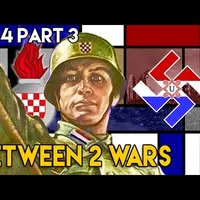
Murder and Fascism - Rise of the Ustaše | BETWEEN 2 WARS I 1934 Part 3 of 4 - YouTube (2)
Europe.
The Ustasa reject parliamentary democracy, espouse fundamentalist Roman Catholicism,
have extreme nationalism as their ideological bedrock, and foster cults of violence and
strong one-man leadership.
In contrast to other fascists, Pavelic has no interest in mass politics.
Instead, his movement is made up of a small and elite fighting force engaging in violent
terrorism.
An Ustasa insurgent, according to Pavelic, "must be severe and merciless, without mercy
and pardon, for his duty is to lessen the pain of the Croatian people with fire, iron
and blood, to crush with force the neck of the foreign parasite and so liberate his homeland."
With this in mind, training camps are set up in Hungary and Italy, two powers with territorial
claims against Yugoslavia, who also provide a great deal of funding to the burgeoning
group.
From these camps, acts of terror are planned and executed.
These primarily involve planting time bombs on trains to Yugoslavia to cause material
destruction, fear, and chaos.
In September 1932, a small uprising in the Lika region of Croatia is planned, with a
police station being raided by Ustaše.
It is, however, quickly crushed, but it unnerves Yugoslav authorities who are unsure how powerful
the movement is.
By 1934, the Ustase number 600 members, all are well trained and fanatically committed
to an independent Croatia.
Throughout all this unrest, resentment, and terrorist fermentation, Aleksandar has slowly
been retreating from public and domestic politics.
Ruling is increasingly left to the JRSD, renamed the Yugoslav National Party (JNS) in July
1933, whose ministers and loyal press largely manage to keep the King placated as he focuses
on foreign policy.
Local elections in October 1933 are once again profoundly undemocratic but this time also
exceptionally mishandled.
Government ministers make no effort to be subtle in the intimidation of voters and manipulation
of results.
The King takes the ministers assurances that the results demonstrate his nation is happy.
In the aftermath of the election, a British diplomat laments that the only person in the
Kingdom fooled by the election is the King himself.
And it does seem that both the King and his government fail to see any danger at this
point.
In the wake of the chaotic elections, the British Consul in Zagreb reports that "every
section of the population of Slovenia and Croatia cordially hates the Belgrade Government
and bitterly resents the failure of the Monarch to attempt to remedy the situation."
On a royal visit to Zagreb to celebrate his birthday on December 16, authorities foil
a Ustasa assassination plot.
The police only tell Aleksandar about this the following day.
He reacts pretty calmly and decides to stay in the city as planned until December 26.
As 1934 rolls around, Yugoslavia simply seems to be adrift.
Srskic resigns as prime minister in January and is replaced by Nikola Uzunovic who continues
the same policy of issuing the same unitarian slogans, the same unitarian policies, and
the same police repression that has been the order of the day since 1929.
But change seems to be in the air.
On advice from France, Aleksandar has softened government relations with the HSS.
Indeed just before embarking on a visit to France on a diplomatic mission, he tells a
confidant that upon his return "I will do everything that is necessary to form a Royal
government from all former political groups or parties, respectively, which have until
now been in opposition."
But he'll never be able to make this happen.
He arrives at the French port of Marseilles on October 9, 1934.
The King and the French Foreign Minister ride through streets flocked with onlookers and
cameras.
A gunman leaps forward shooting at the King and the Minister.
Aleksandar dies instantly, victim of one of the first assassinations captured
on film.
The attack is carried out by Vlado Chernozemski a member of the IMRO and an instructor at
an Ustasa camp in Hungary.
In fact, the assassination is a joint effort from the two anti-Yugoslav terrorist groups.
Chernozemski tries to flee the scene but is cut down by a police saber, shot in the head,
and then savagely beaten by the crowd.
Somehow he survives and is taken for interrogation.
He dies later that evening.
Three Ustasa members have traveled with Chernozemski to support his effort, are also unable to
escape, and are arrested.
Surprisingly, and despite governmental fears, ethnic violence does not flare up in reaction
to the Kings death.
In fact, Aleksandar's body first comes to Zagreb to lie in state and is visited by an
estimated 200,000 Croats.
Yugoslav flags fly at half-mast across the entire Kingdom.
His grand funeral takes place in Belgrade, and some nationalist firebrands are even released
from prison to attend proceedings.
One Slovene politician is quoted as saying that "everything else is forgotten" and that
"we ought to work and live for Yugoslavia."
Macek is also freed in December and similarly appeals for unity.
Foreign leaders also pay their respects.
Hermann Göring from Germany and Phillipe Petain from France solemnly attend the event.
But is is not over; instead, Aleksandar's death has put an end to any unification process.
The rest of the decade will see further stratification along ethnic lines, the continued influence
of fascist ideology, and growing public apathy.
In 1941, when the Nazi war machine turns to the East, Pavelic and the Ustasa will join
them, grow into an army and proceed to subjugate, oppress, incarcerate, and murder hundreds
of thousands of Serbs, Yugoslav Jewish, Roma, and Sinti men, women, and children.
If you haven't seen our first two installments on interwar Yugoslavia, then you can watch
them right here.
Our TimeGhost Army member this week is [!!!]. Thanks to people like [!!!] we are able to continue
making quality historical content such as this, so do the right thing and subscribe
to us on Patreon.
Subscribe, ring the bell and...
