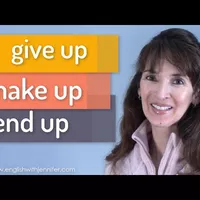
Give Up, Make Up, End Up ✨ Most Common Phrasal Verbs (16-18)
Hi everyone. I'm Jennifer from English with Jennifer.
The fact that you're watching this video tells me that you've been studying
English for some time. You worked hard to reach the intermediate or perhaps the advanced level.
It wasn't easy, was it? So, what I know about you is that you're not one who gives up easily.
You didn't quit before, so I doubt you'll quit now. We'll go on studying English together.
"Give up" means to quit. This phrasal verb can be intransitive. "Don't give up"
are words of encouragement. A good athlete never gives up halfway through a game or a match.
We can also talk about giving up on someone. This still means to quit, but it's in the
context of our interaction with a person. A teacher should never give up on a student.
A captain shouldn't give up on his or her teammates.
If you give up on someone, then you stop making the effort to guide them toward improvement.
Giving up on someone is about losing hope and losing faith in them.
What happens when someone gives up smoking? What do they do? They quit.
Note how we can use "give up" with an object. This phrasal verb can be transitive and separable:
Give up smoking. Give it up.
You don't just give up bad habits, though. A while ago, I took taekwondo classes with my children,
but when they lost interest and wanted to try other activities, I had to give up taekwondo, too.
"Give up" can simply mean to stop doing something or stop using something.
Are there things that you chose to give up or had to give up over the years?
Have you ever read aloud with me? I've shared some original stories and poems in my Oral
Reading Fluency series. Besides teaching, I enjoy creative writing. I like making up
stories. Students who've joined my live streams may also know I like creating stories on the spot.
How about you? Can you invent characters and use your imagination to create a world around them?
"Make up" means to create or invent. It could be bad, like making up lies.
But it could also be fun and good, like making up a game to play with your nieces and nephews.
"Make up" is transitive and separable: Make up a story. Make it up.
Can you guess these other meanings?
You need nine players to make up a baseball team, so you need eighteen to play.
Every time my sister looks at a menu, she needs at least ten minutes to make up her mind.
I plan to have a big birthday party this year to make up for the one I didn't have last year.
In sentence A, "make up" means "form or compose." Nine players form one whole team.
Sentence B uses the expression "make up one's mind," which means to decide. The meanings in
Sentence A and B are somewhat similar. It's about forming something, like forming a decision.
Sentence C uses "make" with two particles: make up for. When you make up for something,
you compensate for something lost or something not done.
Make up for lost time. Make up for past mistakes.
In a work setting, do you think a great personality makes up for weak skills?
Did you know that I had planned to teach English in Japan at one point?
Well, my plans changed, and I ended up staying in Russia longer than I expected to. Plenty of
unexpected things happen in life, and it's not a bad thing. Right? I started teaching
in the classroom, and I ended up building my career online.
"End up" means you reach a place, a state, or a situation,
and it wasn't planned. The outcome was unexpected. This phrasal verb doesn't
require an object, but you need to specify that place, that state, or that situation.
In the TV series A Discovery of Witches, the main character grows up trying to avoid magic,
but she ends up becoming one of the most powerful witches ever.
In Season 2, Diana Bishop's powers allow her to time travel. She ends up in 1590.
We see the chemistry between Diana and Matthew, a vampire, and it's no surprise
that they end up romantically involved. They end up husband and wife, though it's forbidden.
Has life ever taken you by surprise? What did you end up doing? Have things turned out well?
We've now covered the 18 most common phrasal verbs in English. Go back and review as necessary.
Take on my challenge and answer the three questions I asked in this lesson.
I don't think I need to point out how important it is to go beyond
studying the definitions. Practice using the phrasal verbs, and then you'll master them.
That's all for now. Please like and share the video if you found it interesting and useful.
As always, thanks for watching and happy studies! I'd like to say a special thank
you to a kind-hearted patron. Liz pledged two dollars a month for one year. Thank you, Liz!
Everyone, visit me on Patreon. You can join to support my online work,
get live lessons and bonus videos, and some of you may even want a monthly one-on-one video call.
