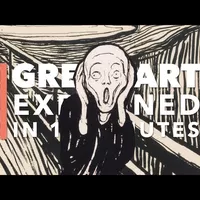
The Scream: Great Art Explained (2)
figure, is this Peruvian mummy which Munch certainly saw on display at the Paris world's fair of 1889.
The figure itself is featureless, ungendered and de-individualized, and perhaps one of the reasons
why despite being a deeply personal painting, it has become a universal symbol of anxiety. It is a
blank page into which you can project yourself, and so it becomes about what we the viewer bring to it.
The figure is looking right at us, which pins us down "locking us" into the angst-ridden scene/
Barely visible on the painting, is a pencil inscription stating
"Could only have been painted by a madman". Infrared images show that it was Munch's
handwriting, and that it was written AFTER the painting was first exhibited in 1895.
Several important critics had questioned Munch's mental health, and it deeply hurt the artist who
had a morbid fear of insanity. We can look at the later added inscription as an angry
ironic comment from Munch. Then there is another inscription by Munch on an earlier lithograph.
"I felt a huge scream through nature" confirming that the figure is not screaming at all, but nature around him is.
What is interesting, is why Munch was in that location in the first place.
The setting of "The Scream" came about after the artist took a scenic walk,
as described in his diary. The actual place is called Ekberg which overlooks Oslo Fjord,
with a view towards the setting sun during the winter months. But as so often with Munch
his strength is how he departs from reality. He was not here for the scenery, but to visit
his younger sister Laura, who had recently been confined to an asylum near this spot.
Munch's father had just died, and after a lifetime of abandonment, through death and disease,
it is not too difficult to imagine the distress that he must have experienced as he left his beloved sister behind.
Her screams of terror must have haunted him as he walked away. In a world of extreme and rapid
change, combined with a life of desperate anxiety and alienation, Munch, who would have a nervous
breakdown in 1908, must have felt overwhelmed, as if his life was unravelling. All of us in some way
understand the desperate feeling Munch must have had, of wanting to block out all of this noise.
i know quite a lot about art, but next to nothing about wine. But I'm learning
about wine, the way I learn about art, by trying new things to expand my horizons.
In the same way I am trying to demystify art, Bright Cellars are taking the same
no-nonsense approach to wines. They help you learn about wine pairings, try different wines,
and increase your knowledge while you try. You just start with a quick seven question quiz,
and then they match you with wines from all over the world, curated to your taste palette.
They send the wine directly to you and each box comes with wine education cards that outline
tasting notes, suggested pairing, best serving temperatures, and origins. The boxes you get improve
as you rate your wines. I really like the approach Bright Cellars have, and their packaging is 100
percent eco-friendly. Art is really important to me, as are food and wine. I think this is a
brilliant business model, and Bright Cellars give an amazing discount if you click on the link below.
