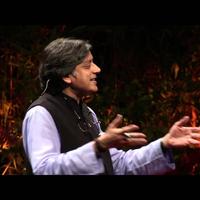
A well educated mind vs a well formed mind: Dr. Shashi Tharoor at TEDxGateway 2013 (2)
We need to do things that others haven't done before,
which we used to do in our culture where Nalanda invented the zero.
Remember how the Romans used to write their numerals in long strings of letters,
till an Indian thought of the idea of zero emerging from the notion of "śūnyatā"
in Hindu and Buddhist thinking?
That came into the zero "śūnya" which transformed global mathematics.
We need to think like that again; we need to come up with ideas.
With 17% of the world's brains, why do we only have 2.8%
of the world's research output coming out of our country?
Well, perhaps we need to start in the classroom.
Get our kids, not just to have their heads filled full of facts,
and textbook materials, and teachers' lectures.
Because frankly, that gives you a well-filled mind,
but in the era of the Internet, you don't need a well-filled mind,
you've got Google, right?
Find everything you want with 2 clicks of the mouse.
What you need is a well-formed mind.
A mind that reacts to unfamiliar facts and details
that can actually synthesize information that it hasn't studied before.
A mind, in other words, that can react to the bigger examination called 'life, '
which doesn't actually only give you the things you're prepared for.
And for that you need a mind that's shaped by original thinking,
a mind that doesn't just ask the teacher, "Why?", but "Why not?"
I've actually had a little experience of out of the box thinking myself.
I wear glasses, I don't need them to read or to see you folks on the front,
but if I want to catch somebody in the back row,
there I have to look though glasses.
But because I hardly ever wear them, I keep losing or breaking them.
I shove them in the pocket, bang them against the wall or something,
they crack, I put them on the lap, when I get up, they fall down,
somebody steps on them, they break.
In the first 3 months of this year, I lost or broke 6 pairs of glasses.
So I was telling a friend about this,
and he said: "A simple solution, why can't you think of one?"
I said: "Look, there is no easy solution
because for 150 years, glasses have been made in one way, right?
They join together at the center, then hang over your ears.
That's what I've found an inconvenience, so I take them off."
And he said, "No, no, no, no, no, you will find a different way.
You can re-imagine glasses in a way they're not going to hang over your ears,
or join at the middle," and this is what he did.
I'm wearing them right now; and if I want to see anybody at the back,
I just pull them together,
it has two magnets in the middle that click together,
and I can see you all at the back. (Applause)
Now, it's just a silly example perhaps,
but it's an example of how one can think out of the box.
Things, familiar objects can be thought of
in ways they haven't been thought of before.
And that way, we can move forward in the world.
I have no doubt that the challenges are enormous,
there is simply no question that here, in our country,
we have to become literate.
But there's one piece of good news.
95% of our 12 year-olds across India can read and write.
So the future looks good.
And as far as the workforce is concerned,
if we can get all these other pieces in place,
we can say to the rest of the world, "We are coming."
Thank you very much.
(Applause)
