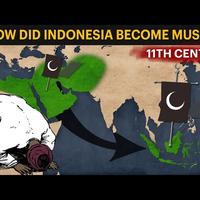
How did Indonesia become Muslim?
Which country has the largest Muslim population in the entire world?
Saudi Arabia, Pakistan, Egypt or Nigeria
Well, none of them. The correct answer is Indonesia
Islam is the religion in Indonesia with most of its adherents with eighty-seven point two percent of the Indonesian population
Identifying themselves as Muslims and 2010 survey
Indonesia has the largest Muslim population in the world with approximately
220 million Muslims, but they look at the map of the world and know that Islam began in Arabia in the seventh century
In terms of expanding to include more people, especially in continental North Africa and Southwest Asia a
The question just popped up. How did Islam reach this archipelago?
How did these distant islands become Muslim?
We are glad to say that this episode was brought to you by the sponsor
CuriosityStream
A subscription to broadcast service that provides thousands of documentaries and non-fiction titles from some of the world's best directors
Including the exclusive
Origins
Curiosity Stream is a documentary movie streaming site where you can find thousands of educational films that will enhance your knowledge
Including dozens of history movies because you watch our channel and because you love history so much. We have a special offer for you
You will get unlimited access starting only
$ 2.99 a month or
$ 19.99 a year and our audience their first 30 days is completely free if you sign up for
Curiosity stream comm lowered Nelly gia and used promo code Malecha during the registration process
Go to CuriosityStream.com for unlimited access to the world's best documentaries and
Nonfiction series
The Islamic conquests after Muhammad's death led to the creation of the caliphate
These empires expanded rapidly and occupied enormous geographical areas
Occupying more and more lands, the conversion to Islam was promoted through missionary activities
Especially those imams. They told the religious teachings of the local people
Due to the rapid military expansion, the new religion expanded as well, and new territories were conquered
These early dynasties focused on spreading the new religion
But they also focused on the economics of research and trade
During the Islamic Golden Age more and more people became accustomed to this religion, including the crowned heads
Nobles but also merchants and merchants led to a rapid spread towards the Indian and Atlantic Oceans
The influence of Islam first appeared in the Indian subcontinent
During the early seventh century AD with the emergence of Arab merchants
Arab merchants used to visit the Malabar region
Which was a link between them and the ports of Southeast Asia for trade even before the establishment of Islam in the Arabian Peninsula
Arab merchants and merchants became bearers of the new religion and spread it wherever they went
However, the subsequent expansion of the Islamic invasion into the Indian subcontinent
Over the next millennia that cemented Islam in the region, Muslim missionaries played a major role in the spread of Islam in Asia
Some missionaries even assume roles as merchants
They were sent across Asia in all directions under various addresses often as merchants
Missionaries were directed to speak to would-be converts in their native language
Even before the establishment of Islam among the Indonesian societies
Muslim sailors and merchants often visited the shores of modern Indonesia
Most of these early sailors and merchants arrived from the newly established Abbasid caliphs
The ports of Basra and the ball removal were rich in spice
Exotic fruits and other commodities There is evidence that Arab Muslim merchants entered Indonesia as early as the eighth century
But it wasn't until 12 or 13
A century then Islam began spreading
Then it expanded further due to the adoption of local rulers and elites
The missionaries came from many regions and regions, and some came from India and later from the south
Peninsula It is believed that around the 13th century the religion began to appear on the northern coast of Sumatra
After this Islam, it spread by Sufi orders, and finally it was consolidated by expanding lands
Rulers and their societies transformed
Not knowing a specific date when conversion began and there is no clear indication of when Islam first came to the region
We might think first around the eleventh or twelfth century
The first signs of an Islamic grave date back to 1080 - also when Marco Polo visited the area
1292 indicated that Perlak urban port was a Muslim
The first evidence of a Muslim race in the grave is dated
1297 of Sultan Malik Al-Saleh, the first Muslim ruler of the Sultanate of Selj
Chinese sources record the presence of a Muslim delegation to the emperor from the Kingdom of Samudra in General
1282
The spread of Islam generally followed the eastern trade routes
Through the Buddhist region in the first place and after half a century in malakas
We see the first dynasty to arise in the shape of the Malacca Sultanate at the far end of the archipelago
It was formed by converting one Shah into a Muslim and adopting the name Muhammad Iskandar Shah
The spread of Islam among the ruling class arose when Muslim merchants married local women
With some wealthy merchants they marry into the families of the ruling elite
The Indonesian people began as local rulers and kings adopting it
After that their flocks reflected their transformation
Expansion accelerated in the fifteenth century as the military power of the Malacca Sultanate in Malaya, Peninsula
And the other Islamic salt is
He controlled the region with the help of the Islamic coup rings
Wars and superior control over maritime trade and final markets
By the 14th century Islam had been established in Northeast Malaya
Brunei is southwest of the Philippines and between some quarts of eastern and central coastal Java
The fifteenth century saw the decline of the Hindu-Javan Majapahit Empire as Muslim merchants from Arabia and India
Samara and the Malay Peninsula as well as China began to dominate the regional trade that once controlled the Javanese Majapahit
Merchants
The Ming Dynasty of China provided regular support to Malacca
Zhang's Chinese expeditions are attributed to the establishment of a Chinese Muslim settlement in Palembang
North coast of Java
Malacca actively promoted conversion to Islam in the region during the activity of the Ming Fleet
Established Chinese Muslim Malay community in Northeast Coast, Java
Thus creating permanent opposition to the Javanese Hindus. The mission founded a Muslim Chinese
Arab and Malaysian communities in the northern ports of Java
The dominant Muslim kingdoms were more and more present in the archipelago
The historical Hindu population was anemests
Hindus and Buddhists and in time many of them accepted the new religion because the Muslim merchants and merchants
Islamic teachings spread during trade with the local population and their teachings encouraged proselytizing of the religion
Hindus and Buddhists generally do not and evangelize
Islam is a system of monotheistic beliefs, and it does not allow its followers to believe in another deity
Being a Muslim has created more favorable benefits and conditions for the local population
From being non-Muslim some people need safety and certainty
So they choose to declare themselves Muslims
Because Islam appeared in Southeast Asia through trade with the people of southern Arabia and Sufism
The transition took place more peacefully than in the Middle East or North Africa where there are conflicts
Indonesia was the slower process, but was created differently by elite merchants and nobles
The existence of property made it easy for religion to spread among the common people
The presence of Christianity in the monarchy made it easy for the religion to spread to European kingdoms
Meanwhile on the island of Java, the Empire of the Hindu Jeep Majah was collapsing
Some of these new kingdoms were supported by Ming China through assimilation
Trade related property transfers and the invasion of Islam has supplanted
Hinduism and Buddhism as the dominant religion in Java and Sumatra by the end of the 16th century
But many cultural and religious customs were mostly from the Hindu Buddhist era
Tolerance and even incorporation into the Islamic rituals
Aslam did not obliterate pre-existing culture
Incorporation and incorporation of local customs and non-Islamic elements into the rules
part
The strong presence of Sufism is a major enabler for reconciliation between Islam and other religions
When the Europeans came they brought Christianity to the Muslim majority
But not much converted, probably due to the fact that at that time already
The dialect is not put on religion as much as it was in the twelfth or thirteenth centuries, but that is another argument
Indonesia is a large country with over 250 million people of various cultures and ethnicities
Across thousands of islands from a religious point of view
Indonesia is not governed by a single law because more than 80 percent of the population is Muslim
Indonesia can be called one of the Islamic countries in the world
But Indonesia is not traditional Islamic
The constitution is not based specifically on their religion, and it also contains many values
The universal ones that are also available in Islam as well as in other religions
It laid in what is known as Bang Casela the five philosophical pillars of the country
We would like to once again thank a special CuriosityStream for sponsoring this video
Thank you very much for our patreon. Thanks a lot for watching. See you next time
