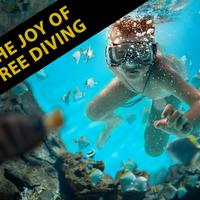
The joy of free diving: 6 Minute English - YouTube
Neil: Hello. This is 6 Minute English, and I'm Neil.
Georgina: And I'm Georgina.
Neil: Now Georgina, what do you know
about free diving?
Georgina: Free diving is a sport where
people dive underwater
as deep as they can without carrying air
tanks, so just by holding their breath.
Neil: That's right. We're going to find out
today about a world record free diver. But
first a question – and this is a physics
one. On dry land, at sea level, the pressure
or weight of all the air above us is known
as an atmosphere. How far underwater
do you have to go until the weight of
water is equal in pressure to another
atmosphere? Is it:
A: 1 metre, B: 10 metres, or C: 100 metres
What do you think, Georgina?
Georgina: Well, water is much heavier
than air, but there is lot of air above us,
many kilometres, so I don't think one
metre of water is heavy
enough. Same for 10 metres. So, I think
100 metres is the equivalent of
1 atmosphere.
Neil: OK. We'll find out if you are
swimming comfortably
or completely out of your depth later.
Herbert Nitsch holds the world record for
the deepest free dive. In 2012 he reached
a depth of 253 metres. Recently he spoke
on the BBC World Service radio
programme, Outlook about his
experiences. He spoke about how he
trained himself to hold his breath for a
long time.
Lungs are the organs in the body that hold
the air that we breathe in, and he says
that he trains himself not by starting with
a big breath, but when his lungs are
already empty. Why is that?
Herbert Nitsch: The reason why I do the
empty lungs is that the urge to breathe
comes earlier and this is when the
training starts. Because when
you hold your breath on full lungs, the
urge to breathe comes a few minutes in,
but the time up to that point is no training
at all. Only the time you have the urge to
breathe and fight against it, that's the
time you're actually training.
Neil: So, why train with empty lungs?
Georgina: Because you have to practise
not breathing when you need to breathe.
Neil: Can you explain further?
Georgina: Of course. Normally our
breathing is automatic.
We don't have to think about it. If you
hold your breath there is a point when your
body tells you that it's time to breathe.
Neil: And at that point, most of us will
take a breath, won't we?
Georgina: Exactly. Our body and brain is
telling us – go on, breathe, take a breath!
This strong feeling to do something is
called an 'urge'.
To hold your breath for a long time you
have to ignore that urge, you have to fight
against it. So to train to do that, it's a
waste of time taking a big breath,
because holding your breath when you
don't need to breathe isn't difficult – you
have to practise fighting against that urge
to breathe.
Neil: Nitsch did a lot of free diving in lakes
in his home country of Austria. Diving in
lakes is very different from diving in the ocean.
Here he is describing the experience.
Herbert Nitsch: In the beginning it's very
spooky, and yes, it's not a pleasant feeling
at all in the beginning. It's something
actually quite intimidating, but after a
while you get used to it and you learn to
appreciate it actually that it's so quiet.
Quiet and you're deprived of all
sensations except the cold, of course,
and so you hear your own heart beat
because there's absolutely no sound.
Neil: How does he describe the sensation?
Georgina: It's very cold, dark and quiet
when diving deep in lakes and at first he
says the experience is 'spooky'. This
means it's a little scary and mysterious –
in the same way we might find a
graveyard at night spooky – that
kind of feeling.
Neil: And he also says it's 'intimidating',
which is a feeling of being frightened by
something stronger and more powerful
than you are.
Georgina: And you experience these
feelings because you are deprived of all
sensations. When you are 'deprived of'
something, it means you don't
have it, it's taken away. And sensations
are the way we experience the world, so
sound, sight and smell. Diving in cold,
dark silent waters you are deprived of
many of our usual sensations, and that is
spooky and intimidating.
Neil: Rather him than me. I don't think I'd
like that experience at all! Right, before
we review our vocabulary, let's have the
answer to the quiz. How far underwater
do you have to go until the weight of
water is equal in pressure to another
atmosphere? Georgina, what did you say?
Georgina: I thought 100 metres.
Neil: Well, that is actually the equivalent
of 10 atmospheres! So the correct answer
is 10 metres. Every 10 metres of depth in
water is the equivalent to the weight and
pressure of the air above us at sea level.
There is a difference between
fresh and salt water, but it's not so much
as to make your answer correct!
Well done if you got that answer right.
Georgina: Well I was clearly out of my
depth with that question.
Neil: You were! Now vocabulary. The part
of our body that holds our breath is our
'lungs'.
Georgina: A very strong need or desire to
do something, like breathe, is an 'urge'.
Neil: Something 'spooky' is a little scary
and mysterious.
Georgina: And it can also be 'intimidating',
which means it's overpowering and
frightening in a way that makes you less confident.
Neil: And to be 'deprived of' sensations,
means to have certain feelings, like touch
and hearing taken away. So Georgina, do
you fancy free diving?
Georgina: Would I like to go hundreds of
metres down in cold, dark, silent, water
without any breathing equipment? Let me
think about that. I've thought about it –
no thank you!
Neil: Not my cup of tea either – and
speaking of tea, it is time for us to go and
get a cuppa. That's all from us. Do
join us next time and if you get lonely, you
can find us online, on social media and on
the BBC Learning English app. Bye for now.
Georgina: Bye!
