Learn to talk about the future of transport in 6 minutes! - YouTube
Rob: Hello I'm Rob and this is 6 Minute English -
the show that brings you an interesting topic
authentic listening practice and some vocabulary
to help you improve your language skills.
Neil: And hello, I'm Neil. Our topic today is transport.
How do you think you'll be travelling to work in, say 30 years' time Rob?
-
Rob: Well, not only will home working be more prevalent, that means common
- but I hope I won't be working
in 30 years' time!
Neil: Good answer! But if we look back and
see how transport has changed in the last
30 years, it makes you wonder what the future holds.
Rob: Yes, we've seen how air travel has become
commonplace for many people. Commonplace means
not unusual. And there's been the development
of high-speed train travel. But the main priority
has been speed - going faster
to make your journeys quicker.
Neil: That's true, and we'll be discussing some ideas
for making transport even faster soon.
But let's not waste any time and speed on
to today's quiz question.
Rob: Ah yes, time waits for no one, not even you Neil.
So can you answer this question?
According to Guinness World Records, in which country
has the fastest ever train been recorded?
Is it in... a) China, b) Japan or c) France
Neil: All these countries have fast trains
but I've heard that Chinese trains go particularly fast.
So I'm going to say a) China.
Rob: Well, you'll have to wait until the end
of the programme to see if you're right.
But let's talk more now about the future of transport.
One development we hear much about is automation.
Neil: Automation means using machines to do work
that humans normally do and in terms of transport
this means driverless vehicles.
It won't be too long before we become the
passenger in a driverless car.
Rob: Scary! And the French train engineering company,
Alstom, is planning to test automated freight trains
later this year. The automated train prototype
can travel for about 100 kilometres
without driver intervention. A prototype is the first
version of something which can be
tested before it is produced in large quantities.
Neil: Of course some trains are already driven
by computers but there's an exciting plan
to develop a form of driverless vehicle
that could move you around
at 1,123 kilometres per hour.
Rob: Come on Neil. That sounds a bit far-fetched -
like flying cars that we see in sci-fi movies -
it's difficult to believe because it's unlikely to happen.
Neil: Well you say that but it's already being tested
in Nevada in the USA and has a name - Hyperloop One.
Rob: Tell me more!
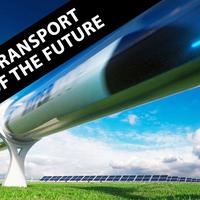
Neil: The idea is, you get loaded into a pod
then you're pushed through a metal tube at high speed,
taking you to your destination in minutes
rather than hours.
Anita Sengupta is the lead systems engineer
and says there's nothing scary about it...
Anita Sengupta: The Hyperloop is a maglev train
in a vacuum system - or in a vacuum tube -
and so you can also think of it as an aircraft
flying at 200,000 feet so people don't have any issue
flying in aeroplanes and people don't have any issue
going in maglev trains. This is simply combining the two
and allows you to be more energy efficient.
Rob: So Anita Sengupta explained the type of
technology the Hyperloop used.
First she mentioned maglev -
that's a short way of saying magnetic levitation.
Neil: It's when trains travel on magnetic track
rather than conventional rails.
Rob: And then she mentioned a vacuum system -
a vacuum is a space that has all the air
and any other gases removed from it.
So the tube these pods travel in have no air
so there's no resistance.
And these technologies are more efficient
and they save energy.
Neil: Which is a good thing.
This sounds like a great way to travel but will it take off?
Rob: Well, BBC technology correspondent
Rory Cellan-Jones isn't so sure.
He thinks it will be quite challenging to convince
governments to allow long metal tubes to be built
on or below ground.
Neil: But we have to try these new technologies Rob.
If we didn't we'd still be travelling
around on horse and cart!
Rob: A good point Neil - and we wouldn't have been able
to travel at the great speeds
mentioned in today's question.
Now earlier I asked you according to
Guinness World Records, in which
country has the fastest ever train travelled?
Is it in... a) China, b) Japan, c) France
Neil: And I said a) China.
Rob: And you were wrong Neil. China does have some
very fast trains. But the fastest recorded train
was a maglev from the Central Japan Railway Company,
which ran on a test track
at a speed of 603 kilometres per hour.
Neil: Now that would make my commute
to work very quick!
OK, shall we recap some of the vocabulary
we've heard today? Starting with commonplace.
Rob: Yes, which means 'not unusual or often seen.'
For example 'free Wi-Fi in coffee shops is
commonplace these days.'
Neil: And very useful it is too! Next we had automation,
meaning 'using a machine to do something
instead of a human.' 'Automation in the car making
industry has led to the loss of hundreds of jobs.'
Rob: Of course when you build a new car
you need to make a prototype -
that's the first version of something which can be tested
before it's produced in large quantities.
'The prototype of a new solar-powered bike
has been so successful
that it's now going into mass-production.'
Neil: Come on Rob, that sounds a bit far-fetched -
and by that I mean 'so unbelievable
it's unlikely to happen.'
Rob: Well something people once thought far-fetched
is now a reality and that's maglev -
that's short for 'magnetic levitation'
and is how some of the world's fastest trains travel.
Neil: Finally, we discussed the word vacuum.
It's a space that has had all the air and other gases
removed from it - basically an empty space.
'The plan for Virgin's Hyperloop One
is to make a maglev even faster by putting it
in a vacuum tube.' And that brings us to the end
of today's 6 Minute English. Don't forget
to check out our You Tube, Facebook,
Twitter and Instagram pages,
and we'll see you next time. Goodbye.
Rob: Bye
