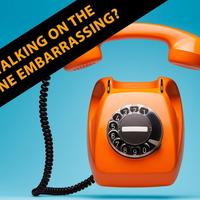
Is talking on the phone embarrassing? - 6 Minute English - YouTube
Neil: Hello, and welcome to 6 Minute English. I'm Neil.
Sam: And I'm Sam.
Neil: Sam, do you know Stephen Fry?
Sam: Not personally, but I know of him.
Stephen Fry is an English writer and comedian
and is well known for being extremely intelligent
and very knowledgeable about many things
cultural, historical and linguistic.
Neil: To be knowledgeable
means 'to know a lot about something'.
I wish I was half as knowledgeable as he is!
Sam: I wish I were a quarter as knowledgeable!
Neil: There is still time, Sam!
And maybe this week's question will help you become
just a little bit more knowledgeable
on the topic of the telephone.
The first long distance telephone call
was made in 1876.
Approximately what was the distance of that call?
Was it: A: 10km?
B: 15 km?
Or C: 20 km?
What do you think Sam?
Sam: So when you say long distance ……?
Neil: For the time, yes.
Remember the telephone was only a baby in 1876.
Sam: In that case, I'll say approximately 15km.
But that's just a guess
- a long distance guess.
Neil: We'll find out if you're right
at the end of the programme.
Stephen Fry is also known as a technophile.
The suffix ‘phile' means 'a lover of that thing'.
So a technophile is someone who loves technology.
Fry was a guest on the BBC podcast Word of Mouth
and was talking about the technology of
communication.
It seems he's not a fan of the telephone.
But why not?
Stephen Fry: I think the telephone was
a really annoying blip in our communications and that's
old technology. I mean that's 1880s, 90s.
When you're on the telephone to someone,
especially if you're British – you know, that
Bernard Shaw thing,
oh, you know - the moment one Englishman opens his
mouth another Englishman despises him
- when you're speaking to someone on the telephone
all the age, class, education, vocabulary
all come into play
because it's in real time
and it's embarrassing. I hate being on the
telephone to people
- especially strangers in shops and things like that
because it's embarrassing and awkward.
Neil: So, why doesn't he like the telephone?
Sam: Well, he uses a quote from the writer
George Bernard Shaw.
It's not the exact quote but the meaning is that
as soon as an English person speaks,
another English person despises them.
To despise someone is a very strong emotion
and it means 'to really hate someone'.
Neil: So, what is it about the English person's voice
that leads others to despise them?
Sam: Stephen Fry goes on to explain
that there is a lot of information about someone that
people get from their voice.
You can make a judgment about someone's age,
level of education and class
from the way that they speak
and the vocabulary they use.
Neil: 'Class' refers to your economic and social position
in a society.
In Britain, we talk about three classes:
upper class, middle class and working class.
The family into which you are born dictates your class.
These used to be a lot more important in British society
but there are still different prejudices and negative
feelings related to the relationship between the classes.
Sam: Exactly, so hearing someone's voice on the
telephone might make you think something negative
about someone based on very old-fashioned
ideas of class.
What makes it worse is that these conversations
happen in real time.
This means they are 'happening live', 'not recorded',
so you have no time to really think about it.
Neil: So he may be a technophile,
but he's not a fan of the phone!
Sam: Indeed. He called it a 'blip',
which is a word for when something is not quite right
- when there is a fault or a mistake which is usually
not long lasting.
Neil: So do you think he's right?
Sam: Well, actually,
I don't like to talk to strangers on the phone very much
myself, but that's just me.
But I do think that although
the class divisions in British society
are much less obvious and much less important
than in the past,
we still do make judgements about people based on
how they speak
and those judgements can often be completely false.
Neil: Right, nearly time to review our vocabulary,
but first,
let's have the answer to today's question.
The first long distance telephone
call was made in 1876.
Approximately what was the distance of that call?
Was it: A: 10km?
B: 15 km?
Or C: 20 km?
What did you think, Sam?
Sam: I guessed 15km. But it was just a guess.
Neil: Well, sadly, on this occasion
it was not a correct guess.
The correct answer is approximately 10km
or 6 miles.
Congratulations if you go that right.
Now on with vocabulary.
Sam: We started with the adjective 'knowledgeable',
which means 'knowing a lot about something'.
Neil: A technophile is someone who loves technology.
Sam: To despise someone is to hate someone strongly.
Neil: 'Class' refers to a group in society you are
said to belong to from your birth.
Certain stereotypes are often attached to different
classes to do with intelligence and education,
for example.
Sam: 'In real time' is an expression that means
'happening live, without any pauses or breaks'.
So for example,
you aren't listening to this programme in real time,
Neil: Well, I am.
Sam: Well, of course, you are Neil,
because you are here with me as we are recording.
But if you're listening to the podcast,
it's no longer real time.
It's been recorded and edited.
Neil: And we had one other word, didn't we?
Sam: Yes, a 'blip',
which is a temporary fault, or mistake.
Neil: Well, that's all we've got for this programme.
For more, find us on Facebook, Twitter, Instagram
and our YouTube pages and, of course, our website
where you can find all kinds of other programmes
and videos and activities
to help you improve your English.
Thank you for joining us and goodbye!
Sam: Bye!
