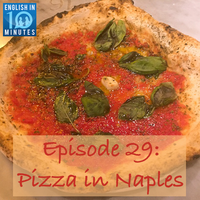
Episode 29: Pizza in Naples
Nick: Today Wendy and I are coming to you from Naples, which is the capital city of Campagna in southern Italy. And it's a chaotic but fascinating city. Umm, but today we want to talk about the most famous product and the most famous export of the city of Naples, which is, of course, pizza. And of course pizza's been now exported all over the world, and Wendy, especially in the United States, it's a lot different from what it is here in Naples.
Wendy: It's very different, yeah. Growing up in the U.S., I thought of pizza as fast food and something very unhealthy, something that I would feel guilty about eating after I ate it, even though I did eat it very regularly. Umm, so pepperoni is by far the most popular type of pizza in the U.S., umm, which, well, that's also something different … the word pepperoni actually means something very different in Italian, uhh, and in Italy, as to what … compared to what it means in the U.S. But in the United States a pepperoni pizza is a pizza with cheese and then sausage, or, yeah, a type of salami, a spicy type of salami, on top of it. So it is very greasy and, yeah, full of fat and, yeah, not very healthy. And it's something that people eat a lot. It's usually pretty cheap. I mean, I suppose you can go to a slightly more upscale restaurant, uhh, and pay a little bit more for it, but usually it's very cheap, you often get it as take-away or as delivery where it comes delivered to your house. And, uhh, college students, especially, eat a lot of pizza.
Nick: Yeah, it's the greasiness I think that really gets you, and even the established, umm, chains, like Pizza Hut and Dominoes, etc, that's really what you get is this kind of greasy pizza that you don't feel too good about after you've eaten it.
Wendy: No.
Nick: And I remember when I was younger in Australia, they … uhh, there was a new chain or a new type of restaurant that opened called Gourmet Pizza Kitchen which was taking it the other way, trying to make more upscale pizza, more high-class pizza, and my brother Tim really liked it. Umm, and that's good on the one hand but it's also not really true to the Italian or the Neapolitan way of making pizza either. And so here in Naples, pizza was very much born out of the Italian culinary concept of cucina povera, and this is basically the use of whatever ingredients you can find if you're living in a rural area or if you're living especially in the south of Italy which is poorer than the north. And so it's the use of humble, available, umm, and affordable ingredients, but ingredients that are also local and fresh and really high quality.
Wendy: Right.
Nick: Even despite the humble origins of the ingredients, if it's tomatoes, or even flour, or olive oil or whatever it happens to be. And so when pizza was created, that's really what it was. It was putting together just a handful of ingredients and seeing what you could come up with.
Wendy: Yeah.
Nick: And so in the Neapolitan pizza tradition there are really two pizzas that are kind of the basis of the whole thing. And one is the Marinara, which is just the pizza base, and then it's just the tomato sauce, which has some oregano and garlic and maybe some basil on it, and that's it.
Wendy: Yeah, and it has some olive oil usually, drizzled on the top as well. But that's it - no cheese, no other added, uhh, toppings or anything. It's just a really simple pizza that just brings it back to the basics.
Nick: Right, so it's essentially a pizza with no toppings, because the concept … I mean, they have other pizzas with toppings, but in America and in other western countries pizzas are about toppings and how many toppings you get and it costs a certain amount depending on the number of toppings.
Wendy: Right, and it's also just taken for granted that it's always going to have cheese on it, and ordering a pizza without cheese would be considered really weird in the U.S. and probably in most places outside of Italy.
Nick: And so the Marinara with its, kind of, very humble ingredients, it sounds like it is boring or it could be boring, and maybe if it's made elsewhere, umm, without the freshness and the quality of the ingredients and without the art of pizza making the way it is here in Naples, maybe it would be boring. But yet, here, just these few ingredients, umm, with the pizza base being so soft and fluffy and the sauce being so rich and deep, it's just this explosion of flavour even, uhh, just with a few ingredients.
Wendy: Yeah and I think that's really the secret to Italian cuisine in general and probably cucina povera in particular, is that, yeah, it does use so few ingredients and you have a number of different dishes that are made with just four, five, six ingredients, really just a handful. And the secret to making it so delicious is that it has to be made very fresh and with very high quality ingredients.
Nick: And so the second pizza that's very famous, uhh, in Naples and throughout Italy is the Margherita, and it's basically … virtually the same as the Marinara, except it doesn't have the oregano and the garlic in the sauce, and instead it has some mozzarella cheese on it - not completely covered in the American way but just these pockets of cheese kind of scattered on top of the pizza. And that's still the most popular pizza in Italy.
Wendy: By far, yeah.
Nick: And most pizzerias in Italy and even here in Naples, most of them will serve 15, let's say, 20 different types of pizza but yet, Italians just love to order the Margherita and the simple pizzas rather than the more extravagant ones with different types of toppings on them.
Wendy: Umm-hmm. And in fact we went to, uhh, a pizzeria here that's one of the most famous in Naples, and they only serve two different kinds of pizza, and that is the Pizza Marinara and the Pizza Margherita. They don't do any other toppings.
Nick: Right, and so it's really just Neapolitan pizza at its most basic. And that is a … it's a pizzeria called Da Michele, and it's one of the most famous pizzerias in the whole city, and there's always a line, and it's just massively popular, and it does only two pizzas and that's all it does. It doesn't do anything else that's not pizza, and even within pizza, it just does these two and that's it.
Wendy: Right.
Nick: Umm, and there's an interesting story about the creation of the Margherita as well. It's maybe not true but it's a story that people like and I think it's an important part of the history of pizza here in Naples. And it's that shortly after the unification of Italy in 1870, there was problems … there were problems in Naples as there tend to be, there was disease, I think, in city. And the queen of Italy, and perhaps the king, came to visit Naples, and the queen's name was Margherita. And what she wanted to do was that she wanted to eat cucina povera. She wanted to see what the local people ate and to go to a local, essentially, pizzeria and eat the way that the local people did. And this made her extremely popular among the people because, you know, she was eschewing the gourmet food she could have eaten and instead wanted to eat the cucina povera that everybody else ate. And of the pizzas that she tried, she said the Margherita was her favourite, and it also has the colours of the Italian flag, and so they named the pizza after her, and that's the story of the Margherita.
Wendy: Umm-hmm. And the name of the Pizza Marinara is also worth mentioning as well because it causes some confusion. A lot of people think that Marinara is a seafood pizza because it refers to mare which is sea, the word for sea or ocean in Italian. And actually outside of Italy sometimes you will find pizzerias that call their pizza Pizza Marinara and they'll put seafood on top of it. But the name actually comes from the fact that the fisherman ate this, this was what their wives would prepare for them after they came back from a long day of fishing at sea. Umm, so it is what we talked about before, just the tomato sauce, the garlic, uhh, the oregano and the olive oil, so it's just a very simple, pure pizza.
Nick: And so here in Naples there are many, many, many pizzerias but there are some in particular that are hugely popular with local people, especially in the historic centre of Naples. And there are several of them on the one street, which is the Via dei Tribunali, and it's right in the heart of old Naples. And it's amazing to see people lining outside these pizzerias for their pizza.
Wendy: Yeah, well they don't line up very well. They just kind of make a huge crowd outside the door, but, yeah, you will see dozens of people waiting outside.
Nick: And we saw on the weekend outside Sorbillo, which is one of the most popular ones, even sixty, seventy people, waiting outside. And it's the kind of crowd, that you're kind of walking near it and you see all these people, and you think, ‘Oh, maybe there's an accident, or a fight, or street art, or some kind of event that's drawn people together,' but no, it's just people waiting for their pizza. Wendy: Yeah.
Nick: And it's cool because it shows that the people are fiercely loyal and that they value the quality of their pizza above all else.
Wendy: Yeah.
Nick: So they'll wait for forty minutes or fifty minutes or something like that. And these famous pizzerias, they're very simple inside, kind of spartan in their decoration, and you'll get … your drinks will come in plastic cups and things like that. But they don't care about any of that.
Wendy: No.
Nick: As long as they get the pizza that they think is the best one, that's the most important thing.
Wendy: Yeah the quality of the food is really the most important, even though there might be another pizzeria right across the street where they wouldn't have to wait at all, they're willing to wait an hour if they have to do to get the best quality.
