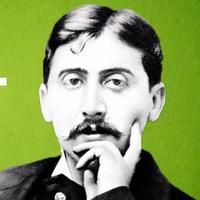
Marcel Proust. LITERATURE. Part 1/2.
[:]placeholder="Type the lesson text here...">Marcel Proust was an early 20th-century French writer responsible for what is officially the longest novel in the world: “À la recherche du temps perdu” [1] – which has 1.2 million words in it (which has 1,267,069 words in it); double those in War and Peace. The book was published in French in seven volumes over 14 years, and was immediately recognised to be a masterpiece, ranked by many as the greatest novel of the century, or simply of all time.
What makes it so special is that it isn't just a novel in the straight narrative sense.ass="mceAudioTime">[:] It is a work that intersperses genius-level descriptions of people and places with a whole philosophy of life. [:] The clue is in the title:
<p placeholder="Type the lesson text here...">“In Search of Lost Time.” [“À la recherche du temps perdu”] The book tells the story of one man – a thinly disguised version of Proust himself – in his ongoing (developing) search for the meaning and purpose of life. It recounts his quest to stop wasting time and to start to appreciate existence.
[:]eholder="Type the lesson text here...">Marcel Proust wanted his book to help us, above all.>[:] His father, Adrien Proust, had been one of the great doctors of his age, responsible for wiping out cholera in France. Towards the end of his life, his frail, indolent son Marcel, who had lived on his inheritance and had disappointed his family by never taking up a regular job, told his housekeeper Celeste: ‘If only I could do for humanity as much good with my books as my father did with his work. '[2] The important news is that he amply succeeded. [:]der="Type the lesson text here...">Proust's novel charts the narrator's systematic exploration of three possible sources of the meaning of life.] The first is: SOCIAL SUCCESS.ss="mceAudioTime">[:] Proust was born into a comfortable bourgeois household; but from his teens, he began to think that the meaning of life might lie in joining high society, which in his day meant, the world of aristocrats, of dukes, duchesses and princes. [:] But if you convert this to the present day, that would mean celebrities.
For years, the narrator devotes his energies to working his way up the social hierarchy; and because he's charming and erudite, he eventually becomes friends with lynchpins of Parisian high society, the Duke and Duchesse de Guermantes. But a troubling realisation soon dawns on him. These people are not the extraordinary paragons he imagined they would be. The Duc's conversation is boring and crass. The Duchesse, though well mannered, is cruel and vain.
[:]lder="Type the lesson text here...">Marcel tires of them and their circle.>[:] He realises that virtues and vices are scattered throughout the population without regard to income or renown. He grows free to devote himself to a wider range of people. Though Proust spends many pages lampooning social snobbery, it's in a spirit of understanding and underlying sympathy. It is a highly natural error, especially when one is young, to suspect that there might be a class of superior people somewhere out in the world and that our lives might be dull principally because we don't have the right contacts. But Proust's novel offers definitive reassurance: life is not going on elsewhere. There is no party where the perfect people are.
The second thing that Proust's narrator investigates in his quest for the meaning of life is: LOVE. In the second volume of the novel, the narrator goes off to the seaside with his grandmother, to the vogueish resort of Cabourg (the Barbados of the times).
There he develops an overwhelming crush on a beautiful teenage girl called Albertine. She has short hair, a boyish smile and a charming, casual way of speaking.
For about 300 pages, all the narrator can think about is Albertine. The meaning of life surely must lie in loving her. But with time, here too, there's disappointment. The moment comes when the narrator is finally allowed to kiss Albertine:
“Man, a creature clearly less rudimentary than the sea-urchin or even the whale, nevertheless lacks a certain number of essential organs, and particularly possesses none that will serve for kissing. For this absent organ he substitutes his lips, and perhaps he thereby achieves a result slightly more satisfying than caressing his beloved with a horny tusk…”[3]
The ultimate promise of love, in Proust's eyes, is that we can stop being alone and properly fuse our life with that of another person who will understand every part of us. But the novel comes to darker conclusions: no one can fully understand anyone. Loneliness is endemic. We're awkwardly lonely pilgrims, trying to give each tusk-kisses in the dark.
