

How to Learn Greek: A Complete Beginner’s Guide
 Tyler Tolman
1 May 2026
Tyler Tolman
1 May 2026
TL;DR
- Learning how to learn Greek starts with one thing: the alphabet. It takes 2-3 days to read phonetically. Start there.
- Greek is a Category III language, harder than Spanish, but very learnable with the right method.
- The fastest path to fluency is comprehensible input: reading and listening to real Greek content from day one.
- Duolingo is a solid free tool for the alphabet and beginner habits. LingQ takes you from intermediate to fluent.
- Expect 6-12 months for conversational Greek, and around 1,000 hours for professional-level fluency.
Greek has a reputation for being hard. The alphabet looks foreign, the grammar has cases, and the FSI classifies it as a “moderately difficult” language for English speakers. All of that is true.
Here is what is also true: tens of thousands of people learn Greek every year, and most of them start with the same hesitation you probably have right now. The right method makes an enormous difference, not just in how fast you progress, but in whether you actually enjoy the process.
This guide covers everything: the alphabet, the best apps, essential phrases, and the approach I have used to learn over 20 languages.
Why Learn Greek?
Greek is spoken by approximately 13 million people, primarily in Greece and Cyprus, but its reach extends far beyond that. As an English speaker, you already know thousands of Greek-derived words: democracy, philosophy, technology, biology, psychology. Greek is baked into the foundations of English in a way that no other language quite matches.
Beyond vocabulary, there is the culture. Greece is a vibrant, modern society with an extraordinary depth of history behind it. The word filoxenia, Greek hospitality, literally “love of strangers,” gives you a sense of what awaits when you start speaking the language. Learning Greek turns a tourist into a guest.
Modern Greek vs Ancient Greek: Which Should You Learn?
Before going further: this guide is about Modern Greek. Ancient Greek is a separate discipline, studied primarily by classicists and theologians. The two share the same alphabet and many roots, but their grammar, pronunciation, and everyday vocabulary have diverged significantly over 2,000 years.
If you want to travel, watch Greek TV, or talk to people in Athens, Modern Greek is your target. If you are interested specifically in Koine Greek (the Greek of the New Testament) or Classical Greek, see the FAQ at the bottom of this guide. The approach is different: more grammar-intensive and text-based, without the benefit of living native speaker audio.
Is Greek Hard to Learn?
The Foreign Service Institute (FSI) classifies Greek as a Category III language, “moderately difficult” for English speakers. The FSI estimates around 1,012 class hours (roughly 44 weeks) to reach professional working proficiency.
For context: Spanish is Category I (600 hours). Greek takes more time because of three main factors:
1. A different alphabet. Greek is not written with the Latin script. This is the first hurdle, and fortunately the fastest one to clear.
2. Inflection. Greek nouns, adjectives, and articles change their endings depending on their grammatical role: four cases in total, Nominative, Genitive, Accusative, and Vocative.
3. Verb conjugation. There are more patterns to internalize than in most Western European languages.
None of this should put you off. The alphabet takes days, not weeks. And the inflections, while numerous, follow consistent patterns your brain absorbs naturally through reading and listening, without needing to memorize tables.
Step 1: Learn the Greek Alphabet (2-3 Days)
The most common reason people quit before they start is the alphabet. Seeing a new writing system feels like a massive hurdle, but it is actually the fastest win in the entire process.
You can learn to read the Greek alphabet phonetically in two to three days. Many letters are identical or very similar to their English counterparts (Α, Β, Ε, Ζ, Κ, Μ, Ν, Ο, Τ). Others are familiar from math and science (Δ for delta, π for pi, Σ for sigma). A few are genuinely new, but there are only 24 letters total.
The trick is not to memorize a chart in isolation. Start reading simple words immediately. Do not worry about perfect spelling; just focus on sounds. Within a week of consistent exposure, your brain stops seeing symbols and starts seeing words.
Tip: Duolingo is a great entry point for total beginners, especially for learning the Greek alphabet. The gamified drills are effective for internalizing letter sounds, and the free version is fully functional at this stage.
Step 2: Greek Lessons for Beginners — Building Your Foundation
Once you can read the alphabet, the goal is not precision. It is curiosity. Focus on building a base of high-frequency vocabulary and getting comfortable with the sounds of the language. Do not try to master grammar before engaging with content. You will absorb far more through exposure than through study at this stage.
How to Say Hello in Greek
The most common way to say hello is Γεια σου (Yia sou). This is informal. If you are speaking to a group or being formal, use Γεια σας (Yia sas).
Essential Greek Phrases
- How are you in Greek: To ask a friend how they are, say Τι κάνεις; (Ti kanis?). For a more formal version, use Πώς είστε; (Pos iste?).
- Thank you in Greek: This is a big one. Ευχαριστώ (Efcharisto). It is a bit of a mouthful at first, but you will use it constantly.
- You’re welcome / Please: Παρακαλώ (Parakalo). The same word covers both.
- Yes and No: This trips up almost every beginner. Ναι (Ne) means “Yes” (sounds like “nay”) and Όχι (Ochi) means “No.” It becomes automatic quickly, but expect a few mix-ups early on.
Step 3: The Method That Actually Works — Comprehensible Input
Most traditional methods emphasize grammar rules before you can start engaging with real Greek content. I believe in the opposite. You acquire the language, including its patterns, through massive amounts of listening and reading.
When you use comprehensible input, you choose material that is just a little above your current level. You listen to it, read the transcript, and look up the words you do not know.
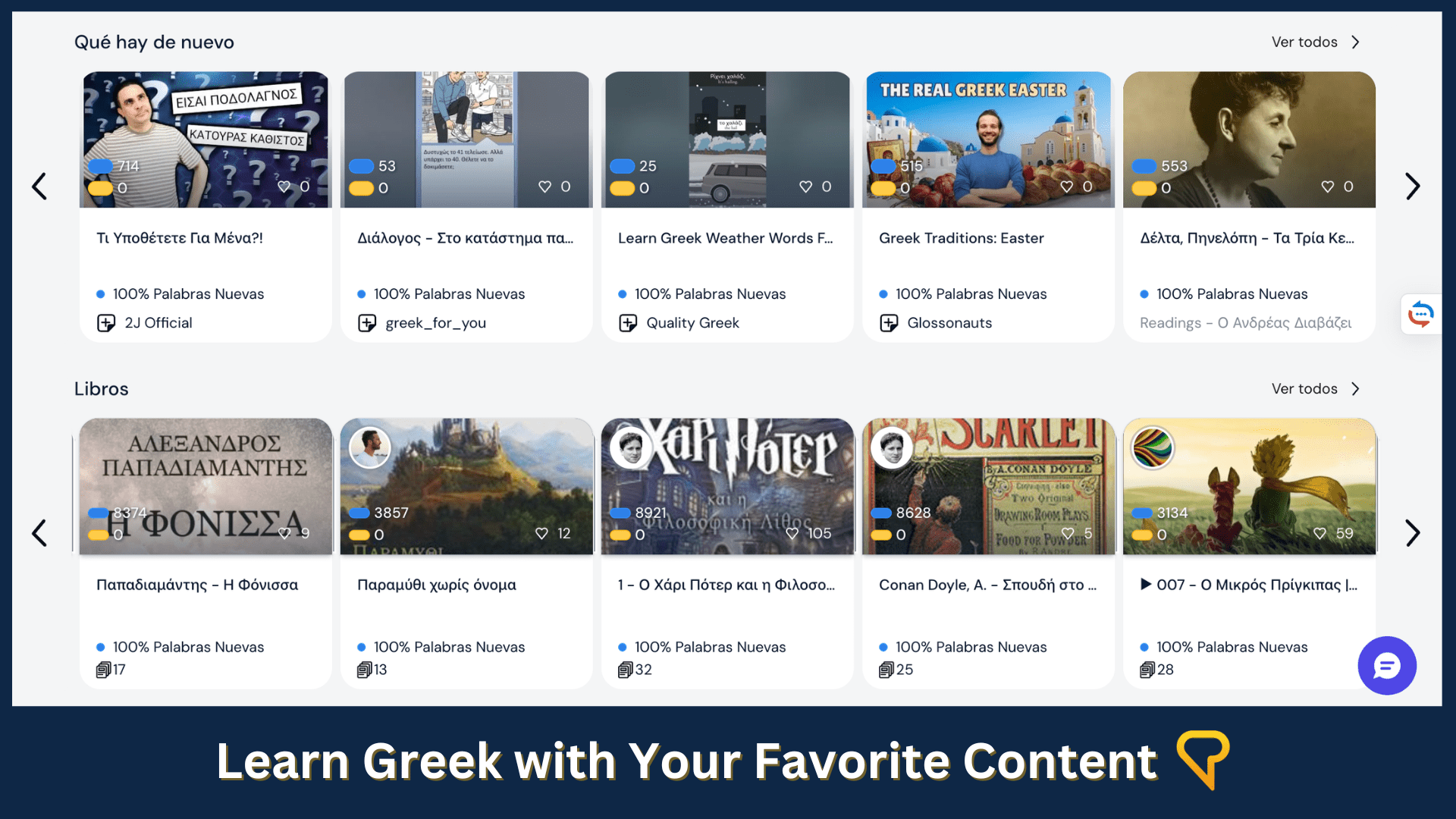
Why this works for Greek: Greek grammar is complex. If you try to learn the rules of three genders and four cases by heart, you will get frustrated. But if you see the word θάλασσα (sea) in twenty different sentences, your brain will start to notice the patterns of how it changes. This is how you develop a natural feel for the language, and it is far more durable than memorization.
Step 4: Best Apps to Learn Greek
No single app will make you fluent. But the right combination of tools dramatically reduces friction, especially early on.
Duolingo Greek The best free entry point for total beginners. The gamification works well for building a daily habit, and the Greek alphabet module is genuinely effective. The free version is usable, though the 2025 energy system caps daily practice at roughly 15-20 minutes for free users. Duolingo tops out around an A2 level: useful for getting started, not for getting fluent.
LingQ Once you have a basic foundation, LingQ is the most effective tool for reaching fluency. It lets you import any Greek content, a YouTube video, a podcast episode, a news article, a book, and turns it into an interactive lesson. Tap any unknown word to see a translation, save it to your vocabulary list, and track your progress over time. Your vocabulary grows in context, attached to real content you chose. This is comprehensible input done right.
Language Transfer: Complete Greek A free audio course that builds genuine understanding of Greek structure without rote memorization. One of the best free resources available, and it pairs well with both Duolingo and LingQ.
italki No app replaces a real conversation. Once you have a few hundred words, booking even one session per week with a Greek tutor on italki will accelerate your speaking confidence faster than any course.
Step 5: How LingQ Accelerates Your Greek
If you want the best language learning app for Greek, you need something that lets you use real content.
LingQ supports your Greek journey by allowing you to:
- Import anything: Find a Greek news article or a YouTube video? Import it into LingQ and turn it into a lesson. Read and listen simultaneously, look up words with one click, and review at your leisure.
- Track your vocabulary: Watch your “Known Words” count grow. Seeing that number hit 1,000, 5,000, or 10,000 is the best motivation there is.
- Listen on the go: Use the mobile app to listen to your Greek Mini Stories or playlists while driving or at the gym.
Step 6: Greek Learning Resources — Organized by Level
Beginner
- LingQ Greek Mini Stories: High-frequency vocabulary in repetitive, beginner-friendly stories. The best structured starting point on LingQ.
- Language Transfer: Complete Greek: Free audio course. Excellent for understanding how Greek works before you have read much of it.
- Duolingo: Good for the alphabet and building a daily habit.
Intermediate
- Easy Greek (YouTube): Street interviews with real Greeks, with Greek and English subtitles. One of the best channels for hearing how the language is actually spoken.
- Hellenic American Union Podcasts: More formal listening practice. A curated playlist is available on LingQ, formatted as language lessons.
For listening on the go
- From GreekPod101 to A Modern Odyssey, build up a playlist of podcasts and fill the passive hours of your day with Greek audio.
- Import any podcast into LingQ and listen via the mobile app while commuting, exercising, or doing chores.
Practical Tips for Long-Term Progress
Consistency beats intensity. Twenty minutes of Greek every day outperforms a four-hour session once a week, every time. The brain consolidates language during sleep, so daily exposure matters more than total volume.
Do not fear the grammar. Greek has cases (Nominative, Genitive, Accusative, Vocative). Do not study them in isolation before you have encountered them in context. Use grammar as a quick reference tool, not the primary method.
Speak without pressure. You do not need to be perfect to be understood. If you want to move past how to say hello in Greek, you will need to make a lot of mistakes. Keep the pressure for perfection low and embrace the trial and error.
Track your known words. On LingQ, watching your known word count grow from 500 to 1,000 to 5,000 is one of the most effective motivational tools in language learning. Progress that is visible stays motivating.
FAQs
How long does it take to learn Greek? For a conversational level, expect 6 to 12 months of consistent daily practice. For fluency, the FSI suggests around 1,012 hours of study. The range varies significantly depending on how much immersive content you consume outside of structured lessons.
Is the Greek alphabet hard to learn? No. It looks intimidating, but most learners can read it phonetically within 2-3 days. Several letters are identical to English equivalents, and others are familiar from math and science. The alphabet is genuinely one of the easier parts of learning Greek.
What is the best app to learn Greek? For beginners: Duolingo for the alphabet and habit-building, and Language Transfer for understanding structure. If you are an intermediate learner and beyond: LingQ, which lets you learn from real Greek content you actually care about. For speaking practice at any level: italki.
Can I learn Greek for free? Yes. Duolingo, Language Transfer, Easy Greek on YouTube, and LingQ’s free tier all provide substantial free content. Investing in a paid LingQ subscription and occasional italki sessions will accelerate your progress considerably, but it is possible to reach a solid intermediate level without spending anything.
Is Modern Greek different from Ancient Greek? Yes, significantly. They share the same alphabet and many roots, but grammar, pronunciation, and vocabulary have evolved over 2,000 years. Modern Greek has simplified many ancient grammatical features. Focus on Modern Greek for travel and everyday communication.
How do I learn Koine Greek? Koine Greek, the Greek of the New Testament and early Christian texts, requires a different approach from Modern Greek. The standard starting resource is Mounce’s Basics of Biblical Greek or the free Greek for Everyone course. Because Koine is not a living spoken language, you will rely more on grammar-based study and reading rather than listening immersion. It is a rewarding path, just a different one from Modern Greek.
Start Your Greek Journey Today
Learning a language is about more than just words. It is about connecting with a different way of seeing the world. Greek offers a depth of history and a warmth of culture that is truly unique.
Ready to move past “hello” and “thank you”? Start immersing yourself in real Greek content today.
Learn Greek Online with LingQ. Start Your Trial Now!
Writer Bio

Tyler is an American language teacher and language learner. He’s taught Spanish, French and Latin in the K-12 system since 2018. Tyler also speaks Thai and Italian. Currently, he’s learning German and Polish on LingQ!
Twenty minutes a day beats a weekend of drilling.
Read and listen to things you’d have read anyway — LingQ counts every word you pick up along the way.
- 5M+ learners
- 4.7★
- Free to start

