
Learn Japanese with Badly in Love: Dating Vocabulary, Slang, and Real Conversation
 Estelle
9 Sep 2026
Estelle
9 Sep 2026
TL;DR
You can turn Badly in Love into a full Japanese lesson by watching it with Japanese subtitles on and importing the subtitle track into LingQ with the browser extension. The show is best suited to A2–B1 learners and is especially good for emotional, conversational Japanese, real hesitations, interruptions, and slang, since it’s unscripted reality TV rather than a written drama.
Badly in Love (ラヴ上等, Rabu Jōtō) is Netflix’s Japanese reality dating series built around yankii culture, a subculture associated with rebellious attitudes, distinctive fashion, and strong group loyalty. Season 2 moves the action to a seaside academy in Okinawa with a new cast. What made me actually import it, though, wasn’t the premise, it was that people on this show talk like real people. No writer smoothing out their sentences.
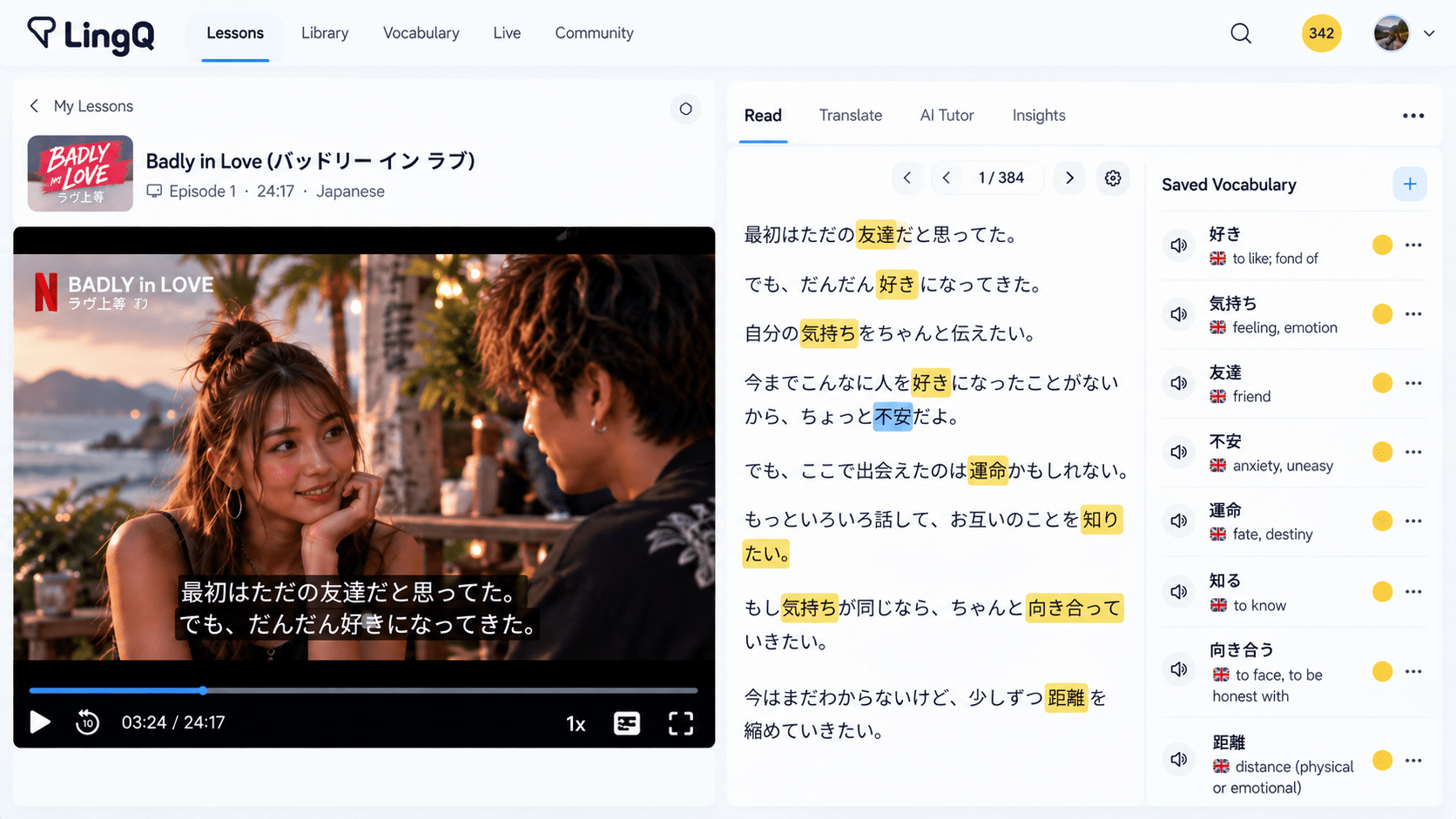
Importing it was the same two-minute process I use for everything now. I opened the show on Netflix, switched the subtitles to Japanese, clicked the LingQ browser extension, and the episode loaded into my library as a lesson, video and transcript together.
What Level Is This Actually For
This one is genuinely more demanding than a scripted drama, and that’s worth knowing going in. Reality TV means people interrupt each other, hesitate, react emotionally, and don’t always finish their sentences, none of the clean, deliberate pacing a script gives you. I’d put it at A2 going into B1, workable if you’re already comfortable with basic conversational Japanese, difficult if you’re still relying heavily on subtitles for every line. The payoff is real, though: you’re hearing Japanese exactly as it’s used socially, not as it’s written for an audience.
The Vocabulary That Actually Stuck
Dating shows naturally repeat vocabulary about emotions and relationships, and a few words came up often enough that I ended up saving and reusing them well beyond this one show:
好き (suki) — to like, to be fond of someone. The absolute core word of this genre, and one that extends in genuinely useful ways once you start noticing it in different forms.
気持ち (kimochi) — feeling, emotion. Comes up constantly whenever someone’s trying to explain what they’re actually feeling, which on a show like this is often.
信じる (shinjiru) — to believe, to trust. A word that carries real weight in any relationship-focused content, worth knowing well beyond dating shows specifically.
Pay Attention to Phrases, Not Just Words
One thing this show does well for a learner: it shows how a single root word extends into real usage far beyond its dictionary definition. Take 好き on its own, useful, but limited. Then you start hearing 好きな人 (suki na hito), the person you like, then 好きになった (suki ni natta), started to like someone, fell for them. Then 好きかもしれない (suki kamoshirenai), I might like them. Suddenly you’re learning how people actually communicate an idea, not just memorizing an isolated entry.
Practicing With Lynx After Watching
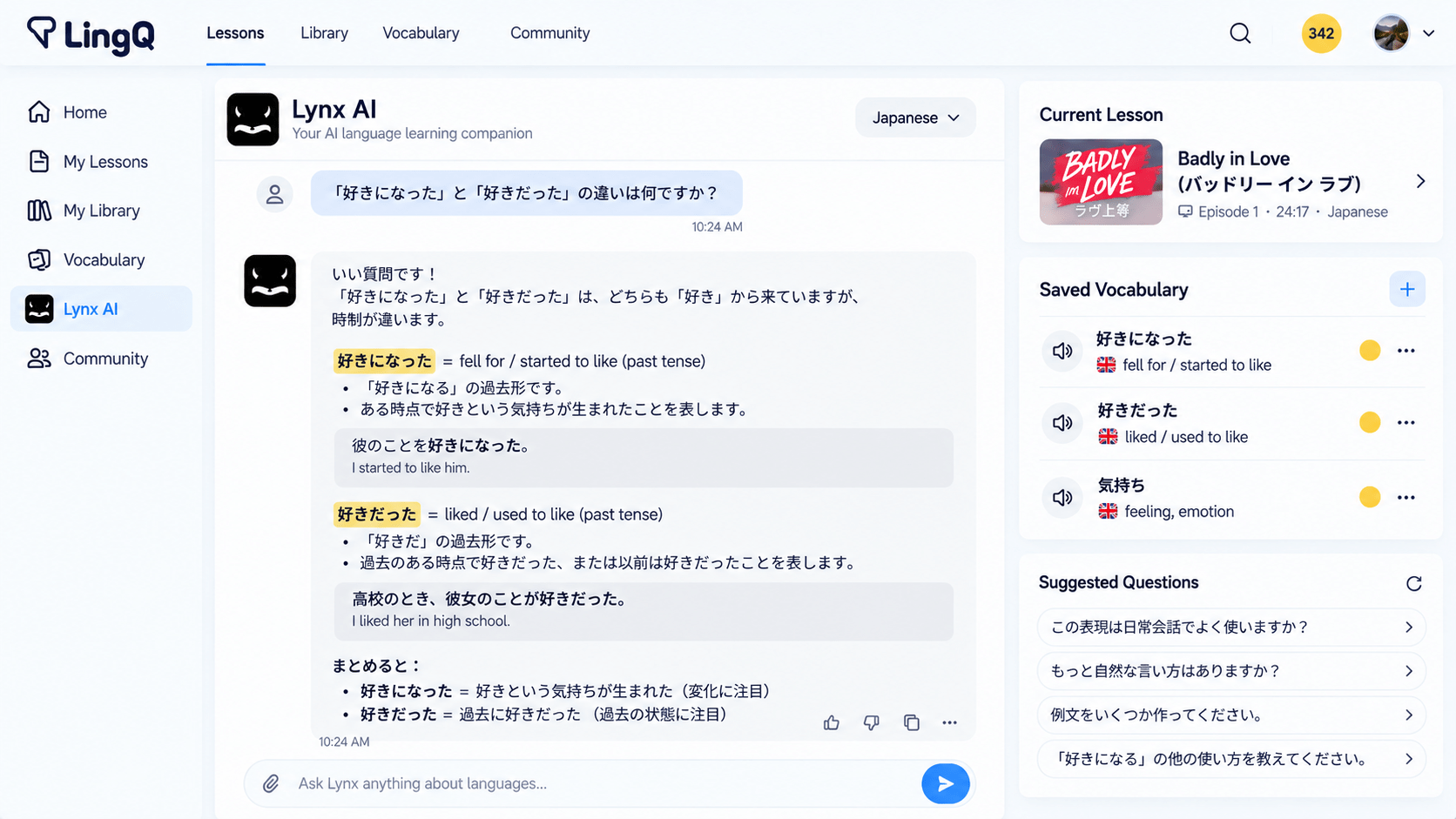
After saving a handful of words from the first episode, I opened LingQ’s Lynx AI chat and asked it directly: 「好きになった」と「好きだった」の違いは何ですか?, what’s the difference between these two past-tense forms of “liked”? Getting a clear, learner-friendly breakdown of a distinction like that, one dictionaries don’t always make obvious, is exactly the kind of practice that turns a recognized word into an actually understood one.
What I’m Queuing Up Next
The same import method works for any Japanese show with subtitles, not just this one. After finishing a season of Badly in Love, I’d want to go back to something scripted for contrast, hearing how much more compressed and unscripted the dialogue is here compared to a written drama is a genuinely useful way to notice how much natural speech actually differs from performed speech.
If you want to try this with something you’re actually planning to watch anyway: install the LingQ browser extension, turn on subtitles in your target language, and click it. That’s really the whole first step.
FAQs
Yes, particularly for A2 to B1 learners. The dialogue is unscripted and emotionally direct rather than simplified, and it’s rich in relationship and dating vocabulary that doesn’t show up as often in typical learner content.
Casual, conversational Japanese with a lot of slang, hesitation, and interruption, genuinely reflective of how people actually speak, rather than the cleaner, more deliberate pacing of a scripted drama.
You’ll get more out of it around A2 or above. Below that, the overlapping speech and lack of clear sentence boundaries will likely be more frustrating than helpful.
Any show or film with subtitles in your target language can be imported the same way, using the LingQ browser extension. This isn’t specific to Badly in Love.
Start Reading Real Japanese
Badly in Love’s appeal is exactly what makes it useful: it wasn’t built for language learners, it was built for Japanese speakers, arguments, slang, and all. The habit that actually works is simple: watch what you’re already curious about, with subtitles on, and let the vocabulary build from there.
If you’re at that point with Japanese, or any language, LingQ is built for exactly this next step. Start with the library, or import content you already love. Your first 20 LingQs are free.
Start learning Japanese on LingQ →

Hi, I’m Estelle, an AI language learner exploring languages through authentic content. I share ideas, tips, and experiences inspired by content-based learning. I hope my posts help make your language journey a little more enjoyable. Happy LingQing!
Twenty minutes a day beats a weekend of drilling.
Read and listen to things you’d have read anyway — LingQ counts every word you pick up along the way.
- 5M+ learners
- 4.7★
- Free to start


You might also like