

How to Learn Kanji (and Hanzi): Why Reading and Writing Work Better Together
 Eric Roberts
18 Jun 2026
Eric Roberts
18 Jun 2026If you’ve ever tried to learn Chinese or Japanese, you already know the wall every learner eventually hits: the characters. Mandarin Chinese uses thousands of hanzi. Japanese layers thousands of kanji on top of two syllabaries, and each kanji can carry multiple readings. They don’t sound out the way an alphabet does, and for a long time the conventional wisdom was that you simply had to grind through them—flashcard by flashcard, stroke by stroke, until something stuck.
That advice was never quite right. And now, with Skritter and LingQ officially integrated, there’s a better way to approach the single hardest part of these languages.
This post answers a question that comes up in nearly every learner forum and search bar: how do you actually learn Chinese and Japanese characters and make them stick? The short answer is that there are two proven paths, they pull in different directions, and the learners who succeed fastest use both. Here’s how that works—and how the new integration finally connects them.
First, how many characters do you actually need?
It helps to know the size of the mountain. In Japanese, the Jōyō kanji list—the government’s standard for everyday literacy—contains 2,136 characters. Proficiency exams stage them: roughly 100 kanji for JLPT N5, climbing to around 2,000 for N1. In Chinese, functional literacy sits around 2,500–3,000 hanzi, and the HSK exam scales from a few hundred characters at HSK 1–2 up to roughly 2,500 by HSK 6.
Those numbers sound intimidating, but they also point to the solution: you cannot brute-force thousands of characters with isolated memorization. You need a system that exposes you to the high-frequency ones constantly and a way to lock in the ones that matter to you.
The two schools of character learning
If you read the most-cited guides on this topic—Tofugu, NihongoShark’s “kanji by sight” approach, or Hacking Chinese’s advice on learning characters—you’ll notice they tend to fall into two camps. You’ll also meet popular method-driven tools along the way: Heisig’s Remembering the Kanji (RTK), WaniKani, and Anki decks all live in this space.
Camp one: learn characters through context and reading. The argument here is that characters aren’t isolated puzzles; they’re parts of words, and words live inside sentences. When you meet 食 (eat) hundreds of times across real stories, articles, and dialogue, you don’t memorize it—you absorb it. You learn what it means, how it combines (食事, 食べる, 飲食), and how it actually gets used by native speakers. Recognition becomes automatic because you’ve seen it doing real work.
Camp two: learn characters by writing them. This camp focuses on the character itself—stroke order, components, radicals, and the muscle memory of producing it by hand. Research on handwriting and memory (for example, Longcamp et al., 2008, and Mangen & Velay, 2010) suggests that physically writing a character creates a stronger and more durable memory trace than passively recognizing it. You notice the difference between 待 and 持, between 未 and 末, because you’ve had to draw each one correctly, radical by radical. Writing forces a level of attention that reading alone never demands.
Here’s the thing most “how to learn kanji” debates get wrong: these aren’t competing philosophies. They’re two halves of the same skill. Reading builds breadth and meaning. Writing builds precision and recall. One without the other leaves a gap—and that gap is exactly why so many learners plateau.
Where LingQ fits: characters through extensive reading
LingQ is built around extensive reading and listening. The core idea is comprehensible input: you read and listen to large volumes of interesting material slightly above your current level, tapping unknown words to see instant translations and saving them to your personal vocabulary for review.
For character learning, this approach is powerful in a specific way. In LingQ, you never study a character in isolation—you encounter it in context. You see 経 inside 経済 (economy), 経験 (experience), and 神経 (nerve), and over dozens of exposures your brain quietly maps the patterns. For Japanese learners, this is also how you start to internalize the multiple on’yomi (音読み) and kun’yomi (訓読み) readings a single kanji can take—because you meet each reading where it actually lives, inside real words. You learn the high-frequency characters first simply because they appear most often, which is exactly the order you should learn them in.
This is how literate native speakers actually acquired their reading ability: not from flashcard decks, but from years of reading. LingQ compresses that process. For a Japanese-specific walkthrough of this approach, see LingQ’s guide on learning to read Japanese. It’s ideal for building the kind of effortless sight recognition that lets you read a menu, a news headline, or a novel without stopping to decode every glyph. What extensive reading is less suited for is teaching you to produce characters from memory—and that’s by design. LingQ’s job is to get you reading fast and reading a lot.
Where Skritter fits: honing the characters themselves
Skritter is the specialist for the other half. It’s the app for learners who want to zoom in on the characters as individual objects of study—writing them stroke by stroke on screen, getting real-time feedback on stroke order and accuracy, and using a spaced repetition system (SRS) tuned specifically for the demands of hanzi and kanji.
Skritter is where you internalize components and radicals, the building blocks that make characters learnable rather than arbitrary. It’s where the difference between similar-looking characters stops being a guessing game. And because it tests active recall—you produce the character, you don’t just recognize it—it builds the deep, durable memory that’s hard to get any other way. Skritter supports both simplified and traditional Chinese characters as well as Japanese kanji, so it fits whether you’re studying for the HSK in simplified hanzi or reading traditional characters from Taiwan.
For anyone who wants to write by hand, take a test like the Kanji Kentei, or simply truly know their characters rather than vaguely recognizing them, Skritter does the focused work that reading alone can’t.
LingQ vs. Skritter: which does what?
These apps aren’t rivals—they cover different halves of the same skill. Here’s the split at a glance:
| LingQ | Skritter | |
|---|---|---|
| Primary method | Extensive reading & listening | Individual character study |
| How you learn | In context, inside real sentences | Character by character, in isolation |
| Core strength | Recognition & meaning through exposure | Stroke order, radicals & active recall |
| Writing practice | Not the focus | Yes—write characters stroke by stroke |
| Memory engine | Repeated exposure across content | Spaced repetition (SRS) |
| Best for | Reading fluency, vocabulary in context | Honing characters, writing, exam prep |
The simplest way to remember it: LingQ is built on reading content; Skritter is built on individual character study. LingQ teaches you characters in context; Skritter lets you drill and write them one at a time.
What the integration actually does: how to export from LingQ to Skritter
Now the vocabulary you save while reading in LingQ can move into Skritter for focused writing and recall practice in a couple of clicks.
Here’s how to export your words:
- Log into Skritter so your account is ready to receive the import.
- Go to your LingQ vocabulary and open the words or characters you’ve been saving as you read.
- Select the words or characters you want to export.
- Click “More Actions,” then “Export Selected for Skritter.”
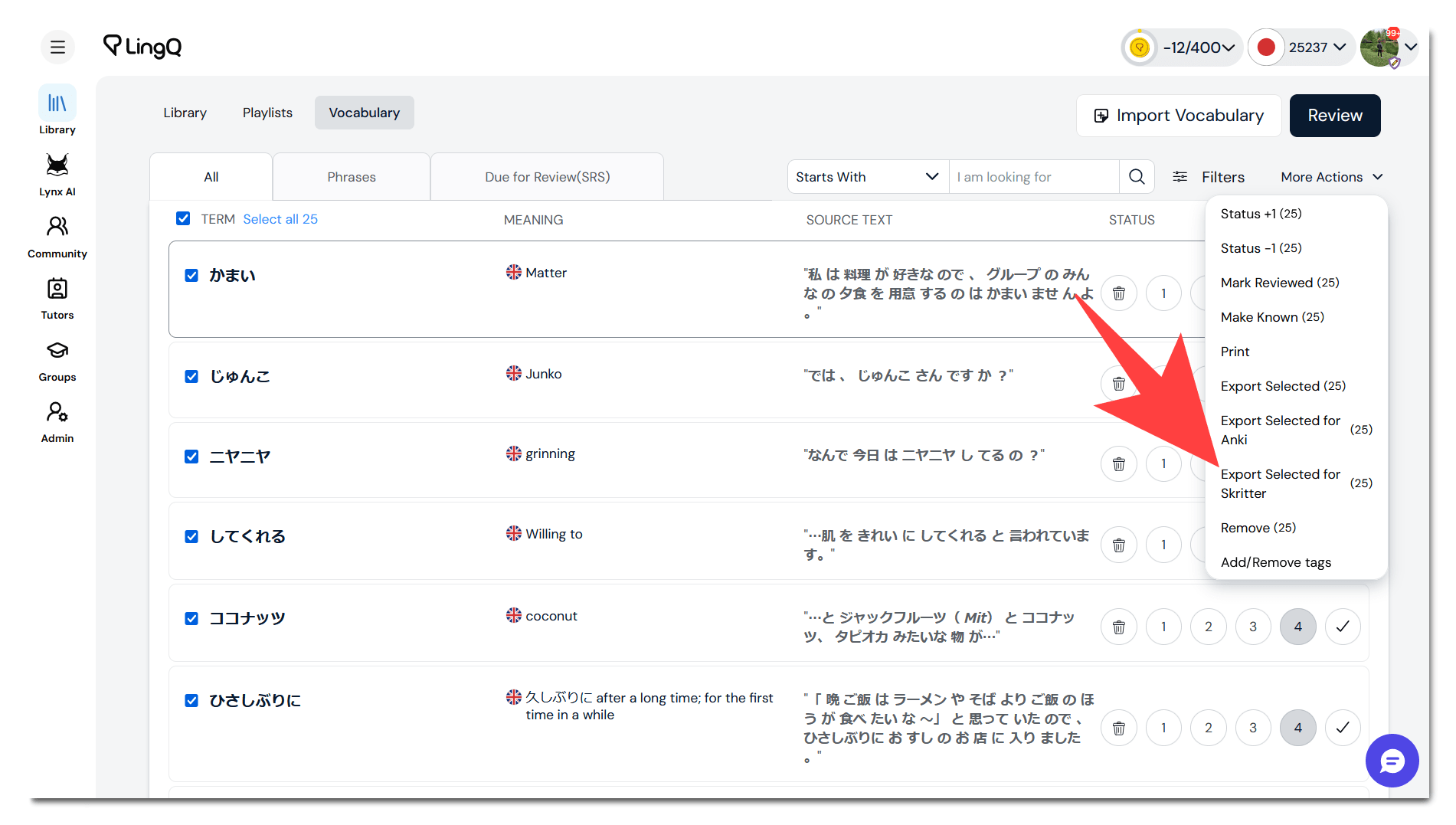
That’s it. You can drill stroke order, radicals, and writing. The learning loop looks like this:
- Read widely in LingQ. Meet characters in real context. Save the words that matter to you.
- Export to Skritter and practice deliberately. Drill stroke order, writing, and active recall on those exact characters.
- Return to reading—and recognize more. The characters you’ve written by hand now jump off the page, and the context you’ve gained makes the Skritter reps meaningful instead of abstract.
Each side reinforces the other. Reading gives your writing practice relevance—you’re drilling words you’ve actually seen and want to know. Writing gives your reading depth—you stop skimming past half-learned characters and start genuinely owning them.
A practical workflow for Chinese and Japanese learners
Here’s a simple routine that puts the integration to work:
- Daily input (20–40 min in LingQ): Read and listen to content you find genuinely interesting—stories, podcasts, articles. Don’t stop to memorize; just save unknown words and keep moving. Volume is the goal. (New to the platform? LingQ’s how to use LingQ as a beginner walks through setup step by step.)
- Focused practice (10–15 min in Skritter): Export the characters from your reading and drill them. Write them out. Pay attention to stroke order and the radicals that recur across characters.
- Weekly review: Notice which characters now feel automatic when you read. Those have graduated. Let new high-frequency ones take their place.
Beginners might lean a little harder on Skritter early, using it to hone in on the most common characters—and a feel for how strokes and radicals work—before diving into longer reading. Intermediate and advanced learners will lean on LingQ for volume, using Skritter to lock down the specific characters that keep tripping them up.
FAQs
No—each works on its own. But they cover different halves of character learning: LingQ builds recognition and vocabulary through reading in context, while Skritter builds writing ability and precise recall through stroke-by-stroke practice. Using both, now that they’re integrated, closes the gap faster than either alone.
Skritter is genuinely good for beginners. Because it helps you hone in on individual characters—their strokes, radicals, and shapes—before you tackle longer reading, it gives newcomers a solid foundation to build on. Starting with a core set of high-frequency characters in Skritter can make your first Chinese or Japanese reading sessions in LingQ smoother.
Writing isn’t LingQ’s focus—LingQ is built on reading and listening, so it excels at recognition and understanding characters in context. That’s exactly why the Skritter integration is useful: it adds dedicated handwriting and stroke-order practice to LingQ’s reading-first approach.
Yes. Skritter supports simplified and traditional hanzi as well as Japanese kanji, so the workflow fits whether you’re preparing for the HSK in simplified characters or reading traditional ones.
The fastest way to learn kanji and hanzi: do both
The old debate—should I learn characters by reading or by writing?—has a new answer: do both, in one connected workflow. Extensive reading in LingQ builds the broad, contextual recognition that makes you literate. Focused practice in Skritter builds the precision, stroke order, and recall that make you fluent with the characters themselves.
Twenty minutes a day beats a weekend of drilling.
Read and listen to things you’d have read anyway — LingQ counts every word you pick up along the way.
- 5M+ learners
- 4.7★
- Free to start


You might also like