
Korean Alphabet: The Complete Beginner’s Guide to Hangul
 Tyler Tolman
14 May 2026
Tyler Tolman
14 May 2026
Most language learners look at Korean writing and assume they’re in for months of memorization. Luckily, that’s not the case. Hangul, the Korean alphabet, was designed in the 15th century specifically so an ordinary person could learn it in a morning. King Sejong, who commissioned it, said as much:
“A wise man can acquaint himself with them before the morning is over; even a stupid man can learn them in the space of ten days.”
This 600-year-old promise holds up surprisingly well. Hangul is logical, phonetic, and built around a system you can actually see. The shapes of consonants, for example, are based on the position of your mouth and tongue when you make the sound. Once you understand how the characters work, reading “안녕하세요” stops being a puzzle and starts becoming a language.
This guide will take you through every letter, the rules for combining them into syllables, and a practical path to reading your first Korean words (before the morning is over).
Why Hangul Is Easier Than It Looks
Hangul is not Chinese. Many confuse the two writing systems, causing unnecessary dread and intimidation.
Chinese characters (called hanja when used in Korean) are logographic. In other words, each character represents a meaning, and there are thousands of them. Hangul is much simpler. It’s an alphabet of just 24 letters: 14 consonants and 10 vowels. Combine those, and you can write any sound in the language.
The Korean alphabet is especially friendly to beginners for three reasons:
1) It’s phonetic. Each letter consistently maps to one sound. Once you know the letter, you know how to pronounce it. Unlike English’s infamous “though, through, cough, and bough” debacle, Korean pronunciation is consistent and predictable.
2) The shapes are systematic. Consonants are designed to look like the position your mouth makes when pronouncing them. The letter ㄱ (g/k) mimics the back of the tongue rising to the soft palate. The letter ㅁ (m) is a closed box, like your lips closing. Once you spot the patterns, the letters become easier to remember.
3) It’s a single, unified system. There is no “advanced” Korean alphabet lurking in the shadows. In Japanese, you learn hiragana with katakana and then thousands of kanji. In Korean, the same phonetic logic you use for basic greetings is exactly what you’ll use to read a newspaper or a novel.
There is one specific challenge that catches new learners off guard: Korean stacks letters into syllable blocks rather than writing them in a straight line. We’ll get to that. For now, let’s focus on the letters themselves.
The Korean Vowels
Korean has 10 basic vowels and 11 compound vowels. Don’t let that number scare you — the compound vowels are just predictable combinations of the basic ones, the same way ai in English is just a + i.
Basic Vowels
There are 10 to memorize. Look at them as a system: vertical lines and horizontal lines with one or two short strokes that mark the sound.
| Letter | Sound | Like in English |
|---|---|---|
| ㅏ | a | father |
| ㅑ | ya | yard |
| ㅓ | eo | son (British “ah” → “uh”) |
| ㅕ | yeo | yuck |
| ㅗ | o | go |
| ㅛ | yo | yo-yo |
| ㅜ | u | blue |
| ㅠ | yu | you |
| ㅡ | eu | (no English equivalent — like “uh” with flat lips) |
| ㅣ | i | see |
Notice the pattern: every vowel with a short double stroke is the “y-” version of its single-stroke counterpart. ㅏ becomes ㅑ. ㅗ becomes ㅛ. Once you spot this, you’ve effectively cut your memorization in half.
The only vowel without a clean English equivalent is ㅡ (eu). Make a flat smile, then try to say “uh” without rounding your lips. That’s the sound. It shows up constantly in Korean, so it’s worth getting comfortable with early.
If you’d like a quick reference, here’s a short clip for pronouncing the Korean vowels.
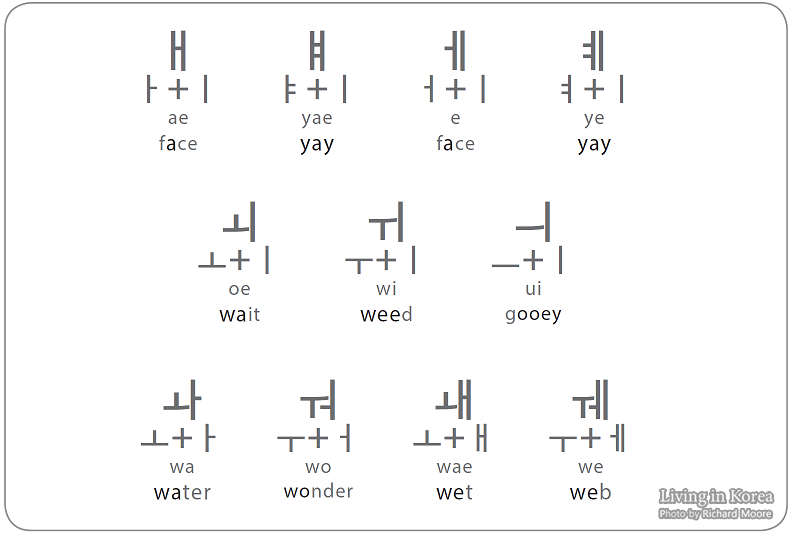
Compound Vowels
Compound vowels are pairs of basic vowels that combine into a single sound. There’s no new logic to learn — if you can pronounce ㅗ + ㅏ separately, you can pronounce ㅘ.
| Compound | Sound | Made From |
|---|---|---|
| ㅐ | ae | ㅏ + ㅣ |
| ㅒ | yae | ㅑ + ㅣ |
| ㅔ | e | ㅓ + ㅣ |
| ㅖ | ye | ㅕ + ㅣ |
| ㅘ | wa | ㅗ + ㅏ |
| ㅙ | wae | ㅗ + ㅐ |
| ㅚ | oe | ㅗ + ㅣ |
| ㅝ | wo | ㅜ + ㅓ |
| ㅞ | we | ㅜ + ㅔ |
| ㅟ | wi | ㅜ + ㅣ |
| ㅢ | ui | ㅡ + ㅣ |
A practical note: in modern spoken Korean, ㅐ and ㅔ are nearly identical — both sound like the “e” in “bed.” Same with ㅙ, ㅚ, and ㅞ, which native speakers pronounce almost interchangeably. Don’t lose sleep over the distinctions. Simply recognize them in writing, and your ear will become a more effective filter with sufficient listening practice.
The Korean Consonants
Korean has 14 basic consonants and 5 doubled (tense) consonants. Five of the basic ones also have an aspirated counterpart. Essentially, form the same mouth shape, but add a stronger puff of air.
Basic Consonants
| Letter | Sound | Notes |
|---|---|---|
| ㄱ | g/k | Like g between vowels, k at the start |
| ㄴ | n | Like n in no |
| ㄷ | d/t | Like d between vowels, t at the start |
| ㄹ | r/l | Between English r and l — flick the tongue |
| ㅁ | m | Like m in moon |
| ㅂ | b/p | Like b between vowels, p at the start |
| ㅅ | s | Like s; before ㅣ, sounds like sh |
| ㅇ | silent / ng | Silent at start of syllable; ng at end |
| ㅈ | j | Like j in jam |
| ㅎ | h | Like h in hat |
The consonants ㄱ, ㄷ, ㅂ, and ㅈ have a quirk worth noting: they’re soft (g, d, b, j) when they appear between vowels, and harder (k, t, p, ch) at the start of a word or after certain consonants. You’ll hear and apply this naturally as you listen to Korean. It’s not a matter of memorization.
Aspirated Consonants
Five consonants get an extra horizontal line to mark them as “aspirated”. They’re pronounced with a noticeable puff of air. Hold a piece of paper in front of your mouth. If it flutters, you got it right.
| Letter | Sound | Aspirated Version Of |
|---|---|---|
| ㅋ | k | ㄱ |
| ㅌ | t | ㄷ |
| ㅍ | p | ㅂ |
| ㅊ | ch | ㅈ |
| ㅎ | h | (already aspirated) |
Doubled (Tense) Consonants
Five letters get doubled to make a tense, sharp version of the sound. These are tighter and harder than the basic version, but no extra air.
| Letter | Sound | Tense Version Of |
|---|---|---|
| ㄲ | kk | ㄱ |
| ㄸ | tt | ㄷ |
| ㅃ | pp | ㅂ |
| ㅆ | ss | ㅅ |
| ㅉ | jj | ㅈ |
Distinguishing between basic, aspirated, and tense consonants is genuinely the trickiest part of Korean pronunciation for English speakers. English doesn’t make the distinction. Bat and pat differ in voicing; in Korean, the relevant difference is air. Listen to native audio side by side — 가 (ga), 카 (ka), 까 (kka) — and the contrast clicks within a few minutes.
For a 2-minute rundown of the Korean consonants with modeled pronunciation, check out this video from 90 Day Korean.
How Korean Syllable Blocks Work
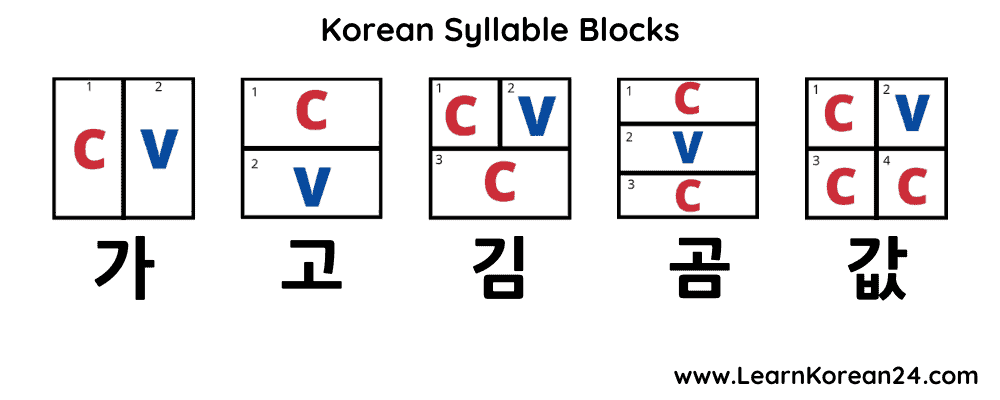
This is where Hangul stops looking like an alphabet and starts looking like Korean. Korean letters aren’t written in a straight line. Instead, they’re stacked into syllable blocks, with each block representing one syllable and roughly one beat of pronunciation.
Every syllable has at least two parts:
- A starting consonant
- A vowel
It can also have a final consonant (called batchim) that sits at the bottom of the block.
The Three Block Layouts
Which layout a syllable uses depends entirely on the shape of the vowel:
Layout 1: Consonant left, vowel right.
Used when the vowel has a vertical orientation (ㅏ, ㅑ, ㅓ, ㅕ, ㅣ).
가 = ㄱ (g) + ㅏ (a) → “ga”
비 = ㅂ (b) + ㅣ (i) → “bi”
Layout 2: Consonant on top, vowel below.
Used when the vowel has a horizontal orientation (ㅗ, ㅛ, ㅜ, ㅠ, ㅡ).
노 = ㄴ (n) + ㅗ (o) → “no”
무 = ㅁ (m) + ㅜ (u) → “mu”
Layout 3: With a final consonant (batchim).
The third letter sits at the bottom of the block, regardless of which layout the first two used.
강 = ㄱ (g) + ㅏ (a) + ㅇ (ng) → “gang”
물 = ㅁ (m) + ㅜ (u) + ㄹ (l) → “mul”
한 = ㅎ (h) + ㅏ (a) + ㄴ (n) → “han”
What About Words That Start With a Vowel?
Korean syllables can’t start with just a vowel, at least not visually. When a syllable starts with a vowel sound, ㅇ is used as a silent placeholder.
아 = ㅇ (silent) + ㅏ (a) → “a”
우유 = 우 (u) + 유 (yu) → “uyu” (milk)
This is why ㅇ has two jobs: silent at the start of a syllable, ng at the end.
Reading Your First Korean Words
The fastest way to make Hangul feel real is to stop studying letters and start reading. Here are common words built from what you’ve already covered:
안녕 — annyeong (hi) ㅇ + ㅏ + ㄴ / ㄴ + ㅕ + ㅇ
사랑 — sarang (love) ㅅ + ㅏ / ㄹ + ㅏ + ㅇ
한국 — hanguk (Korea) ㅎ + ㅏ + ㄴ / ㄱ + ㅜ + ㄱ
김치 — gimchi (kimchi) ㄱ + ㅣ + ㅁ / ㅊ + ㅣ
Try the next ones yourself before reading the answer:
비빔밥 — ?
서울 — ?
친구 — ?
Answers: bibimbap, Seoul, chingu (friend)
If you can sound out these words, you’ve cleared a major hurdle in Korean reading. From here, it’s a matter of building speed and exposure.
How to Practice Hangul Without Burning Out
Memorizing the chart is fundamental, but also the smallest part of the journey. The greater task is making the system automatic. How can you instantly recognize a stack of letters as a word without conscious decoding?
Here are a few approaches that are more effective (and enjoyable) than drilling flashcards:
1) Read along with audio
Find a beginner Korean text with native audio and follow the words on the page while you listen. Your eyes will learn to associate shapes with sounds in real time. This is fundamental to become a fluent reader.
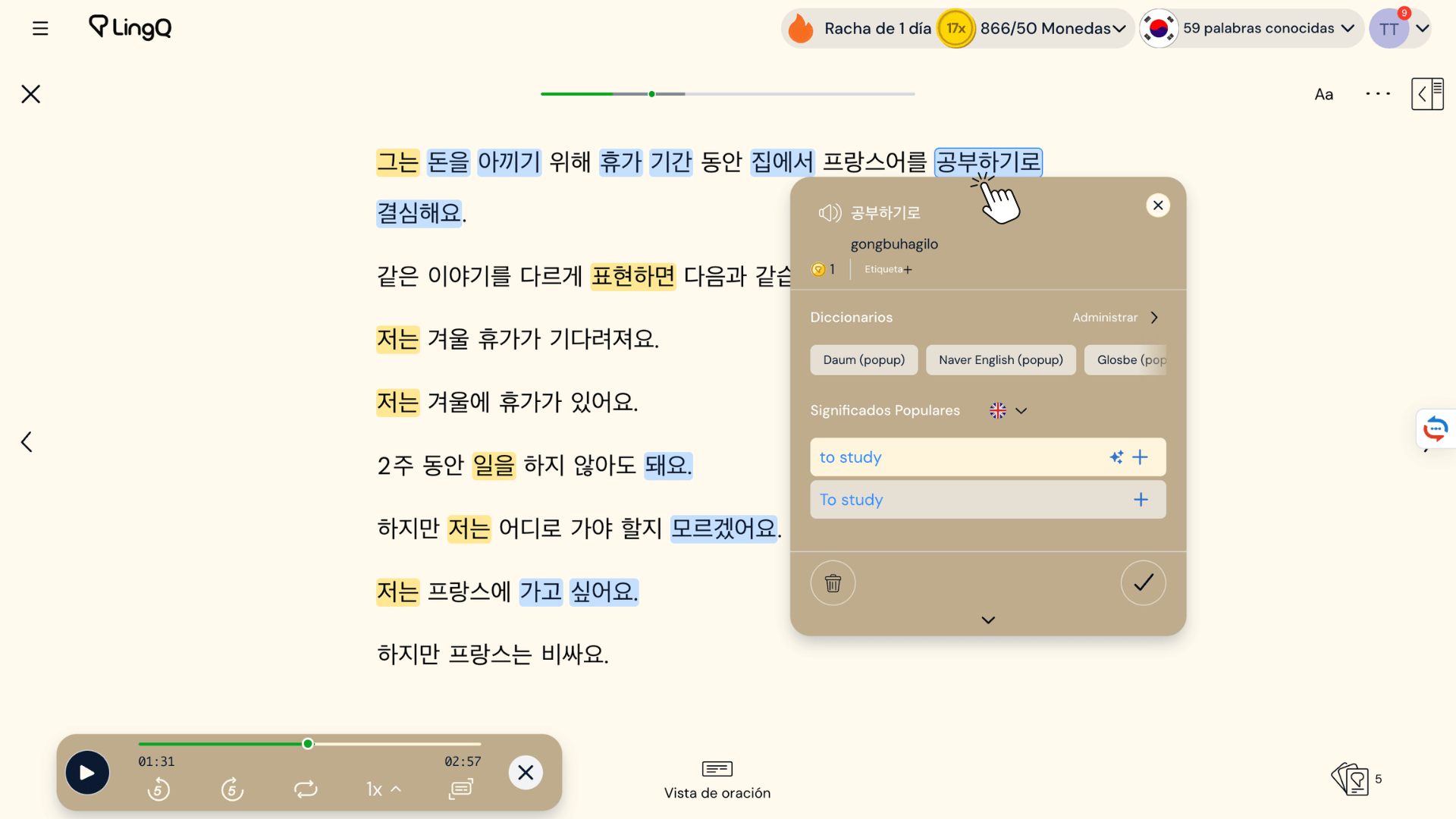
LingQ’s Korean library has plenty of beginner-friendly material, such as Mini Stories with audio for this exact purpose. While you listen, click any unknown word for an instant translation. This minimizes interruptions and keeps your focus on the reading.
2) Read shop signs and labels
If you watch K-dramas or follow Korean creators online, screenshots of menus, signage, and product labels are everywhere. Pause and try to sound out the words. Korean uses tons of loanwords from English written in Hangul (커피 = coffee, 컴퓨터 = computer, 호텔 = hotel). These texts are not only confidence-builders, but short bursts of practice.
3) Don’t worry about perfect pronunciation on day one
Your first priority is simply linking the shapes to the sounds. You can’t confidently produce sounds that you’re still adjusting to. Over time, your pronunciation will become more accurate.
4) Stop studying after 30 minutes
This is the single biggest mistake new learners make. Hangul is meant to be learned in short sessions over a few days, not a single grueling weekend. Twenty minutes a day for a week beats six hours on a Sunday. Build up your reading stamina gradually.
If you want a structured way to start reading Korean today, LingQ’s Korean library is built around exactly this method. Find short lessons with native audio, click-to-translate vocabulary, and a system that tracks the words you already recognize so you can see your progress as you read.

FAQs
Is Hangul really learnable in one day? Yes. Most learners can read individual syllables after 2–4 hours of focused study. However, more fluent, extended reading requires a few weeks of regular exposure. But the alphabet itself is genuinely a one-day project.
Do I need to learn Chinese characters (hanja) too? To read modern Korean, no. Hanja appears occasionally in newspapers, academic writing, and to disambiguate names, but everyday text is written entirely in Hangul. Learn hanja later, especially if your interests lead you toward older texts.
What’s the difference between Hangul and Korean? Hangul is the writing system. Korean is the language. You can speak Korean without knowing Hangul, and you can read Hangul without speaking fluent Korean. Of course, learning them together is more efficient to become fluent in Korean.
Why do some Korean letters change their sound depending on position? Korean has pronunciation rules that smooth transitions between sounds, similar to how English speakers say “gonna” instead of “going to.” Letters like ㄱ, ㄷ, ㅂ soften between vowels and harden at the start of words. You’ll absorb these patterns through listening rather than studying them. Exposure is foundational.
How long until I can read Korean at a normal pace? You’ll recognize letters after a day. You’ll be able to sound out words slowly within a week. And you’ll read short stories at a comfortable pace within 1-3 months (assuming daily practice). Reading native content fluently is a long-term endeavor.
Start Reading Korean with LingQ
You now have everything you need to read Korean at a basic level. The next step is to actually do it.
LingQ’s Korean library has a lot to offer for novice readers. Beginner Mini Stories with native audio give you immediate listening practice. The Reader highlights every word you don’t know yet and tracks your progress as those words become familiar. As you advance, import any Korean content you find online: K-pop lyrics, K-drama subtitles, Korean YouTube videos.
Hangul gets you in the door. Reading gets you fluent.
Writer Bio

Tyler is an American language teacher and language learner. He’s taught Spanish, French and Latin in the K-12 system since 2018. Tyler also speaks Thai and Italian. Currently, he’s learning German and Polish on LingQ!
You might also like