Hey everyone.
This is Aliyah.
Today I am joined by Courtney and we are starting a new series today.
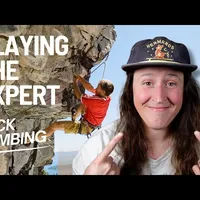
This is the first episode of our new series called playing the expert.
We are going to be taking turns talking about things that we know a lot about.
Things that you could say we are experts on.
And so it'll be things like our hobbies, our interests, or things that are just super interesting to us that we want to learn more about.
And we will go ahead and ask each other lots of questions so that we can share more about these topics with you all.
Uh we're really excited about this series and we think that um you'll like it, too.
So, Courtney, welcome to playing the expert.
Um what are you going to be the expert on today?
» Hi.
Thanks for having me.
I'm so excited for this new series.
Uh today I have to start with a topic that I know a lot about and that is rock climbing.
Rock climbing is something that I do every week and I've been doing it for almost 10 years.
So, I know a lot about rock climbing.
» Yeah, that is a long time to be dedicated to something.
How um how did you get into rock climbing?
» So, I got into rock climbing because a gym opened up near my house and I had never tried rock climbing before.
My husband rock climbed when he was in high school, when he was a teenager, and he thought it was really fun.
So, he told me, "Hey, let's go to the climbing gym.
Let's try rock climbing together."
And so, we did, and I loved it.
I was unemployed.
I didn't have a job during that time, and so I went to the climbing gym almost every day, and it became a good way for me to exercise, but also a good way for me to make friends and be part of a community.
» Yeah, that sounds awesome.
That that sounds like something that you know, a lot of people are looking for in terms of a hobby or, you know, a form of exercise.
Would you say that rock climbing is your main um is your main source of exercise these days, or do you still do other things, too?
» Uh rock climbing is definitely one of my main sources of exercise.
Uh I also like to run, and I also swim, but rock climbing is something that I do every Tuesday and Thursday inside, in the gym.
And then on the weekends, I like to climb outdoors.
» Wow.
Okay, that's super adventurous.
So, I'm super curious to hear more about the difference um between indoor climbing and outdoor climbing, but before we get there, um maybe can you tell me a little bit about what does rock climbing entail?
What do you do every time you go to the rock climbing gym?
How does it work?
Um what, you know, what types of muscles are you working out?
Um Just give me give me the down low.
» Yeah, sure.
So, the simplest way to describe rock climbing is that you start at the bottom and you climb to the top.
Uh that's the simplest way.
Uh in rock climbing, we call we call the climbs routes or problems.
Um problems are shorter.
Uh so, problems are usually no higher than about 20 ft.
Uh and and we we climb those without ropes.
Um typically, there's what we call crash pads.
Crash pads are big cushions underneath the climbing area.
And when you fall, you fall onto the crash pad or or the cushioned area.
Uh and then, typically, climbs that are much taller than 20 ft, we're climbing those with ropes.
So, you might hear people reference that as sport climbing, top rope climbing, lead climbing.
There's different names for it, but those are all climbs that are typically done with ropes.
So, the objective is to start at the bottom of the climb and climb up to the top.
Inside in the gym, the different holds uh the different areas that you're grabbing and that you're placing your hands and feet on are color-coded.
So, for example, if you're climbing a route or a problem, you climb all of the holds or rocks that are pink, maybe, or blue.
But outdoors, it's a lot harder because you're just using whatever part of the rock looks good.
You're just using whatever um to try and get to the top.
So, I would say climbing inside is a lot easier than climbing outside and most people start indoors.
» That makes a lot of sense.
Um and one question about the colors, do those usually indicate like a certain level of difficulty?
Like, let's say if you stick to the red path, it's like, you know, an an intermediate climb versus like the blue path, which might be the the more difficult option or something like that.
Is that how it tends to work?
» Yeah, you're totally right.
So, inside, uh we call the difficulty of a climb uh a grade.
So, there are different climbing grades.
Uh climbing grades range from things that are quite easy to things that are more difficult.
Uh one thing that confuses even English speakers is bouldering grades.
Anything that you're climbing without a rope starts with the letter V.
So, the easiest climb is a V0.
And I think the hardest climb in the world is probably around a V16.
And I don't know what the V stands for.
It's really just the numbers that matter.
Um and then, if you're climbing a roped climb, it's similar.
The climbs usually range from around 5.5 to, I believe, once again, 5 5.16.
Uh but the five doesn't really mean much.
It, once again, is just the second the second uh numbers.
So, yeah.
» Mhm.
Yeah, and that tells you a lot about what types of movements you might encounter, how how hard it might be to hang on to a specific hold or a specific technique that might be more intermediate or advanced.
Um » Mhm.
» Yeah.
» Mhm.
Okay, that's super good to know.
It's so interesting how um you know, I think a lot of things that are related to exercise and fitness have these kind of um ability levels.
Um very similar to language learning, wouldn't you say?
» Yeah, actually I compare language learning to rock climbing often.
One thing that I think about is um we talk about in rock climbing how sometimes you get to the top of the climb, uh but maybe you didn't climb that climb very well.
Maybe you didn't look the most graceful or maybe you could have used your legs more.
A lot of people don't use their legs very much when they start rock climbing, which is super important.
Uh but it's similar to language learning because in language learning, maybe you you kind of understand the meaning of a word in one context, but you might not understand it in all of its contexts.
So, yeah, it's similar.
Just because you're at an intermediate level, um doesn't mean you understand everything in that intermediate level, right?
» Mhm.
Right.
And and maybe if you come back to that, you know, intermediate level climb after, you know, you've put in several days or hours of practice, you might find that um it gets easier over time.
» 100%.
There's been many times where I've I've started a climb and I I can't do the first move.
And I say, "This is impossible.
How could anyone do this?"
And then by the end of the of the climbing session, I've managed to to climb it.
Uh in climbing we say when you when you complete a climb, we say you sent that climb.
So, by the end I've managed to send it.
» That's funny.
We use the same um in snowboarding.
Like when you just like you just go for it, it's called a full send.
You sent it.
» Mhm.
» [laughter] » That's cool.
I really like that.
Um so, you said something interesting earlier about using your legs.
And that kind of goes into my question about um you know, what parts of your body are you using in rock climbing?
What muscles are you working out?
Like which How is it How is it training your body?
I'm really curious about that.
» Yeah.
Yeah, and sorry.
I didn't mean to ignore that part of your question.
Um » No, not at all.
» So, the the muscles that climbing trains is all of your muscles, honestly.
» [laughter] » Um I think most people think that climbing to be able to climb, you have to be able to do a pull-up or just be really strong with your upper body, with your arms and your shoulders and your upper back.
And yeah, to to be a very strong climber, it's important that uh that you can use those muscles.
But, climbing is a full body sport.
That means that you have to use all of the muscles in your body.
Um and it depends on the type of climb.
So, uh there's different types of climbs.
Um the it depends on the angle of the wall.
So, if the wall is angled uh more overhung, uh if you're climbing kind of on the underside of the wall, uh that often requires more core strength, uh your abdominal muscles, and uh and your your upper body strength, your arms and your shoulders.
Uh but if you're climbing on a wall that's that's flatter, we call it slab, um and it doesn't have a lot of um a lot of good places to put your feet, then that works your leg muscles, specifically your calf muscles.
There There have been days where I've climbed a lot of of flatter, more positive climbs, and my calf muscles have been extremely sore, and my arms and hands are totally fine.
» Mhm.
Mhm.
Okay.
And I can imagine.
So, I've rock climbed maybe once or twice in my life.
And the last time was like a long, long time ago.
Um just at it at the gym.
And I do really remember um using my upper body a lot.
Um and and that's also because my upper body is is a lot weaker than my lower body, you know?
Um I don't really have very strong arm muscles.
And so, I remember it really being an intense um arm workout.
Um pulling my body up, you know, um with my arms in most of the situations.
But, I also remember that there were times when, you know, I was able to get a good foothold and that those were really good moments because your legs are a lot longer, right?
And so if you're able to like extend your legs um after getting a foothold, you can really climb like a significant distance in like one move.
Is that your experience as well?
» Yeah.
So, more than strength climbing technique is very important.
I'll tell you a story.
So, my husband is very strong.
He He weight lifts very regularly.
And he can he can lift some very very heavy things.
He's very strong.
But only recently he discovered climbing technique.
So, what what do I mean when I say that?
I mean um how to how to use your hips to balance, how to use your heels to to pull yourself up, how to use even your toes to to hook around a part of the rock.
Um and different things about body positioning um that exactly like you said um really make a huge difference in in your climbing ability.
So, it's not just strength, it's also about technique and and body positioning.
» Mhm.
Mhm.
And I can imagine that those things would work out some really small muscles.
Like you're talking about using your toes, you know, the muscles in your toes.
Like that's really um really targeted.
So, that's super interesting.
» Yeah, also uh it it works a lot of the muscles in your fingers.
Uh one of the biggest injuries that climbers get, one of the biggest ways climbers hurt themselves, is hurting their fingers.
There's There's tendons inside of your fingers.
Tendons are kind of like a stretchy material that help your your fingers take pressure and and weight and they help you to be able to grab things.
They're inside your finger.
» Mhm.
» And » They connect your muscles to your bones.
» Exactly.
That's a great way to describe it.
» And sometimes if you try to to climb too much or try to climb things that are too difficult too quickly, then it can hurt your tendons.
So, you have to be careful, especially when you're first starting climbing to to not not climb so hard.
» Mhm.
Mhm.
Got it.
So, tell me a little bit about the difference between indoor climbing and then like transitioning to outdoor climbing.
» Yeah, that's a great question.
Um Indoor climbing, I I think feels a lot more beginner-friendly.
Like I said before, it's easier to find the routes you're climbing because they're color-coded.
Uh generally the the people at the gym that set the routes, um they usually make them uh progressive.
So, progressive means that they they the difficulty gets harder slowly.
Um and so, if you climb a beginner route, then the progression to an intermediate route is gradual.
Uh outside uh climbs are just a lot harder.
Uh so so a climb that's graded a zero in the gym is going to be way easier than climbs that is are that are graded a zero outside.
So that's one big difference is that uh sometimes when people that have been climbing inside climb outside uh for the first time that they their feelings get hurt or they get upset because [laughter] uh they can't climb the same grades, the same
difficulties as indoors.
Um » Okay.
» Another difference between indoors and outdoors is that you typically have to hike to the to the climbs that you're looking for.
Uh and people use guidebooks.
So a guidebook is uh basically a book with information about how to find the route.
So sometimes a guidebook will say, you know, walk down this trail and you'll see a tree and look to the right of the tree and that's where you'll see a black spot in the rock and that's where your route starts.
Um » [laughter] » So sometimes it's a little bit um uh disheartening.
Disheartening is a word that kind of uh it means that uh it it's a little bit hard [laughter] to to um find the routes, but um you you get used to it with time.
Another skill that you need for outdoor climbing compared to indoor climbing uh are rope skills.
So one question that a lot of people have about outdoor climbing is how do you get your rope back down after after you've climbed the climb?
And » Mhm.
» there's a process.
Um it's pretty simple, but basically you need some extra equipment and you need a knowledge of how to tie some knots.
Um and so when you get to the top of the climb, uh you do a process called cleaning and it's it's just a process where you you remove yourself from the rope while you're still attached to the wall and then you re-tie your knot to yourself so that
you're secure again.
And then and then after that, uh your partner will lower you to the ground and and you can pull the rope through and get your rope back.
» Mhm.
[clears throat] Mhm.
So, what happens in terms of getting the rope set up?
I imagine one person at least has to climb up without the security of a rope to then be able to um situate it, I guess, at the top of the climb?
Is that correct?
» So, it's not, actually.
Um although you can do that, it's not recommended.
Um maybe after this I'll talk a little bit about how climbing's been portrayed in the media um because I I think that's why you would think that.
Um the the way that you set up a climb, the way you you get the rope at the top of the climb is that there are bolts in the wall.
So, there are bolts.
It depends on the climb, but usually about every 5 to 10 ft.
And the first person climbs up and they have a a thing called a a quickdraw.
A quickdraw is a set of I'm going to call them hooks or they're carabiners.
» Mhm.
» Um Yeah.
» Okay.
I Yeah, I see what you're saying.
» these hooks or carabiners and they attach them to the bolt in the wall and you can think of it like levels in a video game.
So, when you're playing a video game, you know, you get to a point in the video game and then you're safe.
If you die in the video game, uh you're not going to to go backwards in the game.
And that's kind of how going up the wall works.
You know, once you attach yourself to the bolt, then it's going to protect you from falling too far past that point.
» Okay.
It's a It's a milestone.
» Yeah.
And and then once once the rope's at the top, um your partner can choose to either climb in the same way that you did using the bolts or they can they can just top rope, which means that the rope's coming from the top and the benefit of that is that
your falls aren't as big.
If you If you fall, you won't fall as far.
You'll just kind of swing a little bit.
» [laughter] » It's pretty It's pretty funny.
People that have never climbed on a rope before, sometimes they'll they'll watch the first person take, you know, a few foot fall and then they'll be scared and uh when they're set up in the other manner on top rope, uh they let go and they'll
scream and then they just they just swing.
They don't really fall that far.
» Okay.
So, not a sport for people afraid of heights then.
» Actually, there are a lot of climbers that are afraid of heights.
They just do it anyway.
» Yeah, they they they learn to live with it and maybe it's a way to deal with that fear, too.
» To learn what you're learn what you're capable of and Okay, super interesting.
So So basically in an outdoor climbing situation, a lot of those locations where you would do that, they they have those bolts in place already.
You don't have to um You You They're They They already exist.
» Yeah, so So that's for sport climbing.
There's another type of climbing called trad climbing or traditional climbing.
And that's where people actually place They place gear in cracks.
Um and so those are kind of similar to bolts.
Um but but those are fully removable.
I I don't do that type of climbing.
I don't trust my mechanical skills.
» [laughter] » Mhm.
Yeah, that's super interesting.
It's definitely uh kicking it up a notch in terms of the the challenge and um abilities.
Um okay, super super interesting.
Um if someone wanted to get into rock climbing, what would be your suggestion to them?
» Yeah, so if someone wanted to get into rock climbing, I would say go to your nearest gym.
The gym staff, the people at the gym, are going to be able to give you a lot of answers to your questions.
Generally, you can rent gear.
So you can rent climbing shoes.
You can sometimes rent chalk bags.
Climbers use chalk um on their hands to keep their fingers dry.
Um but they're going to be able to provide a lot of information.
And then eventually, if you would like to climb outdoors, a lot of gyms also offer classes.
But my biggest piece of advice for anyone wanting to climb is don't don't be afraid or if you are afraid just just ease into it.
You don't have to you don't have to be the world's best climber on your first session and a lot of people really only can climb for about 20 minutes the first time they go without getting too tired.
So, yeah.
Mhm.
» Very cool.
Very cool.
Yeah, I think if you have a rock climbing gym in your area, there definitely are going to be some experts there and some other, you know, recreational climbers or maybe even like climbers who are pretty serious about it who you know, you can you can
talk to and kind of get their perspective on.
So, that's really cool and I can imagine they can also ask you some questions in the comments.
» Yeah, of course.
If anyone has any questions, you can put them in the comments below and I'm happy to answer them.
» Sounds great.
Well, thanks so much for telling me about more about rock climbing.
I do remember enjoying it when I did it and so I think I'm kind of inspired to try it again sometime.
» lots of gyms where you live.
So.
» Yeah, there are.
There are.
Cool.
Thank you so much for telling us about your expertise on rock climbing and anything you'd like to say before we say a goodbye until the next episode.
» excited for episode two.
In episode two, Aliya is going to tell me about Dungeons and Dragons which I don't know basically anything about.
So, stay tuned and we'll see you in episode two.
» Bye.
» Bye.
