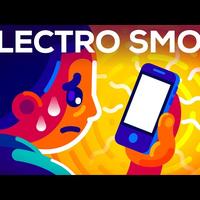
Could Your Phone Hurt You? Electromagnetic Pollution
Electricity is all around us all the time.
It makes our lives easier, safer, more fun,
and most of us never think about it.
But is there such a thing as too much electricity?
Could the thing that is the foundation of the modern world
slowly be killing us?
Before we dive deeper,
let's try to understand what electricity is,
and how it affects us.
Electricity is the movement of an electric charge.
This movement generates Electric and Magnetic Fields
that spread out through space and carry energy.
We call this phenomenon: Electromagnetic Radiation.
Radiation is a word that makes people very nervous.
But, to radiate just means, "giving off".
Like when the radiator in your house gives off heat
in the form of infrared radiation.
Different parts of the electromagnetic spectrum
correspond to different types of radiation.
And, many of them are perfectly harmless.
Some of them can be dangerous though.
Radiation with very short wavelengths
like UV Light, X-Rays, and Gamma Rays
are strong enough to rip electrons out of their atoms,
which can cause burns and genetic damage.
This is what many people have in mind when they hear the term "radiation".
The rest of the spectrum covers a large range of longer waves
from Visible Light, Infrared,
Microwaves, to Radio Waves.
This is the kind of radiation that's emitted by all sorts of human technology.
Mobile phones, Wi-Fi routers,
electric power lines, and household appliances.
This radiation doesn't disrupt molecules in our body.
However, some kinds of radiation can stimulate muscles and nerves
and can also make the hair on your body vibrate,
which can sometimes cause a tingly feeling above certain threshold values.
Other kinds are useful for making dinner.
Microwaves push the water molecules in your food around
which warms it up.
This happens to us all the time.
For example, the pleasant warmth you feel at the beach
is your skin heating up from exposure to
electromagnetic infrared radiation from the sun.
We are surrounded by natural, and generally harmless,
sources of electromagnetic radiation all the time
and always have been.
But, since the Industrial Revolution,
we have added a lot of it to our immediate environment.
The question of whether this is actually dangerous
first got public attention when a 1979 study
linked leukemia to living near power lines.
This particular study was quickly discredited though.
The connection could not be explained
and no direct causal link was confirmed.
But once this had been proposed, the idea persisted.
And the thousands of studies about possible dangers
illustrate that it's still seen as a very real threat.
A lot of people claim to be sensitive to the radiation
coming from our appliances and cell phones.
They report symptoms like headaches,
nausea, skin reactions,
burning eyes, or exhaustion.
But those are just effects reported on a day-to-day basis.
A few studies have found much more unsettling results.
Like, possible connections between the side of the brain,
which people use when they are on their phones,
and the appearance of brain tumors.
The question that science is trying to answer,
is not so much about the acute effects of irradiation.
We know, for example,
that x-rays cause immediate damage to the DNA in your cells
but that the same doesn't happen with radio waves.
The question is rather:
Is the sort of weak electromagnetic radiation we are constantly surrounded by
harmful in the long run as a result of some as-yet-unknown mechanism?
Answering this question was much harder than we first thought.
There are thousands of primary sources,
reports, and statements by an onslaught of different organizations.
So, we read a lot for this video.
You can take a look at our research in the video description.
What we found is that this debate is a good example
of how science should be communicated and how it shouldn't.
Many of the much-cited studies that spread panic about electromagnetic radiation
are highly controversial.
For example,
a series of population studies based on surveys and self-reporting.
What this means is, for example,
asking brain tumor patients how much they think they used their phone in the last few years.
The problem is that people are unreliable.
We tend to misremember things or can be influenced easily.
On top of this,
studies or media reports may be cherry picking the findings that best suit their opinion
or make for the most exciting headline.
For example,
a study looking for cancer in rats and mice from cell phone radiation.
The results seemed to show a connection.
But, for some reason, only in male rats.
And, none at all in mice.
But it was reported as if this study did prove
that mobile phone radiation causes cancer.
Unfortunately, this is the case for studies with both positive and negative findings on the issue.
Another aspect, is that the WHO did officially classify radio frequency fields
as possibly carcinogenic.
But what this actually means
is that there are some hints that they might cause cancer,
but we can't prove it, and that we will keep an eye out.
So, if we zoom out a bit, what's the big picture?
On the whole,
there was no consistent evidence in human studies
that electromagnetic radiation below exposure value limits causes health problems.
There are some statistical associations
but they're mostly weak and inconsistent.
If there were any definite cause-effect relations
we would know by now because of all the data we have.
So, based on the current state of science,
should you worry about the radiation from your laptop, or cell phone, or TV?
The answer is no.
You shouldn't.
But what about the people who say it is harming them?
Research show they could be experiencing what's known as the Nocebo Effect.
If you have a headache and happen to start feeling better right when you switch off your laptop,
you might see a connection between those two things.
Once you get this suspicion, the idea alone that weak radiation might harm you
could be the very thing harming you.
It's easy to belittle these people;
most of them feel they're not being taken seriously,
which makes the situation even worse for them.
They should get support.
But, it's important to be aware that, so far,
we have no robust evidence that electricity below safety limits has any negative effect on humans.
In the attention economy we live in,
talking about unproven dangers can make us neglect things that we know for sure are bad for us.
Just one example:
Outdoor air pollution is linked to 4.2 million premature deaths each year,
and is definitely something we could have a real impact on today.
Still, to make people feel safe, and just to make sure,
there are several long-term studies ongoing already.
For example, the Cosmos study that will look at the possible health impacts of cell phone use
by exactly measuring frequency and duration of phone calls.
But while we wait for the conclusion of these long-term studies,
there are a lot more pressing problems to focus on.
Like, instead of worrying what devices and networks do to your health,
consider how they can harm you in other ways.
When we shop online, share photos,
or watch YouTube videos,
we leave a trail of accounts and passwords all over the Internet.
Radio waves may not hurt us,
but people trying to take advantage of our data certainly will.
If a service becomes compromised, hackers can get your password.
And, if you use the same login details anywhere else,
they can easily slip into your other accounts.
That's why we use dashlane.
It's just one app to stay safe online on any device,
operating system, or browser.
It creates super-strong, unique passwords
but still lets you change them with just one click.
dashlane will even send you breach alerts when sites you use get hacked
and includes VPN for every device so you can securely browse from anywhere in the world
like on your home Wi-Fi.
Because we want you to have nice things,
you can get a 30-day free trial of dashlane by going to:
If you like it, use the code, "Kurzgesagt" at checkout.
The first 200 people will get 10% off.
