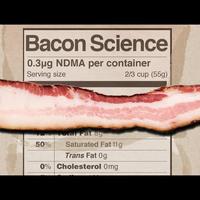
How much Bacon gives you Liver Failure? What about Colon Cancer?
In February 1977, a 42 year old woman was admitted to the hospital with deep jaundice,
shivers and hemolytic anemia - a type of anemia where her red blood cells were being destroyed
faster than her body could make them.
She went on to develop a “hepatic precomatose condition,” - a type of impairment of consciousness
you see in severe liver disease.
The doctors found she had a shrunken liver and an enlarged spleen.
With multiple red blood cell transfusions, the woman recovered, but the cause of this
mysterious liver disease eluded doctors for quite a while.
One day, her husband suddenly brought over some cooked blackberries.
This was a bit odd since he rarely visited her and in fact, hospital staff advised her
not to accept any outside food.
They decided to feed the blackberries to some mice. ...and The mice died.
They sent the blackberries off for analysis and found that they contained about 300milligrams
of the nitrosamine N-Nitrosodimethylamine, NDMA.
The woman's recovery was only temporary.
After discovering the details of her assassination, her mental and physical state progressively
worsened over the following months.
The husband was convicted but unfortunately the woman died.
So what does this have to do with bacon?
Well, Nitrosamines are the cancerous compounds suspected to form from the nitrate and nitrites
found in processed meat.
But the dose the woman was given was 300 milligrams - just how big is that?
We'll get to that in a moment.
"The alarming warning from the World Health Organization's cancer research arm that goes
like this: processed meat causes cancer and red meat probably does too."
In 2015, the IARC declared that processed meat is a carcinogen, a cancer causing agent.
Suspect harmful compounds in processed meat, and analysis of more than 800 observational
studies is what led them to their conclusion.
Billowing Backpacks radioactive man, that's a lot of studies!
However, in the report, all the 127 studies on colorectal cancer, as shown in table 2.2,
used questionnaires as the data collection method.
Actually this type of study, an observational study, is very very common in nutrition research.
The questionnaires usually have a similar format - Here's one from Cambridge University.
Do you happen to know what your average use of bacon was for all of last year?
Then, what these questionnaires have difficulty taking into account is: Do you eat your bacon
like this or like this?
Or like this?
Back in 1994, a study “found” that hot dogs increase brain cancer risk in children.
"They asked the people: did you eat a hot dog?
They didn't ask them: Did you put it in a bun, did you put ketchup on it?
That's important because it may be that it's not the hot dog at all that's causing this
increase risk of cancer, maybe it's the bun, maybe it's the ketchup, maybe it's the mustard
so..."
I thought this newscaster had a decent point - think about the type of people who eat the
most hot dogs - what other foods are they likely to eat more of?
For the record, I'm not here to say processed meat is some great health choice.
I'd say if you're going to eat meat, then make it good quality fresh meat.
But, let's be realistic: is a breakfast of an egg, avocado, and some bacon really
that bad for you?
The main suspect bad compounds put specifically in processed meat are nitrates and nitrites.
During heat processing of the meat, a small portion of the additive sodium nitrite is
suspected to turn into the cancerous nitrosamines like the earlier mentioned NDMA.
But, the acidic nature of our stomach is suspected to allow nitrates and nitrites to turn into
nitrosamines in the body during digestion.
Now, there are some major issues with the nitrate nitrite idea.
First, both compounds are found in vegetables.
This study found that in italians vegetables provided 5.5 times the nitrate and nitrite
of cured meat.
In fact celery juice which has very high concentrations of nitrate, and is used to make the all natural
“no added nitrates or nitrites” processed meat.
In fact, there is a cycle in the body where nitrate is turned into nitrite and nitrite
is turned into nitric oxide then nitric oxide is turned back into nitrate.
Part of this cycle takes place in the mouth, so there is naturally plenty of nitrite in
our saliva.
“...what the hell, you drooled on me!”
OK So in the body, nitrite is reduced to nitric oxide… and Nitric oxide is regarded as essential
for health because your body uses this molecule to relax blood vessels.
This paper refers to both nitrate and nitrite as nitric oxide therapeutics.
As the paper explains, nitrate and nitrite have been shown to be good for blood pressure,
mitochondrial efficiency, exercise performance, and have a therapeutic effect on pulmonary
hypertension.[R]
Which is why, you'll find nitrate supplements like these beet root powder ones designed
to improve blood flow and heart health, reduce blood pressure and improve exercise performance.
Now hold on a minute, because the point is not that you should be scared of bacon and
celery sticks and beet powder . A Chemist and Biochemist who has published relevant
research in several journals like the American Journal of Physiology, Dr. Mark Miller, says
that nitrate and nitrite are not nitrosating species - that is, these molecules cannot
directly form cancer causing nitrosamines, so whether your bacon contains inorganic sodium
nitrite or all natural nitrate from celery juice, it's not getting turned into the
cancerous nitrosamines in your body.
I won't get into the details here, but in the description I'll link to an article
where he clearly lays out the chemistry and biochemistry for this.
Moving on, here's a study where researchers wanted to see how processed meat affected
the development of colon cancer.
They first injected the rats with azoxymethane, a compound known to cause colon cancer.
Surprisingly, they found that not only did a bacon diet not cause cancer, it actually
consistently protected them from the cancer- bacon reduced the number of precancerous lesions
in rats injected with the azoxymethane.
But of course this is just one study, so let's move on.
What about cancerous Nitrosamines already present in bacon, frankfurters or salami thanks
to heat processing.
Nitrosamines are definitely bad for you, that's not in question - in high enough doses they
mess up your liver, and yes, can cause cancer.
But precisely how much can a human tolerate without having any issues?
After all, few people would suspect a half glass of wine a couple days a week to be bad
for you.
"Many studies have shown that drinking a moderate amount of red wine can help the fight against
heart disease, alzheimer's and some cancers."
But, 50 half glasses of wine in one night could cause serious injury to your liver.
The dose is important.
So, we need to use some logic to get an idea of how much nitrosamine a person can tolerate:
This is a table from the IARC report looking at nitrosamines in processed food.
The LD-50 is a measure of toxicity looking at what dose will kill half of the people
given that dose.
Based on the LD50 data, the nitrosamine NDMA appears to be the most toxic.
NDMA - this is the same compound given to the woman mentioned at the start of the video.
300 milligrams of NDMA is the amount she was given in the blackberries - how much processed
meat do you have to eat to get that amount?
Based on the highest value provided in the table from the IARC, 84 micrograms per kilogram
of Frankfurters, you would need to eat 3500 kilograms of frankfurters.
"Thousands of pounds of wieners are produced daily..."
That is more than the weight of a Hummer H2 of frankfurters to get the same dose as the
woman who died from the blackberries.
OK But we don't want to know how much to eat to die, we want to know how to not get
cancer.
This study put various doses of NDMA in the drinking water of over 4000 rats and followed
them over their lifespan, about 2 years.
They found that “since the experiment continued on into extreme old age, effects became measurable
at doses of only 0.01 to 0.02 mg/kg/day,” that is, they only got the cancerous tumors
at .01 mg/kg per day and higher.
Using Anroop Nair's human equivalent dose conversion, we can estimate that a 70kg human
would need a dose of .0013milligrams or 1.3 micrograms per kilogram of NDMA.
So, assuming we can apply this mouse data to humans, you would have to eat more than
1.1 kilograms, which is 2 and a half pounds or 2700 calories of frankfurters a day, for
years, to develop a cancerous tumor at some point probably in the second half of your
life.
That's 80 times the amount of Nitrosamine the average American actually consumes.
To give you some perspective, the LD50 of Oxalate is 25 grams, boiled spinach is about
0.60% oxalate, meaning 4.3kg of boiled spinach, eaten once, has a 50% chance to kill you.
I'm not trying to say Nitrosamines are harmless,The point is, if we're going to point at a substance
in some food as a mechanism for that food being bad, we need to be realistic with the
dose - what is an actually realistic amount of that substance a person can get from food?
There are many other ideas for why processed meat is bad for us that I didn't explore,
but most of these can be applied to red meat in general, so stick around because we'll
take a look at those in my next video.
One more thing, the IARC report concluded that "Each 50 gram portion of processed meat
eaten daily increases the risk of colorectal cancer by 18%."
That doesn't mean people who eat processed meat raise their absolute risk of colon cancer
from zero to an 18% chance.
What that really means is, for example for 100 Australians not eating processed meat,
over their lifetime, 8 will get colorectal cancer.
For 100 Australians eating 3 slices of bacon a day, 9 will get colorectal cancer.
The other thing about this report is, if you're familiar with epidemiology you'd know that
a study with a relative risk under 2 is probably noise and should be thrown out.
More than 2/3rds of the studies on colorectal cancer did not find a relative risk over 2.
Another thing is that these studies don't differentiate between organic prosciutto that
is just pork and salt and cheddar cheese stuffed hot dogs with added corn syrup and soybean
oil.
and once again For the record, I'm not saying we should all eat more processed meat.
Actually I rarely choose to eat processed meat and I think meat quality needs to be
prioritized much more by those who can afford it.
I just wish points for or against foods were more realistic.
"This program was made possible by the generous donations from my Patreon patrons and, viewers
like you."