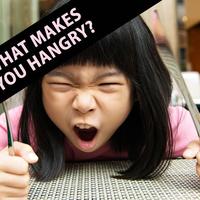
Talk about the word 'hangry' in 6 minutes - YouTube
Neil: Hello. I'm Neil.
Dan: Hello. I'm Dan. Neil, aren't you going
to say the 'welcome to 6 Minute English' bit?
Neil: Hmmm maybe. How's your mood
today, Dan? Feeling happy?
Dan: Oh yes, very happy. I've just had
lunch. What about you?
Neil: Well, to be honest, I haven't had the
chance to eat yet and it's making me a bit
grumpy.
Dan: Why haven't you eaten?
Neil: Well, I was doing some research for
today's topic which is all about feeling
angry when you are hungry. You know
what I'm talking about?
Dan: Oh yes, we're talking about being
‘hangry'. It's quite a new word, isn't it?
A combination
of hungry and angry.
Neil: Yes, hangry is our topic. But before
we learn more about it, here's today's
quiz. English has quite a few words which
are made by joining two
different words together
like ‘hangry', for example: brunch, motel,
Brexit. What do we call these words? Are they…
a) Suitcase words
b) Portmanteau words, or
c) Backpack words
Dan: Well, I think I know this one, so I'll
keep the answer to myself - don't want to
give away any spoilers. What I do want to
know is if hanger is a real thing – or is
it just something that's been made up by
grumpy people, like you?
Neil: Let's hear from Sophie Medlin, who
is a lecturer in nutrition and dietetics at
King's College London. Is hangar a real
thing and where does the word come from?
Sophie Medlin: We've long recognised
that hunger leads to irritability - in science.
But the wonderful world of social media
has merged the two words for us
and now we know
it as hanger.
Neil: So, is hangar a real thing and where
does she say the word comes from?
Dan: According to Medlin it is a real thing.
She says that science has recognised that
hunger leads to irritability. Irritability
is a noun which means being easily annoyed,
not in a good mood.
Neil: And she says that it was the
wonderful world of social media that
joined the two
words together. She used the verb merge.
Merge, meaning join together.
Dan: I know social media is responsible
for many things, but the word hangry actually
appeared in the 1990s – so a little before
the arrival of social media. But it's certainly
true that social media has made it more prominent.
Neil: Me, right now, hashtag hangry!
Let's listen to that clip again.
Sophie Medlin: We've long recognised
that hunger leads to irritability - in science.
But the wonderful world of social media
has merged the two words for us and
now we know it as hanger.
Neil: So now we know that hangar is a
real thing, let's learn a bit more about it.
Why does it happen? Why do we get
angry when we are hungry?
Here's Sophie Medlin again.
Sophie Medlin: As the blood sugars drop,
we increase our cortisol and adrenalin – so
our kind of fight or flight hormones – and
those have an impact on our brain and the
neuropeptides – the things that control
our brain, the chemicals in our brain, the
ones the trigger for hunger are the same
ones that trigger for anger and also for rage and
impulsive type behaviours. So that's why
you get that sort of same response.
Neil: So it's all to do with blood sugar,
isn't it?
Dan: Yes, it seems so. When we are
hungry the level of sugar in our
blood is lower and
this causes an increase in particular
hormones. Hormones are the
chemicals we make in our
bodies that control certain biological
and psychological functions.
Neil: The hormones released when we are
hungry are the same as our
fight or flight hormones.
They are the hormones that the body
uses to prepare us to either
fight or run away from
a dangerous situation.
Dan: When these hormones are
increased, it can cause anger and rage.
Rage is another
word for being very angry.
Neil: And when we are angry we can
behave impulsively. Impulsive
behaviour is when we
do things without thinking, without
considering the consequences.
Dan: So when we are hungry, the same
emotions can run through us.
We can be angry and make
poor decisions. And that is hanger.
Neil: Which brings us nicely to our quiz
question. What do we call words, like
hanger, that are
made by joining two different words
together? Now you said you knew the
answer Dan?
Dan: I did!
Neil: What was it?
Dan: Portmanteau words.
Neil: And you are absolutely correct.
The answer is portmanteau words.
Congratulations if you knew that.
Dan: I did.
Neil: Alright then smarty pants. No need
to boast!
Dan: I can see that you're
still a bit hangry Neil.
Neil: Yes, I'm hungry and that is making
me angry! But I think I can hold on to get
through a review of the rest
of today's vocabulary.
Dan: Well, we also had the noun irritability,
meaning getting annoyed very easily, just
like…
Neil: Don't, just don't. Or I might just
merge my fist with your face.
Dan: Ouch. Yes, merge meaning join
different things together. I can see your
fight or flight
hormones are kicking in. Those
chemicals in the body that prepare us
for aggression or escape.
Neil: I haven't quite reached rage yet.
This was another of our words, rage,
and it means a state of being
very, very angry.
Dan: Our last word was impulsive.
This is an adjective to describe
when we do things
without really thinking about them.
We just do them without any control and
without thinking
about the consequences.
Neil: Now I'm off, I'm starving.
I've got to eat before I do
something impulsive.
That is it for this programme.
For more, find us on Facebook, Twitter,
Instagram and our
YouTube pages, and of course our
website bbclearningenglish.com,
where you can find all kinds
of other programmes
and videos and activities
to help you improve your English.
Thank you for joining us and
goodbye.
Dan: Bye!
