What can you do about an opponent who hits passing shots over and over? (Part 2)
Secondly, I recommend that most of the time you come into the net after hitting a down the line approach shot. And this is so that you can most easily cover the court and cover the angels on the court. When you hit the ball down the line, you are in a better position automatically to cover the possible angels. If you hit cross court, you leave open a lot of court down the line for your opponent to hit a passing shot.
Now this is not an ironclad law and you don't always have to approach down the line. Sometimes down the middle can be successful. Sometimes even cross court can be successful. But in general, I would go down the list in that order of success. Possible success. Down the line down the middle cross court. Cross court–unless you hit a really good shot–is going to really open up a lot of court for your opponent to pass you.
This is kind of difficult to describe with words via audio. I'm actually getting ready to put up a video at essentialtennis.com/video that really demonstrates this. When you really see the court it's easy to kind of understand this. But I'm just kind of leave it that for now and just make you aware and make sure that you're aware Dropshot and the rest of my listeners that down the line is usually the way to go in singles when you're approaching the net. So when it comes to quality of shot those are the two important criteria: deep and down the line. Now, once you've hit your deep down the line approach shot and you're pressuring your opponent with this shot, make sure that you position yourself on the side of the court that you hit the ball. And so if you hit a forehand approach shot on the do side, it was a short forehand you were over on the right side of the court if you're right handed. And you direct that deep down the line right in front of you to the right. From your prospective. You want to position yourself a little bit to the right of the central line, and this because it's going to be much easier for your opponent as around the run to get to your approach. It's going to be much easier for them to hit the ball straight than it is to catch the ball early and hit a big angle. Now you describe your opponent here being able to hit these big sharp angles. And we're going to talk just a little bit later about what to do about that. But you should be usually covering down the line first and positioning yourself in front of wherever you hit your approach shot.
So if your approach to the left, you should be a little bit on the left side of the court. If you approach to the right, you should be a little bit to the right side of the court. This is called ‘ shading. ‘ And basically the rule of thumb is that you should be following the ball. What ever direction you hit your approach shot to, that's should direction you should be moving as you position yourself. Alright, so that's my #1 piece of advise for you Dropshot, is to come forward on a quality shot and position yourself correctly. If you do those two things then the amount of times that you get past should drop quite a bit. I'd be willing to bet that a lot of these passing shots that are being hit on you are the result of not challenging your opponent very much, and not putting yourself on the right spot. Now I have three other pieces of advise here for you. First of all, make sure that when they do hit a good passing shot, you're stepping across your body for the most amount of reach. Like a launch that you suggested earlier in your question.
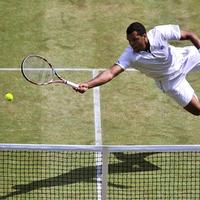
So if you're right handed and you are stretching out to your right to try to get a ball that has been hit well and you're going to have a hard time reaching it, you should be stepping with your left foot. This is very important. If it's a backhand and you're moving to your left, you should be stepping across with your right foot. This is going to give you the most amount of reach as you step across your body and into a lunge type position like you were talking about.
So make sure that you were doing that and you're not stepping with your out side foot. Your right foot for a forehand and your left foot for a backhand. That's going to limit your amount of reach quite a bit. Secondly, pay close attention to the tendencies of your opponents and anticipate. Just about everybody you play is going to have a preference. When you hit to their forehand side they are going to usually like a certain type of passing, whether be down the line or cross courts or hard and flat or top spin or maybe they like to lob. When you hit to their forehand or backhand, they will have tendencies as far as what they like to try it first. They are going to have probably a favorite shot or maybe two favorite shots that they like to try to hit when you do come forward to the net. It's your job to pay attention to these. And Dropshot you should not get beaten by the same shot again and again and again. If you approach on a quality approach shot and you position yourself correctly and you get beat cross court with a sharp high quality angle, you need to put that in your mental log book. If you do it again: approach to the same spot again with the quality of approach and you position yourself correctly and they pass you again with the same shot, OK. At this point after they've done it a hand full of times successfully. At that point you need to start altering your strategy and either approaching to a different place or approach to the same place and anticipating where they are going to go. And you need to change your position on the court accordingly. Do not continue to do the same thing and get beat by the same shot again and again.
And this obviously sounds really fundamental and it sounds very obvious. I guess you'll have to point this out. But this is where matches are win and lost and the patterns of good shots being hit, and one player or the other not making any adjustments. So make sure that you're paying close attention to your opponent. You're watching their tendencies. And then start to anticipate them and make adjustments accordingly.
Now last piece of advise here for you Dropshot. Being in better shape and being stronger can always help. So I'm not going to tell you, ‘No don't work out. Don't get in better shape. Don't get your legs stronger.' No, I'm not going to tell you that obviously. I mean all those things cab definitely help you. But I just want to point out the several tactical advantages you can have and also the placements of your shots in your technique. I gave you some shots to work on: hitting deep and down the line of a short ball. Doing exercises and getting your body strong can definitely help, but compared to everything else that I talked to you about it's probably going to be the least important part of covering the passing shot correctly. And covering it effectively.
So Dropshot, hopefully that answers your question. If you'd like me to go into any more depth to any of these topics individually, definitely let me know. And yes, I mean you're obviously not as fast as you were when you were 20 years old. That's just how the body works, but if you're smart out there and you know what to look for and you know where to place your approach and where to place yourself. You should definitely be more successful. So good luck with this. Please let me know if you have any more questions, and I'd be happy to help out.
