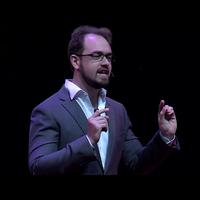
Why We Struggle Learning Languages | Gabriel Wyner | TEDxNewBedford (2)
But instead of using translations on those flashcards,
I began with pictures.
If I wanted to learn the French word for dog, chien,
then I would search on Google Images for chien,
and I would find that French bloggers didn't choose the dogs I would expect.
Their dogs were smaller and cuter and, somehow, more French.
(Laughter)
And so, I used these dogs to learn chien
and built a vocabulary
out of these pictures from French bloggers.
And as I built that vocabulary, I graduated over to sentences.
And I started learning abstract words and grammar that way,
using fill-in-the-blank sentences.
If I wanted to learn a word, like, went is the past tense of to go,
I would use a story.
Yesterday, I blank to school - with a picture of a schoolhouse.
And so, I learned my abstract grammar in that way.
And then, three months later, I had that interview.
And I found myself in this room with this French person,
who began our conversation with "Bonjour."
And then, the first thing that came to my mind was,
"Bonjour."
And she started speaking to me in French,
and I realized I understood what she was saying,
and what's more, I knew what to say back.
And it wasn't fluent; it was a bit stunted,
but this was the first time I had spoken French in my life,
and I was speaking in French, and I was thinking in French,
and we had a 15-minute conversation,
and at the end of this conversation, the teacher tells me,
"You know, there something wrong with your placement test.
It says you should be in the intermediate level,
but we're placing you in the advanced level."
And so, over the next seven weeks,
I read 10 books, I wrote 70 pages of essays,
and by the end of that summer, I was fully fluent in French.
And I realized that I had found something important.
And so I started writing about it and creating computerized tools around it
and tinkering.
In 2012, I learned Russian.
I had my revenge on that language.
In 2013 through 2015, I learned Hungarian.
In 2015, I started Japanese, then stopped, learned Spanish,
came back, and started Japanese again because Japanese is endless.
In each of these experiences, I learned a lot.
I learned ways of tweaking the system to find efficiency boosts here and there,
but the overall concept has always remained exactly the same.
If you want to learn a language efficiently,
then you need to give that language life.
Every word needs to connect to sounds and images
and scents and tastes and emotions.
Every bit of grammar can't be some kind of abstract grammatical code;
it needs to be something that can help you tell your story.
And if you do this,
you will find that the words begin to stick in your mind,
and the grammar, it begins to stick too.
And you start to realize
that you don't need some kind of language gene,
some gift from God to accomplish this.
This is something that everyone
has both the time and the ability to do.
Thank you.
(Applause)
