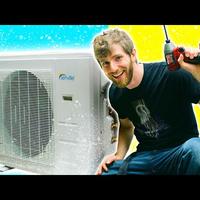
This was MUCH harder than I expected... DIY Air Conditioning Pt 1 (1)
- The unit's finally here
for my DIY, home air conditioning, on the cheap and,
I made some mistakes.
Not once, but twice.
I actually ordered completely the wrong kit.
My warehouse staff was extremely disappoint.
And so unfortunately, I only have the outdoor unit today.
But that's okay because there's still plenty that I can do.
I can run coolant lines up the house.
I can run a big fat, tech cable to get power
to the outdoor unit from my panel.
And if all of this sounds like something that I'm gonna have
one heck of a time doing unassisted, you're right.
In fact, I wasn't even moving this box on my own.
(laughs)
The one and only, Brian the electrician is here to help.
And help is what I need.
♪ Brian the electrician ♪
♪ He's electrifying and helpful ♪
♪ Such a helpful man ♪
- And do you know what else I need?
To tell you guys about Ruggable.
Protect your floors from your computer chair with Ruggable.
Ruggable rugs are machine washable and they'll stay in place
with their non-slip pads.
Use code linus10, to get 10% off your order,
at the link below.
(upbeat music)
All right, so by three o'clock it's a 43% chance of rain
and by four o'clock, that goes up to 69%, nice.
Not nice.
What that means is, we should probably focus on
the outdoor stuff first.
- Yeah.
- Okay, the tape measuring competition with the like,
having more tools than me thing,
has gotten outta hand here.
(laughs)
You don't have to pull up with a whole truck of tools.
What are we gonna need here?
This is some armor for where the cables are gonna
come down the wall, I guess.
- Yeah.
- Wow, what's that, like eight gauge?
- [Brian] Yeah.
- Dang!
Whoa, that one's heavy.
It's a good thing you didn't throw this at my chest.
(laughs)
Oh man, now we've got armor plus eight gauge.
Oh wait, that one's not that heavy.
Is this not eight gauge?
- No it's eight gauge, it's just a lot shorter length.
- I see that.
What do we need this for?
- Strapping on the outside.
- Really?
My wife is gonna have a fit when she sees this
running up the outside of the house.
- No, no, 'cause everything's gonna be running up,
you just put this across, then we'll only do two screws
through your siding, instead of multiple straps.
Everything straps to this.
- Okay.
This right here, so this is our suction and
what's this one called?
- That's the suction of the low pressure,
that's your discharger of your high pressure.
- Got it, okay.
So this is just in case the kit,
which does include a 25 feet of each, per ceiling unit.
It's just in case the kit doesn't include enough,
which it doesn't.
I get the feeling that this kit is designed more for like
a single storey rancher style installation.
But because we're going all the way up the wall
and we're actually going quite deep into the house,
we're definitely gonna need some extra.
And how much did all of this cabling cost?
- About 800 for the materials.
- 800 bucks.
- [Brian] Yeah.
- Wow, okay.
Compared to what I was quoted for air conditioning.
- Yeah.
which was 25 grand plus.
We're doing real well.
- Yeah.
- Because the entire setup for the, like the kit.
- Yeah.
- Was 2800 US dollars.
- Yeah.
- So plus another 800 Canadian rubles.
- Yeah, yeah exactly.
- I'm still at like four grand, Canadian.
Which is, like a quarter of the price.
Even after I paid a filming crew to be here and like,
watch us do it.
- Yeah.
- And I'm assuming I should probably pay you as well.
(laughs)
Not bad.
While I've been waiting for the air conditioner to arrive
and while Brian's been prepping materials,
I have been getting my attic ready.
So one of the other issues with my house
is that my insulation was about 35 years old.
And never particularly amazing.
You can see there's actually a little bit of it left here.
And it's basically just like, kind of
roped onto this skylight.
Lots of gaps in it.
Anywhere you have a gap in your insulation is an opportunity
to lose a lot of heat in the winter
and have a lot of heat come in, in the summer.
So we actually had all of the insulation in the attic
removed in preparation for this project.
So I've been running ethernet runs,
putting in new security cameras.
Doing all the stuff that is really easy to do
while you've got things removed and really hard to do,
once it's back in here.
Over on this side, is where the lines are gonna come in.
And then we're gonna have two ceiling units here and here
for the two bedrooms that are combined into one.
But that we may put back together some day.
We're gonna have one that comes clear across the ceiling
to right under where Andy's standing there.
And then we actually need one more, way over here.
You're not gonna be able to follow me over here
but I'm going to go over into the front attic,
where the office is.
So that's where the computer room and stuff like that is.
One of the most important things that I did for prep,
was get lighting installed in my attic.
It used to be, that there was just one little like,
desktop lamp that hung off of this two by four.
And then was plugged into an outlet right here.
Instead, now we've actually got four light sockets up here,
so we can actually see what we're doing.
Now, you were concerned about the overall capacity
of this panel.
'Cause it's only a 100 amp service.
- [Brian] Yes.
- You're allowed to use what, 80% of it?
- Yeah, you have baseboards upstairs that
this will not only function as an air conditioner
but it will also work as a heat pump.
- Okay.
- So, yeah, baseboards upstairs we can disconnect,
that you don't need anymore.
And, then you were also talking about going to a gas range.
- Conveniently, the electric baseboards are already
a 240 volt circuit.
So that means, it's as simple as, I mean,
should we put in, like a switch, to switch between them?
Or like, what's the plan?
- As long as they're disconnected,
there's no way they can come on and you know,
be a load right?
- So what are we looking at here?
- So, well, we need to figure out which breaker
is for your upstairs baseboards.
- Aha.
I spent an entire evening mapping out this panel.
Because the labels that were on it before are terrible.
Also part of the original plan that I laid out
on the land show, when I first found out about these things,
was putting the outdoor units, so this is the condenser,
in the eave's of my house.
So actually I had intended, instead of using a four-way,
like a one to four, mini split system,
I had intended to use just one to one,
smaller outdoor and indoor units.
And just like, mount them in the soffits of my house.
Brian informed me that it was really stupid, that plan.
(laughs)
He's being really nice right now and keeping his mouth shut.
- It's all I can really do, sometimes.
(laughs)
- I have to be nice to you, I'm still relying on you to
actually hook it up right and not, you know.
(laughs)
Make my house burn down.
It was really nice of the contractor who came
and put this in, to do it.
Everyone else we called was like, are you for real?
That is the smallest, stupidest job ever, I'm not doing it.
They just kinda, kept putting one little concrete pad here.
But yeah, a couple hundred bucks,
so we'll add that to the tally for the whole project.
- Yeah.
That's not bad really.
- Perfect.
- Yeah.
- So now what?
- Well, now we get the lines that came with this thing,
see how wide they are and how much room we're gonna need
to run up the wall.
And we can start cutting pieces to mount to the wall
and strap everything.
- Okay.
- All the refrigerant lines come in, down on this side.
For each cassette unit, there's going to be open discharge
in the suction line.
The discharge is small and the suction line's bigger.
So everything ties in here.
It will be four separate pairs running up the wall.
Each unit also gets a power run from this.
- Oh wow, that's 12 things running up the wall.
And then we also need the tech cable to bring power to this.
- Yeah.
- That's lucky 13 things, running up the wall.
- Considering how getting everything here has gone for you,
13 seems appropriate.
- Okay, here we go.
So this is the accessory kit
for the cassettes that we're still waiting for.
A cassette is the terminology for the in-ceiling mounted
cold side units that are gonna go in each room.
Compared to, I forget what the wall mounted ones are called.
But I really don't like those.
I think they look like a big wart
and so I wanted to go with the in-ceiling ones.
Which is why I did that second exchange.
- Okay, so it does look like this is what I thought it was.
The ends of the valves here, this is just a cover nut,
that comes off.
And then, you use an allen wrench on the valve underneath
and that's what actually opens and closes them.
- I noticed that A down here.
- Yeah.
- Has a fatter suction, than B, C and D.
- [Brian] Interesting.
- [Linus] Any reason why that might be?
- I'm presuming, kinda from what I've seen in here,
it looks like, if you have more than one of these,
you can actually link them together to increase capacity.
And you can only link them through the A set.
- All right.
We're gonna do 15 inch wide straps up the house,
that gives us two inches each for the suction and discharge.
An inch for the tech cable and then another inch
for this bundle, that's gonna go from the outdoor unit
to the four indoor units.
We're gonna have four of these.
Oh hold on, I gotta fix my ladder carrying form
before you roll on this Andy.
All right.
There we go, oh yeah.
Moving a ladder like a pro now.
Here we go, yeah, yeah, very funny, smart guy.
(laughs)
Well this is quite the invention.
This is the, Brian the electrician, cutting table.
Okay.
- So, actually grab a file out of the truck,
so we can clean up the burs.
- Okay, I'm assuming that's gonna be a me job.
It's kind of an assistant sounding job.
Deburring the cuts.
I'm not even pouty that I'm getting the (beep) tasks now.
I'm gonna have air conditioning when we're done.
- By code, you have to have a disconnect close to these.
Literally, you just pull that out to disconnect.
- Okay, cool story bro.
- There's rubber feet for this thing too, it looks like.
- Oh, okay, neat.
I guess we should put those on or, does it matter?
Oh yeah I guess, for vibration it might be nice to have.
- Yeah.
- Okay, sure, why don't we just put those on
now then, I guess.
- Then they're there.
- Then they're there.
Yep, that's 18 exactly.
And that's 18 exactly, hashtag nailed it, okay.
What's this?
- Duct seal.
- This is duct seal.
Oh, it's gotta be the same stuff then.
- Same idea.
- Yeah. Okay.
Asbestos free.
Wonderful, I didn't wanna pay for asbestos.
What can I do?
That would be useful.
- Screws, washes and then.
- Put those on the wall.
- Pretty much.
- Why don't I climb to the top and get a piece of string
and put a weight on it and hang it on the wall.
- That would be magic.
- Okay, so where do you want it?
- I'm thinking, kinda here, about.
