

How to Learn Icelandic: A Complete Beginner’s Guide
 Tyler Tolman
30 Jun 2026
Tyler Tolman
30 Jun 2026
Icelandic is famously conservative. Due to the island’s geographic isolation, strong literary tradition, and commitment to linguistic purism, the language has not changed much since the 9th century.
What’s the result? Well, a modern English speaker would likely struggle to read Beowulf in the original Old English. Spaniards still stumble on 17th-century words and syntax found in Don Quixote. An Icelander, however, should have no issue reading medieval Viking Sagas.
With only around 370,000 native speakers worldwide, Icelandic is a less commonly learned language. While some might be dissuaded by the small pool of speakers, curious language learners see Icelandic as an opportunity. Icelandic is a niche, highly respected skill that instantly connects you to a proud community and one of the world’s oldest living literary traditions.
If you want to discover how to learn Icelandic without losing yourself in lists and charts, this guide will provide a roadmap rooted in your personal interests and comprehensible input.
Is Icelandic Hard to Learn?
To put it briefly, yes. For a native English speaker, Icelandic is difficult. According to the US Foreign Service Institute (FSI), Icelandic is classified as a Category IV language. This means there are significant linguistic and cultural differences between English and Icelandic. Icelandic requires roughly 1,100 hours of classroom study to reach professional proficiency.
Why is Icelandic more difficult than other Scandinavian languages? It comes down to two fascinating structural features:
- Preserved Old Norse Grammar: While sister languages like Swedish and Norwegian gradually simplified over the centuries, Icelandic retained its grammatical complexity. It features three grammatical genders, four noun cases (nominative, accusative, dative, and genitive), and a robust verb conjugation system.
- The Linguistic Purism Policy: Iceland purposefully doesn’t borrow words from English or French. Even when modern technology creates a new concept, new Icelandic words are constructed using ancient Old Norse roots. For example, the word for computer is tölva, a hybrid of tala (number) and völva (prophetess). The word for helicopter is þyrla (whirler).
While this sounds intimidating, it makes for a more cohesive language. Icelandic vocabulary relies on a finite set of historical roots rather than random Latin or Greek borrowings.
First Steps: Say Hello in Icelandic
If you’re an absolute beginner, dabble. Explore some basic phrases, familiarize yourself with the sounds, and focus merely on building a baseline familiarity with the language. Let’s start by looking at a few survival phrases in Icelandic.
| English | Icelandic | Pronunciation Hint |
| Hello (General) | Halló | hah-loh |
| Good Day | Góðan daginn | goh-than die-yin |
| Hi (To a man / woman) | Sæll / Sæl | sight-l / sight |
| Thank you | Takk | tahk |
| Goodbye | Bless | blehs |
Pronunciation Alert: Notice that “ð” (Eth) makes a soft “th” sound like the word then. The double “ll” in words like sæll creates a unique click sound, resembling a soft “t-l”. Don’t worry about perfecting this immediately. Pronunciation improves over time via continuous repetition and exposure.
The 4-Step Guide on How to Learn Icelandic
Traditional language instruction emphasizes declension tables from the very beginning. This method kills motivation and treats language learning like a mathematical puzzle. Instead, use an immersion-based approach to naturally acquire the language of Iceland.
1. Build a Foundation with Mini Stories
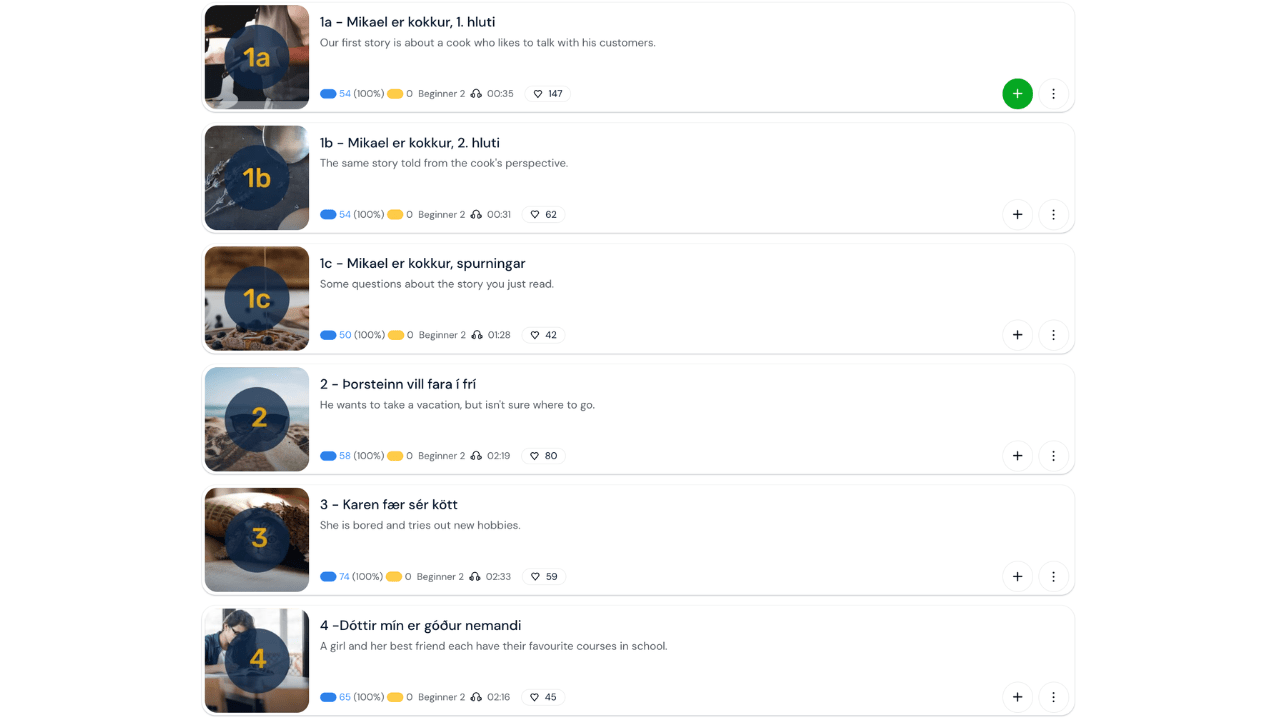
You can immerse yourself in Icelandic as a beginner. However, prioritize novice-level texts. If a text is short and simple, it’s more repeatable. Repetition is especially valuable for beginners. It boosts confidence and constantly reinforces knowledge.
A phenomenal resource for this stage is the LingQ Icelandic Mini Stories. These stories are specifically designed for beginners, featuring high-frequency vocabulary, essential sentence structures, and deliberate structural repetition. Furthermore, each story comes with audio read by a native speaker, enabling you to build your listening and reading comprehension simultaneously.
2. Focus on Word Recognition, Not Case Drilling
Treat grammar lightly at the beginning. When reading or listening, focus on meaning. Don’t constantly interrupt your learning to identify the genitive plural ending of a feminine noun.
This is exactly the kind of friction LingQ is built to remove. Instead of stopping to parse why hestur (horse) became hesti or hests, you tap the word, see the translation in context, and keep moving. LingQ saves that word automatically, so the next time it shows up, you’re not starting from zero. Your immediate goal is simply to recognize words in context, and the tap-to-translate flow lets you do that without ever opening a grammar reference.
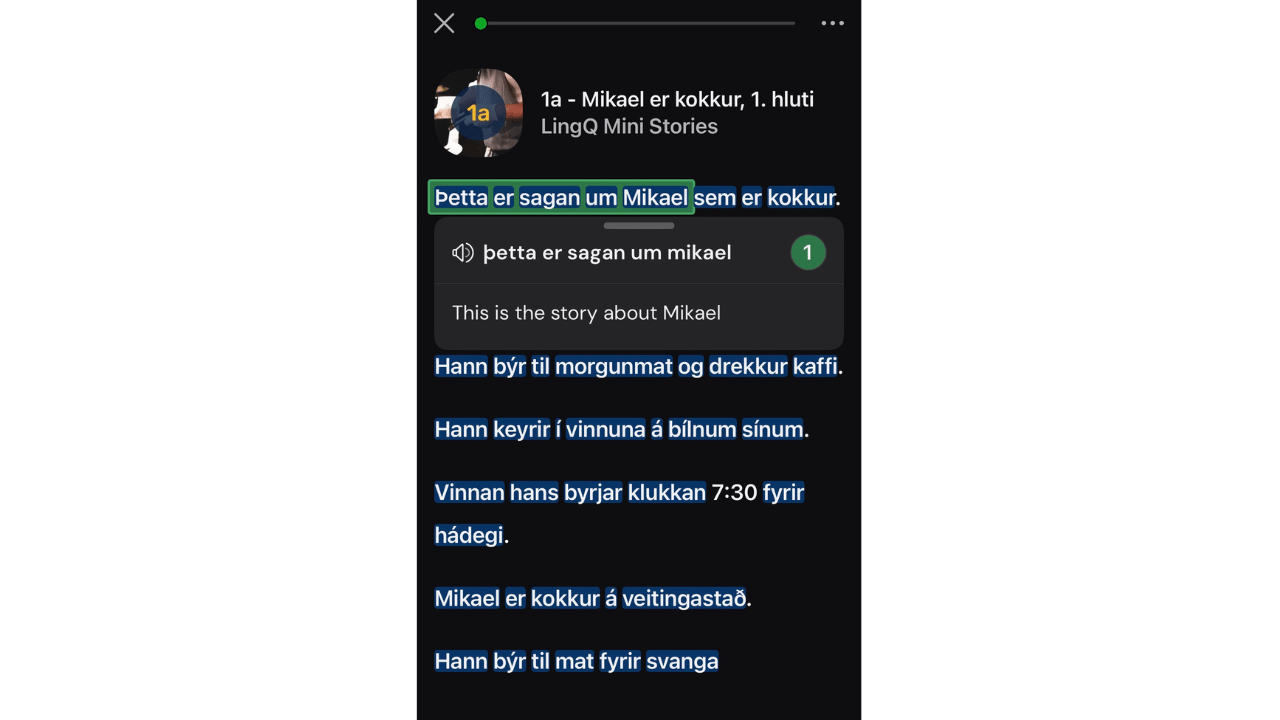
Especially as a beginner, use context clues to realize a changed word still relates to the same idea, and move on. Once you become more familiar with the language, these case changes will seem less arbitrary and confusing. You’ll eventually build a sense of intuition for which endings “sound right,” and you’ll get there faster by reading through it than by studying around it.
3. Transition to More Challenging and Engaging Content
Again, your Icelandic studies consist mostly of reading and listening. As you progress, you can reduce the emphasis on repetition and start to introduce more topical variety. Stronger listening and reading comprehension enable you to pursue more interesting content.
This is where LingQ’s browser extension becomes useful. Any Icelandic content you find, a podcast transcript, a YouTube video, an article, a short story, can be imported directly into LingQ and turned into a lesson with the same word-tap lookup and tracking you used from day one. You’re not switching tools as you progress. You’re just feeding more advanced material into the same system.
Examples of Content for Intermediate Learners
- Icelandic Immersion — a podcast featuring unfiltered Icelandic at a comprehensible rhythm. Import the transcript into LingQ to read along while you listen.
- Short Stories in Icelandic — build up your reading stamina with material from polyglot Olly Richards.
- SpeakViking — a YouTube channel covering Iceland, Icelandic, and various cultural topics. Import any episode into LingQ to study the dialogue directly.
Examples of Content for Advanced Learners
- RÚV — explore the world of Icelandic national television. Transcripts and clips can be imported into LingQ for full lookup support.
- Icelandic Literature — you’re past reading material for language learners. Explore authentic texts, and import excerpts into LingQ if you want translation support without losing the reading flow.
- italki — meet with an Icelandic tutor to develop your spoken fluency.
Stay consistent, find Icelandic content that interests you, and gradually increase the difficulty. The ultimate goal is to consume native-level Icelandic content, and LingQ is what makes that content usable at every stage rather than just aspirational.
4. Track Your Progress as You Go
By this point you’re not using a separate set of tools for beginner content and advanced content. You’ve been using LingQ from the first Mini Story through your first native Icelandic podcast, which means your vocabulary growth has been tracked the entire time.
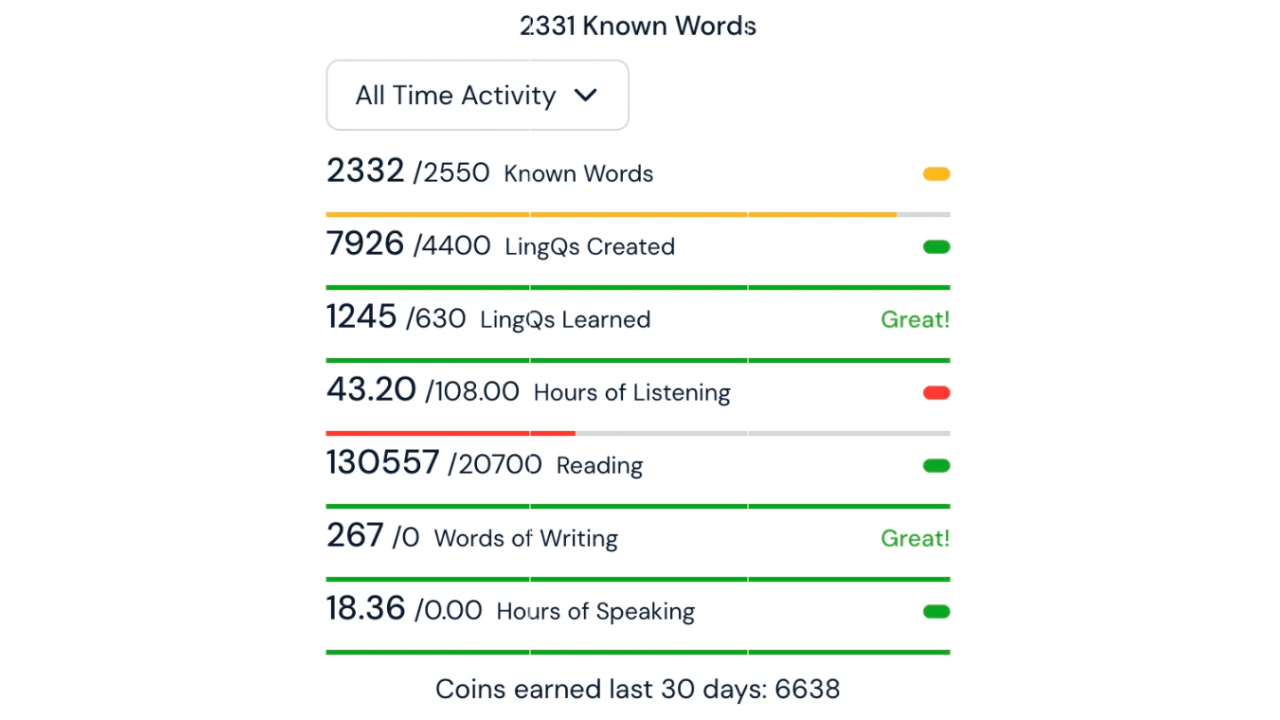
LingQ shows you your known word count, time spent reading and listening, and how much of any new piece of content you’ll already understand before you start. That last part matters more as you move into harder material: instead of guessing whether a podcast or article is within reach, you can see it before committing the time.
This is the same approach LingQ users have used to reach fluency in languages with far smaller learning communities than Icelandic. The method does not change with the language. What changes is the content you feed into it.
Ready to start your Icelandic adventure? Explore the LingQ library and start learning Icelandic online today.
FAQs
Icelandic grammar shares structural similarities with German (four cases, three genders), but its lack of international loanwords makes it slightly more challenging. However, unlike Russian, it uses a familiar Latin-based script.
Yes, the vast majority of Icelanders speak English well. However, relying entirely on English keeps you in a tourist bubble. Attempting to learn the language opens up deeper cultural appreciation, respect, and insight into local traditions.
With consistent, daily exposure (around an hour per day), you can expect to navigate basic daily routines, order food, and understand straightforward news broadcasts within 6 to 12 months.
Final Thoughts: Enjoy the Journey
Learning Icelandic serves as a portal into a rugged, beautiful world of volcanic landscapes, ancient folk tales, and unparalleled literary history.
Be patient with yourself, embrace the initial confusion, and focus on enjoying the content you consume. Your brain is built to recognize patterns and determine what sounds natural. You just need to give it consistent time and exposure.
Ready to start your Icelandic adventure? Explore the LingQ library and start learning Icelandic online today!
If you enjoyed this breakdown of Icelandic, you might also like our tips on how to learn a language fast.
Writer Bio

Tyler is an American language teacher and language learner. He’s taught Spanish, French and Latin in the K-12 system since 2018. Tyler also speaks Thai and Italian. Currently, he’s learning German and Polish on LingQ!
Twenty minutes a day beats a weekend of drilling.
Read and listen to things you’d have read anyway — LingQ counts every word you pick up along the way.
- 5M+ learners
- 4.7★
- Free to start

