
French Conjugation: A Simple Guide to Every Tense
 Tyler Tolman
22 Jun 2026
Tyler Tolman
22 Jun 2026
French has 21 tenses. You need to actively use about eight. Four of those carry most of what you’ll ever say out loud.
TL;DR
French conjugations can feel overwhelming, but it doesn’t have to be. For example, there are 21 tenses, but in practice you only need to actively use about eight. Four tenses carry most everyday spoken French. This guide walks through every essential tense with conjugation tables, the most useful irregular verbs, and tips to acquire all of this information through reading and listening rather than memorization.
The Rundown
Conjugation is the process of changing a verb to match its subject (je, tu, il, nous, vous, ils) and tense. Regular French verbs follow predictable patterns based on their ending (-er, –ir, or –re). Irregular verbs (être, avoir, aller, faire, and about 15 others) don’t follow the patterns and require more attention. Most spoken French uses just four tenses: present, passé composé, imparfait, and futur proche. The rest are useful but less frequent in everyday French.
Why French Conjugations Feel Overwhelming (And Why It Isn’t)
French has 21 tenses, including ones that almost never appear in real conversation. School textbooks often present all of them and emphasize them equally, which is why learners walk away convinced that the system is impossible to master.
The reality is simpler. Native French speakers, in daily speech, use four tenses for roughly 80% of what they say. Three more cover most of the remaining 20%. The literary tenses (passé simple, passé antérieur, subjonctif imparfait) appear almost exclusively in novels and formal writing. Even then, you can read French confidently without producing these higher register forms.
The challenge is not the number of tenses. It is recognizing them in context and producing the most common ones reliably.

How French Verbs Are Categorized
Every French verb in its infinitive form ends in one of three patterns:
- -er verbs (the largest group, around 90% of all French verbs): parler (to speak), aimer (to love), manger (to eat)
- -ir verbs (the second group, with two subtypes): finir (to finish), choisir (to choose), partir (to leave)
- -re verbs (the smallest regular group): vendre (to sell), attendre (to wait), perdre (to lose)
Verbs that don’t follow these patterns are called irregular. The most common irregular verbs (être, avoir, aller, faire) are also the most frequently used in French, so you’ll see them constantly.
The Three Regular Verb Groups
-er verbs
The -er group is the largest and most predictable. Take the infinitive, drop the -er, and add the endings.
Conjugating parler (to speak) in the present tense:
| Subject | Conjugation | Translation |
|---|---|---|
| je | parle | I speak |
| tu | parles | you speak (informal) |
| il / elle / on | parle | he / she / one speaks |
| nous | parlons | we speak |
| vous | parlez | you speak (formal or plural) |
| ils / elles | parlent | they speak |
Once you know the -er endings (-e, -es, -e, -ons, -ez, -ent), you can conjugate thousands of French verbs in the present tense.
-ir verbs
The -ir group has two patterns. The regular pattern works like this with finir (to finish):
| Subject | Conjugation |
|---|---|
| je | finis |
| tu | finis |
| il / elle / on | finit |
| nous | finissons |
| vous | finissez |
| ils / elles | finissent |
Some -ir verbs (partir, sortir, dormir, sentir) follow a different pattern and are technically irregular, but they pattern together. Use partir (to leave) as the model and you’ll handle that subgroup.
| Subject | Conjugation |
|---|---|
| je | pars |
| tu | pars |
| il / elle / on | part |
| nous | partons |
| vous | partez |
| ils / elles | partent |
-re verbs
The -re group is smaller but still predictable. With vendre (to sell):
| Subject | Conjugation |
|---|---|
| je | vends |
| tu | vends |
| il / elle / on | vend |
| nous | vendons |
| vous | vendez |
| ils / elles | vendent |
Notice the il/elle form has no ending. This is a quirk of -re verbs worth noting early.
The 8 Most Important French Tenses
These are the eight tenses that cover essentially all of spoken and written French. Master these and you can express anything you need to. The rest are nice-to-have for literary reading or more formal contexts.
1. Le présent (present tense)
Purpose: Describes ongoing actions, habits, and general truths. It’s used for both “I speak” and “I am speaking“.
Conjugating parler, finir, and vendre:
| Subject | parler | finir | vendre |
|---|---|---|---|
| je | parle | finis | vends |
| tu | parles | finis | vends |
| il/elle | parle | finit | vend |
| nous | parlons | finissons | vendons |
| vous | parlez | finissez | vendez |
| ils/elles | parlent | finissent | vendent |
Example: Je parle français tous les jours. (I speak French every day.)
2. Le passé composé (compound past)
Purpose: Describes completed actions in the past. This is the most common past tense in spoken French.
Structure: subject + auxiliary verb (avoir or être) + past participle
Most verbs use avoir. A small group (mostly verbs of motion: aller, venir, partir, and a handful of others) and all reflexive verbs use être. When using être, the past participle agrees with the subject in gender and number.
| Subject | parler (with avoir) | aller (with être) |
|---|---|---|
| je | ai parlé | suis allé(e) |
| tu | as parlé | es allé(e) |
| il/elle | a parlé | est allé(e) |
| nous | avons parlé | sommes allé(e)s |
| vous | avez parlé | êtes allé(e)(s) |
| ils/elles | ont parlé | sont allé(e)s |
Example: J’ai parlé avec lui hier. (I spoke with him yesterday.)
3. L’imparfait (imperfect)
Purpose: Describes ongoing or habitual actions in the past, background details, and how things used to be. Equivalent to “I was speaking” or “I used to speak” in English.
Formation: Take the nous form of the present tense, drop the –ons, and add the imparfait endings.
| Subject | parler | finir | vendre |
|---|---|---|---|
| je | parlais | finissais | vendais |
| tu | parlais | finissais | vendais |
| il/elle | parlait | finissait | vendait |
| nous | parlions | finissions | vendions |
| vous | parliez | finissiez | vendiez |
| ils/elles | parlaient | finissaient | vendaient |
An important irregular verb: être uses the stem ét- (j’étais, tu étais, etc.).
Example: Quand j’étais petit, je parlais espagnol à la maison. (When I was little, I spoke Spanish at home.)
4. Le futur proche (near future)
Purpose: Describes actions about to happen soon. Equivalent to “going to” in English.
Structure: present tense of aller + infinitive
| Subject | Conjugation |
|---|---|
| je | vais parler |
| tu | vas parler |
| il/elle | va parler |
| nous | allons parler |
| vous | allez parler |
| ils/elles | vont parler |
This is the easiest future to learn and the one French speakers use most often in casual conversation.
Example: Je vais parler avec lui demain. (I’m going to speak with him tomorrow.)
5. Le futur simple (simple future)
Purpose: Describes actions that will happen, often farther in the future. Used in more formal contexts.
Formation: Take the infinitive (for -er and -ir verbs) and add the futur simple endings. For -re verbs, drop the final -e first.
| Subject | parler | finir | vendre |
|---|---|---|---|
| je | parlerai | finirai | vendrai |
| tu | parleras | finiras | vendras |
| il/elle | parlera | finira | vendra |
| nous | parlerons | finirons | vendrons |
| vous | parlerez | finirez | vendrez |
| ils/elles | parleront | finiront | vendront |
Several common verbs have irregular futur simple stems, but use the same endings (j’irai for aller, je serai for être, j’aurai for avoir, je ferai for faire).
Example: Je parlerai au directeur lundi. (I will speak to the director on Monday.)
6. Le conditionnel (conditional)
Purpose: Describes hypothetical actions (“would speak”) and softens requests politely (“would you like”).
Formation: Use the same stem as with the futur simple, but add imparfait endings.
| Subject | parler | finir | vendre |
|---|---|---|---|
| je | parlerais | finirais | vendrais |
| tu | parlerais | finirais | vendrais |
| il/elle | parlerait | finirait | vendrait |
| nous | parlerions | finirions | vendrions |
| vous | parleriez | finiriez | vendriez |
| ils/elles | parleraient | finiraient | vendraient |
Example: Je voudrais parler avec vous. (I would like to speak with you.) This polite je voudrais is quite a useful construction in French.
7. Le subjonctif (subjunctive)
Purpose: Expresses doubt, emotion, necessity, or possibility, almost always triggered by specific phrases like Il faut que, Je veux que, …bien que.
Formation: Take the ils/elles form of the present tense, drop the -ent, and add the subjunctive endings.
| Subject | parler | finir | vendre |
|---|---|---|---|
| que je | parle | finisse | vende |
| que tu | parles | finisses | vendes |
| qu’il/elle | parle | finisse | vende |
| que nous | parlions | finissions | vendions |
| que vous | parliez | finissiez | vendiez |
| qu’ils/elles | parlent | finissent | vendent |
The subjunctive feels intimidating for English speakers because we don’t recognize an equivalent in our own language. While learning, latch onto the fact that it is often triggered automatically by a set of preceding clauses. Il faut que je parle. (I have to speak.)
Over time, you’ll start to feel which phrases require it and start to build a sense of intuition for its use and effect.
8. L’impératif (imperative)
Purpose: Gives commands or makes suggestions.
Formation: Use the present tense form for the intended subject, but drop the subject pronoun. For -er verbs, the tu form also drops its final -s.
| Subject | parler | finir | vendre |
|---|---|---|---|
| (tu) | parle | finis | vends |
| (nous) | parlons | finissons | vendons |
| (vous) | parlez | finissez | vendez |
Examples: Parle plus fort ! (Speak louder!) Finissons le travail. (Let’s finish the work.) Vendez votre voiture. (Sell your car.)
The 20 Most Essential Irregular French Verbs
These verbs don’t follow the regular patterns, but they’re also frequently used in French, so you’ll see them constantly. For now, familiarize yourself with their present tense forms.
| Infinitive | Meaning | je form | nous form |
|---|---|---|---|
| être | to be | suis | sommes |
| avoir | to have | ai | avons |
| aller | to go | vais | allons |
| faire | to do / to make | fais | faisons |
| dire | to say | dis | disons |
| venir | to come | viens | venons |
| voir | to see | vois | voyons |
| pouvoir | to be able to | peux | pouvons |
| vouloir | to want | veux | voulons |
| savoir | to know (a fact) | sais | savons |
| devoir | to have to | dois | devons |
| prendre | to take | prends | prenons |
| mettre | to put | mets | mettons |
| partir | to leave | pars | partons |
| sortir | to go out | sors | sortons |
| tenir | to hold | tiens | tenons |
| connaître | to know (a person) | connais | connaissons |
| écrire | to write | écris | écrivons |
| lire | to read | lis | lisons |
| boire | to drink | bois | buvons |
These twenty verbs account for a huge portion of everyday French. Once you can recognize and produce them in the present tense, using them more widely becomes easier and logical.
How to Acquire French Conjugations
Memorization can only get you so far. You can memorize every table in this guide and still struggle to produce the right conjugation in real conversation. Knowing the rules is not the same as fluency.
Linguist Stephen Krashen’s research on second language acquisition consistently shows that learners absorb grammar most effectively through extensive exposure to comprehensible input. In other words, we acquire language through reading and listening to content that is mostly understandable. Regarding French conjugations specifically, learners should encounter verbs in real contexts hundreds of times rather than drilling charts.
Here’s a handful of ideas for learners prioritizing French conjugations:
- Familiarize yourself with the top 20 irregular verbs in their present tense forms. Create flashcards with real sentences, review examples, and read/listen to short stories (such as LingQ’s French Mini Stories) that emphasize high-frequency vocabulary.
- Read and listen to French content: podcasts, articles, dialogues, novels, YouTube videos, whatever holds your interest. At first, just focus on comprehension. Afterwards, look for contextualized examples of specific tenses.
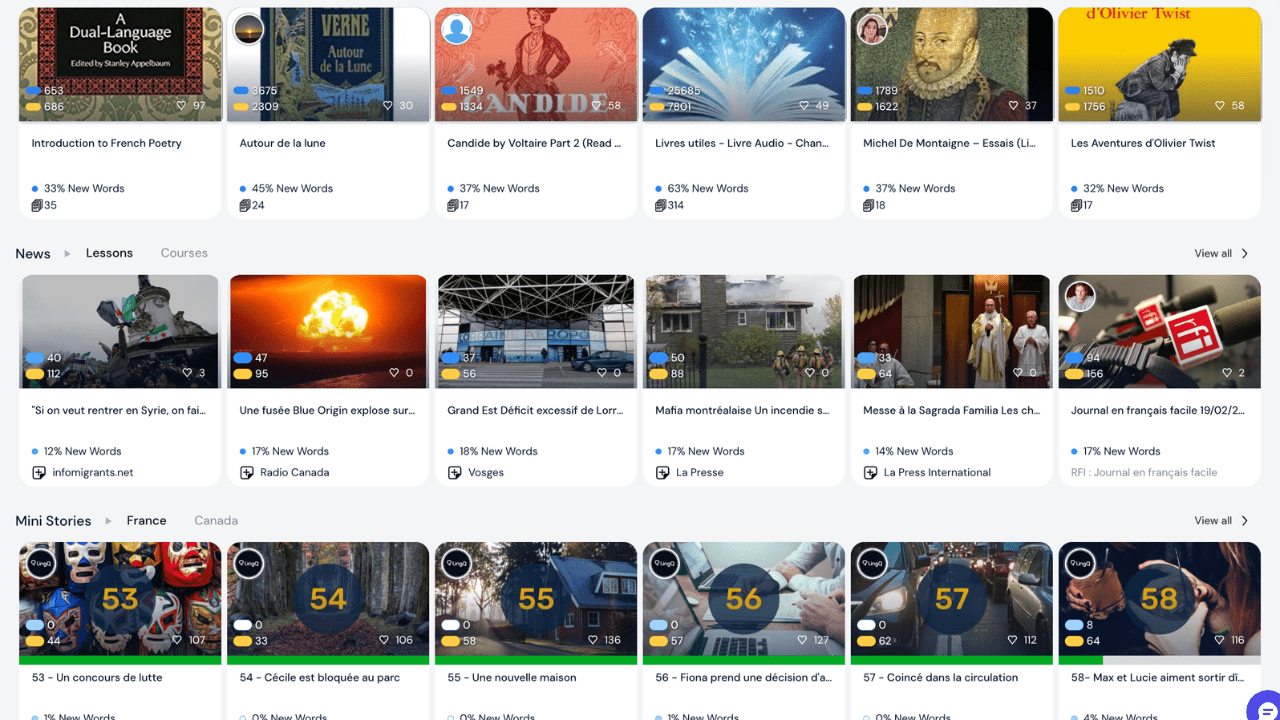
- While reading, if you see a verb form that you don’t recognize, look it up and take note of the tense. On LingQ, this should be done automatically.
- Produce the tenses through writing and speaking practice. This does not need to be the main component of your French studies, but it puts your knowledge to the test. Identify tenses you struggle with, patterns that you’re missing, etc. This can inform your future reading and listening choices.
LingQ is built for immersive-style learning. You import any French content you find online (a podcast episode, a Le Monde article, a YouTube video) and read it alongside the audio. Every word is clickable. Tap any verb form and you see its translation, save it to your vocabulary, and add it to your known-word count.
Ultimately, the goal is to eventually stop thinking about conjugation rules and just produce them. Native French speakers don’t drill conjugations to use them appropriately. Why should you?
LingQ supports French as one of its core languages, with a sizable content library for every level, a French grammar guide, full conjugation tables embedded in the dictionary, and the import tool that turns any French content into a custom language lesson.
Frequently asked questions
French has 21 grammatical tenses, but in practice native speakers use about 8 in daily life. The four most common in spoken French are le présent (present), le passé composé (compound past), l’imparfait (imperfect), and le futur proche (near future). The literary tenses like passé simple and subjonctif imparfait appear almost exclusively in novels and formal writing.
Passé composé describes a completed action (“J’ai mangé” / I ate). Imparfait describes an ongoing or habitual action in the past (“Je mangeais” / I was eating, or I used to eat). In a story, the passé composé pushes the narrative forward while the imparfait sets the scene.
Almost. The notable exception is aller (to go), which is fully irregular. A few -er verbs have small spelling changes in certain forms (manger becomes mangeons, commencer becomes commençons) to preserve pronunciation.
Yes, but it will take time to understand. Start with recognizing which expressions trigger it (il faut que, je veux que, bien que) and gradually you’ll incorporate it into your speech with more confidence.
The fastest path is a combination of brief upfront study (the regular -er, -ir, -re patterns and the top 20 irregular verbs in the present tense) plus heavy exposure to French content where you see these forms in real context.
Ready to learn French through real content?
LingQ turns any French content you find online into a personal study lesson. Import a podcast, an article, or a YouTube video, and read it alongside the audio with every word clickable for instant translation. Develop your ability to conjugate the way native speakers do, through real exposure rather than drills.
Writer Bio

Tyler is an American language teacher and language learner. He’s taught Spanish, French and Latin in the K-12 system since 2018. Tyler also speaks Thai and Italian. Currently, he’s learning German and Polish on LingQ!
You might also like