How to Learn Polish: Minna’s 5-Month Story
 Tyler Tolman
24 Mar 2026
Tyler Tolman
24 Mar 2026
TL;DR
Minna-Moffat Feldman learned Polish so well within five months of using LingQ that her native Polish friends were shocked by her progress. Her secret: short, daily reading sessions with content she actually cared about, no grammar drills. This is her story.
“If I’d learned English as quickly as you’re learning Polish,” commented one friend, “I would have had a very different start in this country…”
That’s what one of Minna Moffat-Feldman’s Polish friends told her after five months of learning the language. Five months. No immersion program. No year abroad. Just Minna, in Manchester, reading content on LingQ. How did Minna learn Polish? What makes Minna’s friends so confident that she’s ready to travel to Poland?
Here’s her story.
Why Polish?
Minna’s connection to the Polish language started in the Catholic Church. She’s met a number of Polish people through her church, and her patron saint is a Polish nun, Faustyna Kowalska.
“I read her diary in English, and then I wanted to read it in Polish,” shared Minna. “Translations are never as the author truly wrote. Subtle nuances are missed.”
The Problem with Most Language Apps
Minna has a doctorate in second language acquisition. She knows the research. And she’ll tell you plainly: most apps get the fundamentals wrong.
Minna is also significantly deaf, which means she relies on texts and captions in a way most language learners don’t. For Minna, an app that puts text at the centre isn’t just useful. It’s essential.
She understood that immersion through reading is fundamental to learning Polish. “Real exposure matters more than grammar explanation,” she says. “Repeated input, content you actually understand. That’s how acquisition works.”
She’d tried Duolingo and Babbel alongside private tutors. Minna progressed, but always with the sensation that the knowledge didn’t really stick. Her pronunciation wasn’t improving, and she wasn’t able to connect the language with her interests: her church community, her conversations, the articles she was already reading.
That changed when she found LingQ.
“LingQ Is Literally a Game Changer”
Minna discovered LingQ via a review from Wing Wing Languages. Attracted to LingQ’s emphasis on text and immersion, Minna quickly committed to using the platform regularly.
“Once I saw how easy it was to get the meaning, to see everything in context and the ways to review, it was a no-brainer.”
She no longer had to follow a set learning path. With LingQ, Minna determined her material, her routines, and her priorities.
What Her Routine Actually Looks Like
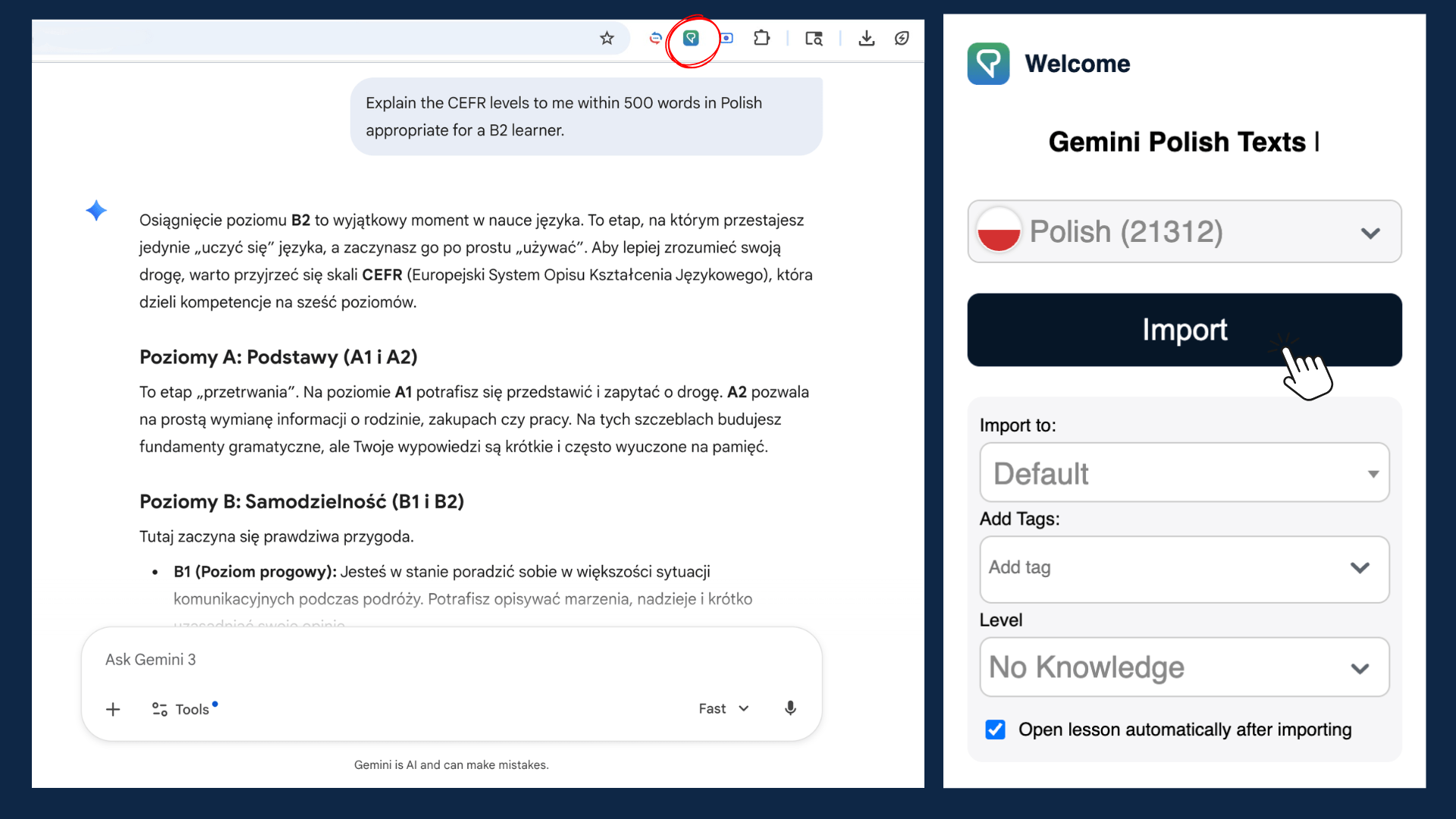
Minna’s workflow is built around importing. Tutor messages. Articles. Religious content. YouTube videos.
“Sometimes I’ll use AI for material. After a session with my tutor, I’ll use AI to solidify new vocabulary. My prompt will be ’15 sentences at the A2 level with the following vocabulary.’ I upload the response directly into LingQ and start reviewing.”
Minna prefers to use LingQ in short bursts. Her ideal day consists of three 10-minute sessions. She aims to “flood the brain in Polish”, and fares better with smaller, more intense sessions.
Minna’s Go-To Features to Learn Polish
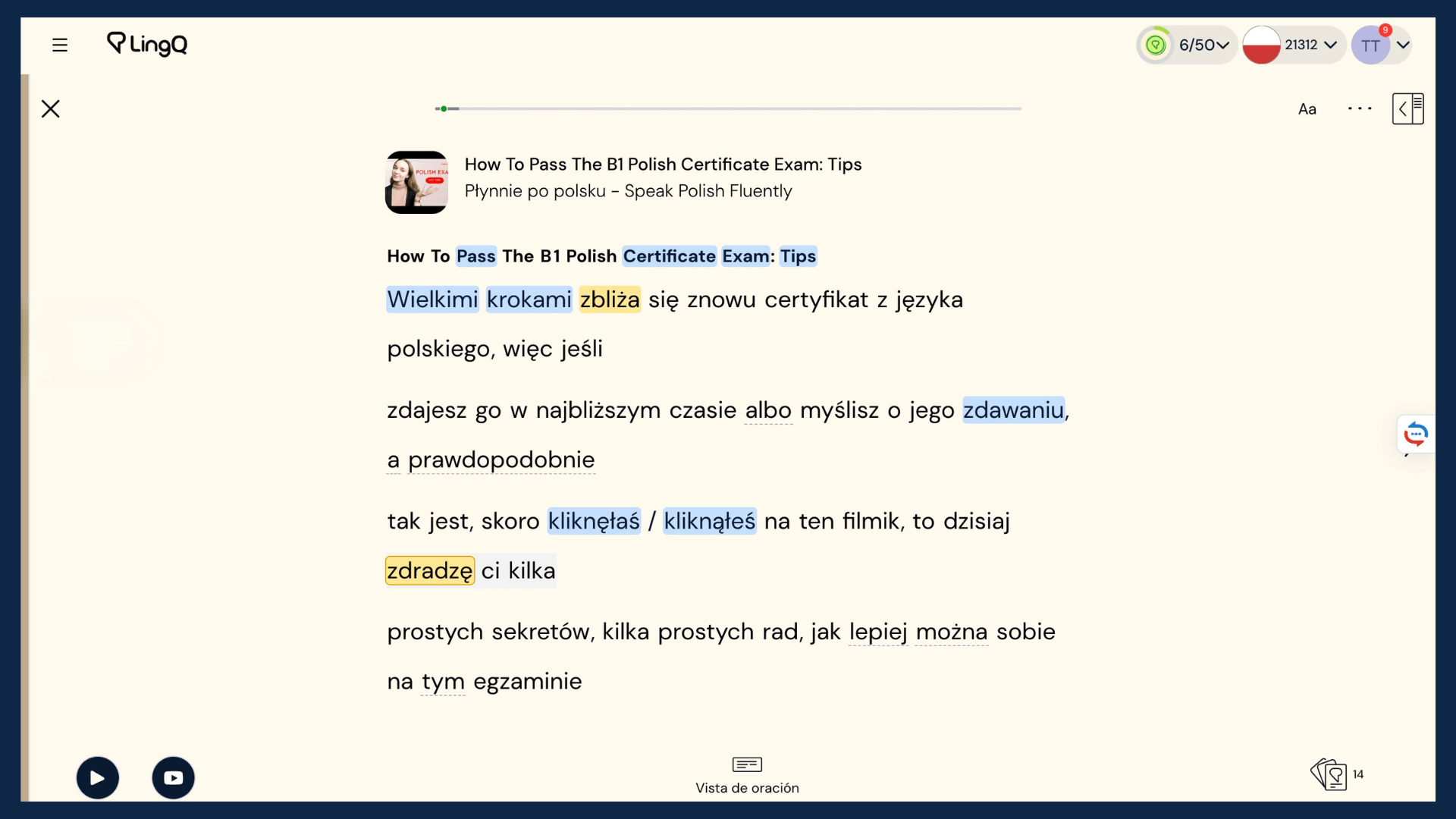
Unknown word percentage allows Minna to quickly see how much of a text she won’t know. That number helps her choose material that challenges her without overwhelming her. The sweet spot between too easy and too hard.
Phrase linking makes for more accurate translations. Polish is full of multi-word expressions, and these are better captured and understood by saving phrases instead of individual words.
LingQ’s speech assessment tool has been critical for improving Minna’s pronunciation. “With LingQ, I’m able to see which parts of the word I’m not saying correctly,” explained Minna. “As a deaf person, the visual representation of my pronunciation was pivotal.” This feature alone sets LingQ apart from every other app Minna tried.
What “Scary Good” Actually Means
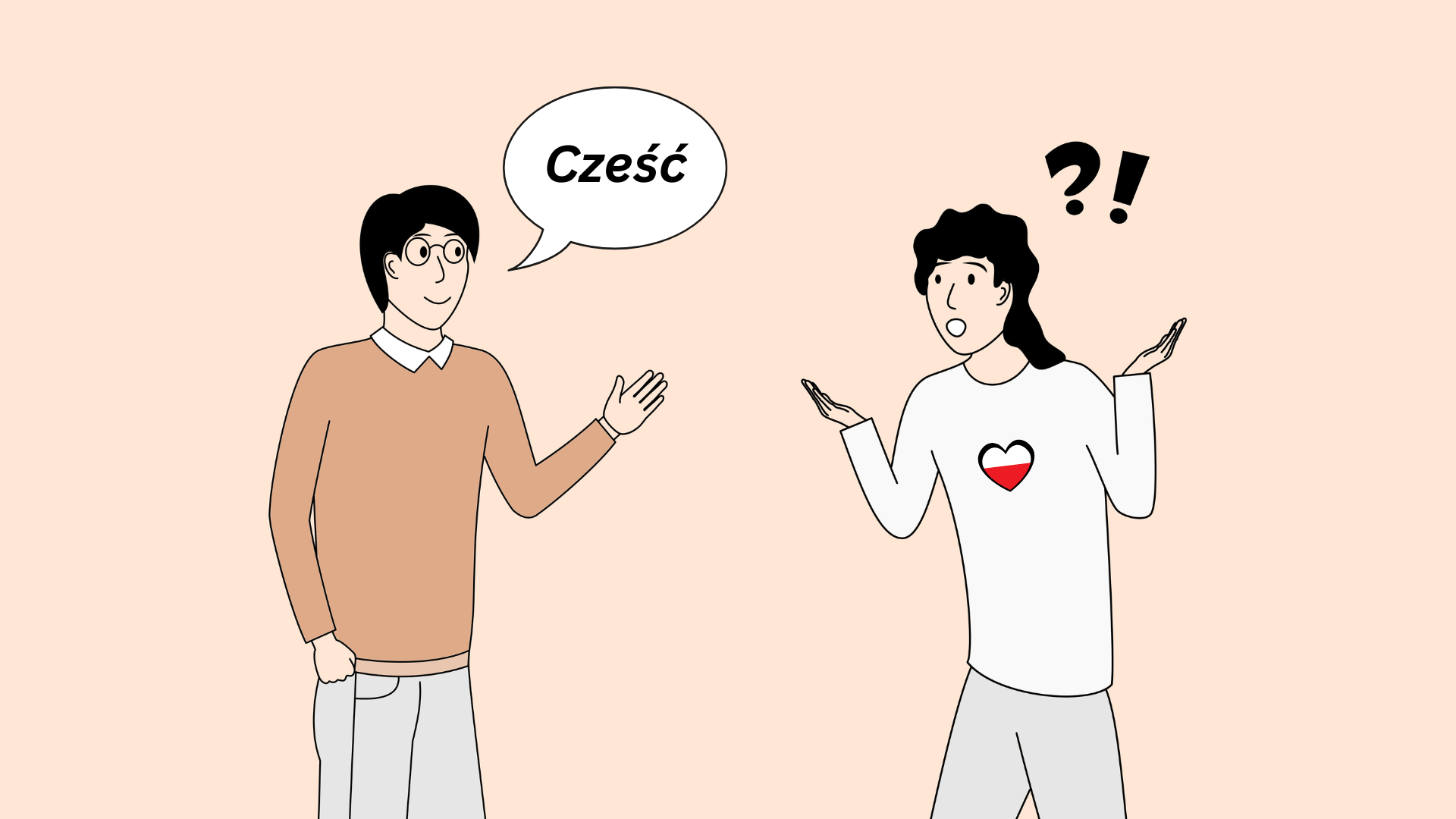
“I think you are going to have a wider vocabulary than me,” commented one of Minna’s Polish friends.
Within five months, Minna’s Polish became noticeably more advanced. This is fast progress. Polish is not an easy language. It has seven grammatical cases, complex consonant clusters, and very little overlap with English vocabulary.
The fact that native speakers were noticing real progress at the five-month mark says something about the method, not just the effort.
What She’d Tell Someone Starting Polish Today
Polish can be intimidating, especially for English speakers. However, Minna understood that fluency isn’t unlocked through grammar drills, but rather spending quality time with the language.
“LingQ doesn’t fare well as a grammatical resource, but it helps you discover the rhythm of the language. Using LingQ to read in the target language is what made everything come together a lot quicker.”
If there’s one thing Minna’s experience illustrates, it’s that the right method matters as much as the hours you put in. Duolingo can build a habit. Babbel can introduce vocabulary. But if you want your Polish-speaking friends to look at you like you’ve done something impossible, you need to be spending time with real content, in the real language.
LingQ is where you do that.
Start Your Own Polish Journey
Polish has a reputation for being one of the hardest languages for English speakers to learn. Minna’s progress in five months suggests that reputation is more about method than difficulty.
If you want to try the same approach, importing content you actually care about, tracking your vocabulary, and reading and listening your way to real comprehension, start with LingQ’s free tier. You don’t need a doctorate in second language acquisition to make it work. You just need content you’re curious about and a place to put it.
Happy learning!
FAQs
Is Polish really one of the hardest languages to learn? Polish has a reputation for difficulty. The Foreign Service Institute categorises Polish as a Category 4 language, estimating around 1,100 classroom hours to reach professional proficiency. That said, learners using immersion methods typically report reaching conversational ability well before that figure, particularly when they spend consistent daily time reading and listening to real content rather than studying grammar in isolation.
How long does it take to reach conversational Polish? It varies significantly by method and hours invested. The FSI estimates 1,100 classroom hours for professional-level proficiency, but conversational ability tends to come much earlier for learners who prioritize input over drills. Minna reached a level that impressed native speakers in five months of daily practice.
Can you learn Polish without living in Poland? Absolutely. LingQ’s import feature lets you bring Polish podcasts, YouTube videos, articles, and books into your learning, so you can build an immersive environment from wherever you are.
What makes LingQ different from Duolingo for learning Polish? Duolingo offers structured beginner lessons and habit-building mechanics. LingQ is built around reading and listening to real Polish content at your level, with vocabulary tracking built in. Most serious learners use both at different stages.
Ready to start your own Polish journey? Learn Polish on LingQ: try it free and import your first lesson today.
Writer Bio

Tyler is an American language teacher and language learner. He’s taught Spanish, French and Latin in the K-12 system since 2018. Tyler also speaks Thai and Italian. Currently, he’s learning German and Polish on LingQ!
You might also like