

How to Learn Vietnamese: A Complete Beginner’s Guide
 Tyler Tolman
30 Aug 2026
Tyler Tolman
30 Aug 2026
TL;DR
The best way to learn Vietnamese is comprehensible input, heavy listening first to internalize the six tones before worrying about speaking, paired with reading, since Vietnamese uses the Latin alphabet rather than a new writing system. Expect real difficulty from tones and pronunciation, not from the script itself.
If you’re wondering how to learn Vietnamese, a good starting point is understanding what actually makes it hard, and what doesn’t. Vietnamese is known to be a difficult language. In one sense that’s true: Vietnamese is a tonal language with six distinct tones, and getting those tones wrong can change the meaning of a word entirely. But in another sense, Vietnamese is more approachable than people expect. Vietnamese uses the Latin alphabet, just like English, but with added diacritical marks. You’re not learning a new writing system the way you would with Mandarin, Japanese, or Korean. And that’s a huge advantage.
This guide covers why Vietnamese is worth learning, what often stumps Vietnamese learners, and the method that works best for long-term fluency.
Why Learn Vietnamese
The Vietnamese language is spoken natively by roughly 85 million people, primarily in Vietnam, with significant diaspora communities in the United States, France, Australia, and Canada. Vietnam’s economy has also been growing rapidly, making Vietnamese increasingly useful for business, trade, and manufacturing relationships across Southeast Asia.
Beyond the practical case, learning Vietnamese opens up a rich food culture, a distinctive literary and musical tradition, and direct connection with a large, often close-knit community. For travelers, Vietnam has become one of Southeast Asia’s most visited countries, and even basic conversational Vietnamese goes a long way with locals who don’t often hear foreigners attempt the language.
Is Vietnamese Hard to Learn?
For English speakers, yes. Vietnamese is quite difficult. The U.S. Foreign Service Institute classifies Vietnamese as a Category III language, estimating around 1,100 class hours to reach professional proficiency. That places it below the hardest tier of languages (Mandarin, Cantonese, Japanese, Korean, and Arabic, at roughly 2,200 hours) but still significantly above easier languages like Spanish or Italian, which sit around 600-750 hours.
The difficulty in Vietnamese comes almost entirely from two things: tones and pronunciation. The grammar, by contrast, is surprisingly simple. Vietnamese doesn’t conjugate verbs for tense, person, or number the way European languages do, and there aren’t any irregular verb tables to memorize. Word order is also relatively straightforward and closer to English than you might expect.
The Latin Alphabet Advantage
You do not need to learn a new writing system to read Vietnamese. Vietnamese uses the Latin alphabet. It was standardized this way in the 17th century by Portuguese and French missionaries, replacing an earlier Chinese-character-based writing system entirely.
This means once you learn how the diacritical marks work, the small marks above and below vowels that indicate tone and some vowel sounds, Vietnamese becomes a genuinely phonetic language. In fact, Vietnamese is more consistent than English when it comes to spelling and pronunciation. Vietnamese spelling reliably tells you how a word sounds, tones included, once you know the system.
This is a real, practical advantage over Mandarin, Japanese, or Korean, where you’re learning both a new sound system and an entirely new set of characters simultaneously. In Vietnamese, you only have to conquer the sound system.
The Tone Challenge, and How to Actually Approach It
Vietnamese has six tones (five in some southern dialects), and each one can change a word’s entire meaning. The classic example taught in nearly every Vietnamese course is ma, which depending on tone can mean ghost, but, cheek, rice seedling, tomb, or horse. This is the part of learning how to speak Vietnamese that trips up almost every beginner.
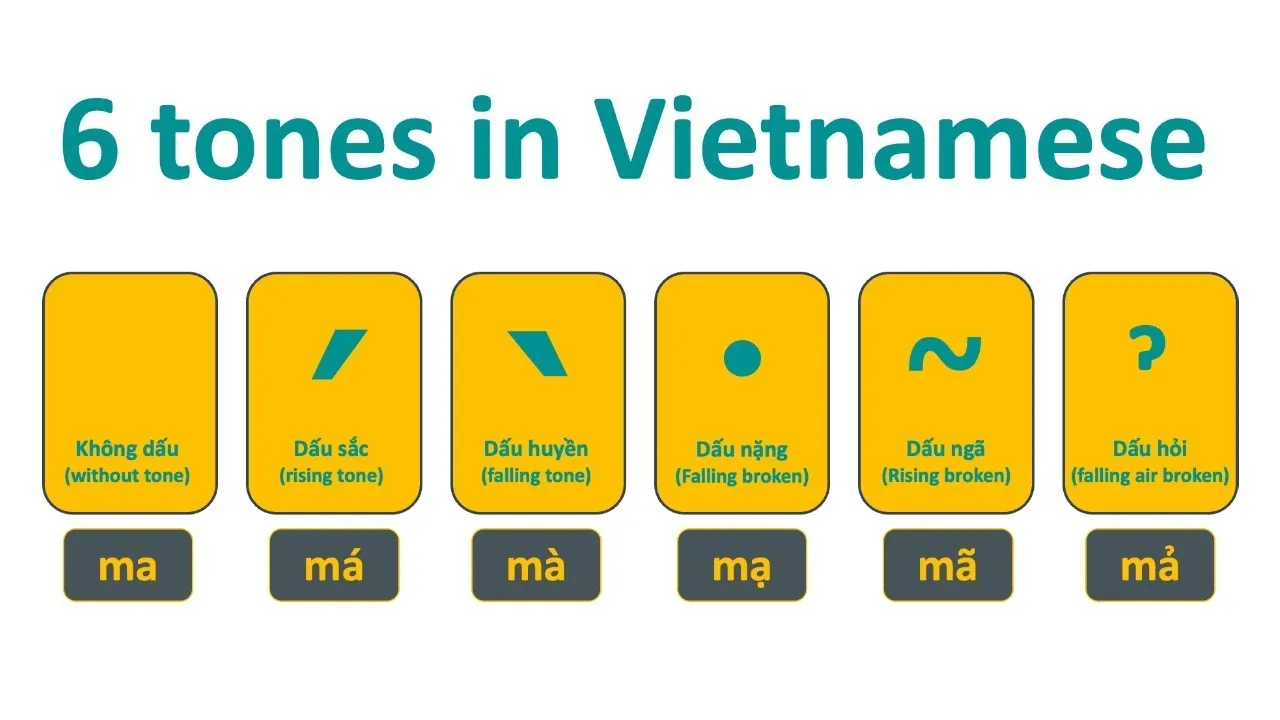
The mistake most learners make is trying to memorize tones in isolation, drilling syllables with a chart in front of them. This rarely works well. It’s arguably useful as far as producing the tones, but navigating the tones spontaneously in a natural conversation requires exposure, not memorization. To develop an ear for Vietnamese’s tones and their usage, you need heavy, repeated listening to real speech.
Practically, this means front-loading your first weeks and months with listening, even before you feel ready to speak. Let your ear get used to how tones actually sound in real sentences, spoken by real speakers, and don’t stress trying to reproduce them yourself. In fact, speaking too early, before your ear has calibrated to the tone system, risks baking in mispronunciations that will have to be corrected later.
The Best Way to Learn Vietnamese
Given everything above, the most effective learning path for Vietnamese looks like this:
Start with heavy listening, paired with text. Since Vietnamese has a relatively consistent spelling system, reading along with audio lets you connect the sounds you’re hearing directly to the tone marks on the page, reinforcing both at once.
Don’t rush into speaking. Give yourself real listening exposure before focusing heavily on production. This should last weeks, not days. You’re not avoiding speaking forever. You’re just being strategic. Strengthen your ear and familiarize yourself with the tones before practicing incorrectly. You want to be able to actually hear the difference.
Use real content, not just textbook dialogues. Vietnamese YouTube channels, podcasts, and shows expose you to how the language actually sounds at natural speed, which is different from the deliberately slow, clear audio most courses use. Of course, use level-appropriate learner materials, but incorporate (and gradually transition to) authentic, native-level content.
Build vocabulary through context, not isolated lists. Because Vietnamese grammar is comparatively simple, most of your effort will go toward vocabulary and toward training your ear on tones, both of which are better served by reading and listening to real material than by flashcard memorization alone. When expanding your vocabulary, you’re not just trying to memorize words, but also understand appropriate usage and natural phrasing. This requires context that you don’t get from a flashcard.
Best Resources for Learning Vietnamese
A few starting points worth knowing about:
- Vietnamese YouTube channels aimed at learners or at Vietnamese daily life content give you real, current spoken Vietnamese. Check out Tieng Viet Oi, Learn Vietnamese with Annie, and Learn Vietnamese with SVFF.
- Podcasts, particularly slower, learner-aimed ones early on, before graduating to native-speed content. Give Easy Vietnamese and VietnamesePod101 a listen.
- LingQ’s Vietnamese library, which includes a Mini Stories course built for complete beginners, simple, repetitive sentences designed to introduce basic patterns. These stories often serve as a launchpad into richer, intermediate-level content.
How LingQ Supports Learning Vietnamese
LingQ is built around exactly the comprehensible-input-based approach this guide recommends: reading and listening to real content, at your level. With instant word lookups, progress tracking, and personalized review, you understand what you’re reading and listening to more deeply with greater flow and ease.
You can start with the built-in Vietnamese library, including playlists curated for absolute beginners, or import your own content (a YouTube video, a podcast, an article, etc.). LingQ lets you transform content that you genuinely enjoy into interactive language lessons. Every word you look up gets saved and tracked, allowing you to see it shift from new to known. Your progress is visible and quantifiable, providing needed assurance that you’re on the right track.
If you’re serious about how to learn Vietnamese online, LingQ’s Vietnamese library is a good place to start. Browse the collection, click on something that looks interesting, and start immersing yourself in the language.
Are you considering learning other languages? Check out our guide on Which Language Should I Learn? for a breakdown on speaker reach, difficulty, and demand across major world languages. It’s useful context if you’re still weighing Vietnamese against other options.
FAQs
It’s moderately difficult, FSI Category III, roughly 1,100 class hours to reach professional proficiency. The main challenge is the six-tone system and pronunciation, not the grammar or writing system.
No. The Latin-based Vietnamese alphabet was developed beginning in the 17th century and eventually became Vietnam’s standard writing system.
The FSI estimates around 1,100 hours of study for professional working proficiency, though conversational comfort can come well before that with consistent listening and reading practice.
The six-tone system, since getting a tone wrong can completely change a word’s meaning. The best way to handle this is heavy listening before heavy speaking. Let your ear calibrate to the tones before you try to produce them yourself.
Start Learning Vietnamese with LingQ
Vietnamese rewards a listening-first approach more than almost any other language, given how much of its real difficulty lies in its tone and cadence rather than grammar or script. Whatever your reason for learning it, business, family, travel, or curiosity, consistent exposure to real Vietnamese content is what gets you there.
Start learning Vietnamese on LingQ →
Writer Bio

Tyler is an American language teacher and language learner. He’s taught Spanish, French and Latin in the K-12 system since 2018. Tyler also speaks Thai and Italian. Currently, he’s learning German and Polish on LingQ!
Twenty minutes a day beats a weekend of drilling.
Read and listen to things you’d have read anyway — LingQ counts every word you pick up along the way.
- 5M+ learners
- 4.7★
- Free to start

