
Comprehensible Input: A Practical Guide for Language Learners
 Tyler Tolman
19 Mar 2026
Tyler Tolman
19 Mar 2026TL;DR
Comprehensible input (CI) is the practice of learning a language by reading and listening to content you can mostly understand. Linguist Stephen Krashen coined the term, arguing that acquisition happens through meaningful exposure, not grammar study. In practice: choose level-appropriate content, engage with it consistently, and gradually push toward more challenging material. The more time you spend with the language, the more naturally it sticks.
Comprehensible input. If you spend any time in language learning communities, you’ve heard the term. Polyglots swear by it. Linguists debate it. And a lot of learners aren’t entirely sure what it actually means in practice. Steve Kaufmann covers the theory in depth.
Here’s the short version: comprehensible input is the idea that you acquire a language by understanding messages, not by studying rules. You read and listen to content you can mostly follow, and the language seeps in. It’s how children learn their first language, and according to linguist Stephen Krashen, it’s the primary driver of second language acquisition too.

This post covers the theory, how to actually apply it, and what a realistic CI-based routine looks like at different levels.
What CI Looks Like in Practice
The theory is easy to grasp. The harder question is: what do I actually do?
A comprehensible input routine, at its simplest, means spending time reading and listening to your target language every day. The content should be mostly understandable, not word-for-word perfect, but enough that you can follow along and enjoy it.
Here are a few sample routines depending on how much time you have:
The 20-Minute Daily Routine
- 10 min: Listen to a short podcast or story
- 5 min: Read the transcript
- 5 min: Review new vocabulary
The Listening-Focused Routine
- 20–30 min: Listen to a podcast during a walk or commute
- 20–30 min: Re-listen with the transcript
Extensive Reading
- 20–60 min: Read in your target language — something you’d actually enjoy
The Pre-Speaking Routine
- 20 min: Listen to a podcast while reading the transcript
- 30 min: Discuss what you heard with a tutor or conversation partner
None of these is the “correct” routine. The best one is the one you’ll stick to. What matters is that you’re consistently exposing yourself to the language in a way that engages you.
Choosing Content at Your Level
Comprehensible input only works if the content is actually comprehensible. That sounds obvious, but it’s where most learners go wrong. Looking for comprehensible input examples that fit your level takes practice, either you stay too comfortable with material that’s too easy, or you push too hard too fast and end up lost.
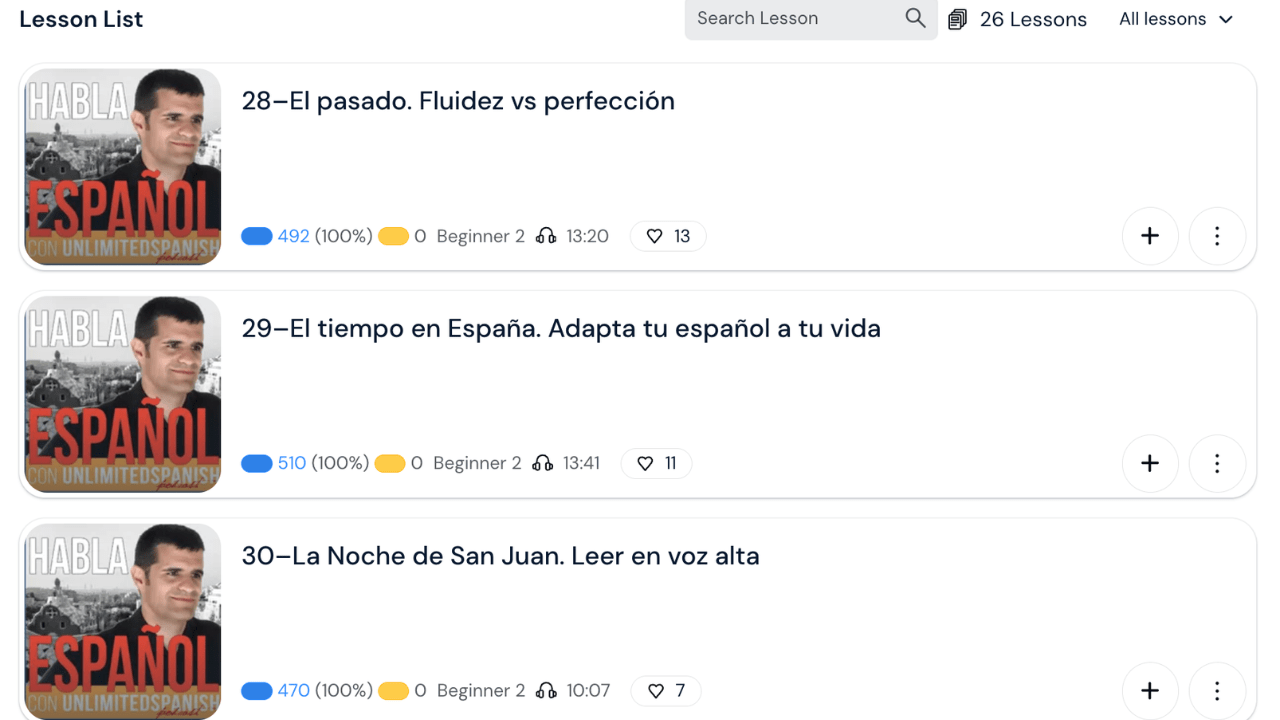
Beginners should start with material made for learners: graded readers, learner podcasts, and short stories designed for early stages. The goal isn’t to understand everything perfectly. The goal is to get a feel for the language and build a foundation. LingQ’s Mini Stories are a good example — short, repetitive, beginner-friendly narratives available across 50+ languages.
Intermediate learners can start mixing learner content with authentic material. YouTube videos on topics you already know something about, TV shows with subtitles, intermediate podcasts — these all work well. The familiarity with the topic helps you fill in the gaps in the language. At this stage, your content choices should start reflecting your actual interests.
Advanced learners should be engaging with the language the way native speakers do: podcasts without transcripts, books, long-form journalism, films without subtitles. At this level, CI is less about acquiring new structures and more about deepening vocabulary and developing an ear for nuance.
The common thread across all levels: when content feels like a wall of noise you can’t break through, it’s too hard. When it feels effortless, you’re probably not growing. You want the middle — understanding most of it while still encountering new things.
Does CI Mean You Never Need to Speak or Study Grammar?
This is where a lot of people get confused — or frustrated with CI advocates.
The answer is no, CI doesn’t mean you abandon output entirely. What it does mean is that speaking before you’ve absorbed enough input is often frustrating and counterproductive. You don’t have much to draw from. But once you’ve accumulated enough reading and listening, speaking tends to come more naturally — because you’ve heard and read so much of the language that patterns have already formed.
Steve Kaufmann, who speaks over 20 languages and co-founded LingQ, has written and spoken extensively about this. His view: focus on input heavily early on, and speaking takes care of itself once you’ve built the foundation. That doesn’t mean never speaking — it means front-loading input.
Grammar is a similar story. CI and grammar study aren’t opposites. Grammar explanations can help you notice patterns you’re already seeing in your input. Think of grammar as a map and CI as the territory. The map can help you navigate, but you still have to walk the terrain.
Common Mistakes When Using Comprehensible Input
Staying too comfortable. If you’ve been using the same beginner resources for six months because they feel good, you’re probably plateauing. Push yourself toward harder content, even when it’s uncomfortable.
Going too hard too fast. On the other end, jumping straight to native-level podcasts as a beginner is discouraging and mostly useless. You need enough comprehension to extract meaning. Otherwise it’s just noise.
Treating it as entirely passive. Extensive listening during your commute is great. But if that’s your only learning activity, you’ll progress slowly. Active engagement — reading the transcript, looking up words, reviewing vocabulary — accelerates the process significantly.
Avoiding grammar entirely. Some CI enthusiasts overcorrect and dismiss grammar completely. Don’t. A basic understanding of grammatical structure helps you notice what’s happening in your input. It doesn’t need to be the focus, but ignoring it entirely is its own mistake.
How LingQ Supports a CI-Based Approach
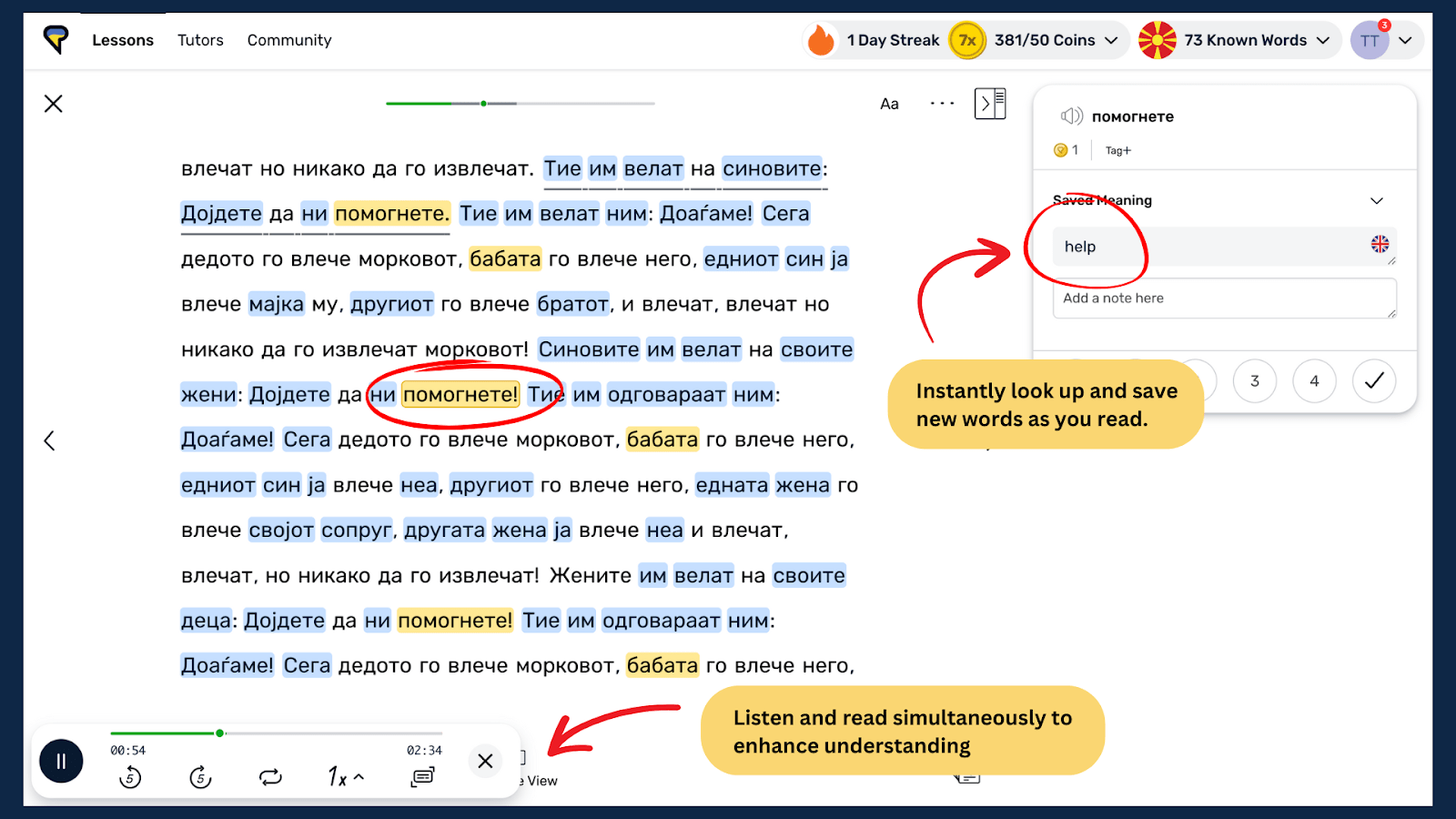
LingQ is built around comprehensible input. When you read a lesson in LingQ, unknown words are highlighted in blue. Words you’ve encountered but haven’t fully learned appear in yellow. Words you know are unformatted. At a glance, you can see exactly how difficult a text is relative to your current vocabulary — and the bluer it is, the more challenging.
When you tap a word, you get instant translations and can save it to your vocabulary. LingQ tracks each word through stages — new, recognized, familiar, learned — so your progress is visible over time.
The import feature makes this work with any content you actually want to engage with. You can bring in a YouTube video, a Netflix episode, a podcast, or an article with one click and turn it into a lesson. This is the practical solution to the “find level-appropriate content I actually enjoy” problem — you’re not stuck with what the platform chose for you.
For beginners who want a structured starting point, LingQ’s built-in library includes Mini Stories, curated beginner lessons, and graded content across 50+ languages. As you advance, the library scales with you into authentic content.
Don’t just take our word for it. An independent study ranked LingQ #1 for language learning outcomes.
FAQs
What is comprehensible input?
Comprehensible input is reading and listening to content in your target language that you can mostly understand. According to Stephen Krashen’s input hypothesis, this is the primary mechanism through which language acquisition occurs.
Does comprehensible input actually work?
Yes — consistent exposure to comprehensible input builds vocabulary, grammar intuition, and listening comprehension over time. It’s how most successful polyglots approach learning, though it works best alongside some grammar study and, eventually, speaking practice.
How much input do you need?
European languages typically require 600–1,000 hours to reach conversational fluency; harder languages like Japanese or Chinese are closer to 2,000+. Daily practice matters more than any single session length.
Do you still need to study grammar?
Grammar study isn’t required, but it helps. Understanding basic structures helps you notice patterns in your input, which speeds up acquisition. Think of grammar as a supplement, not the core.
What counts as comprehensible input?
Anything in your target language that you can mostly follow: podcasts, audiobooks, TV shows, YouTube videos, articles, books. The key word is “mostly” — not every word, but enough to understand the general meaning.
Is reading or listening better?
Both, ideally at the same time. Reading along while listening combines input channels and significantly improves comprehension and retention. If you have to choose: listening builds an ear for the language; reading builds vocabulary faster.
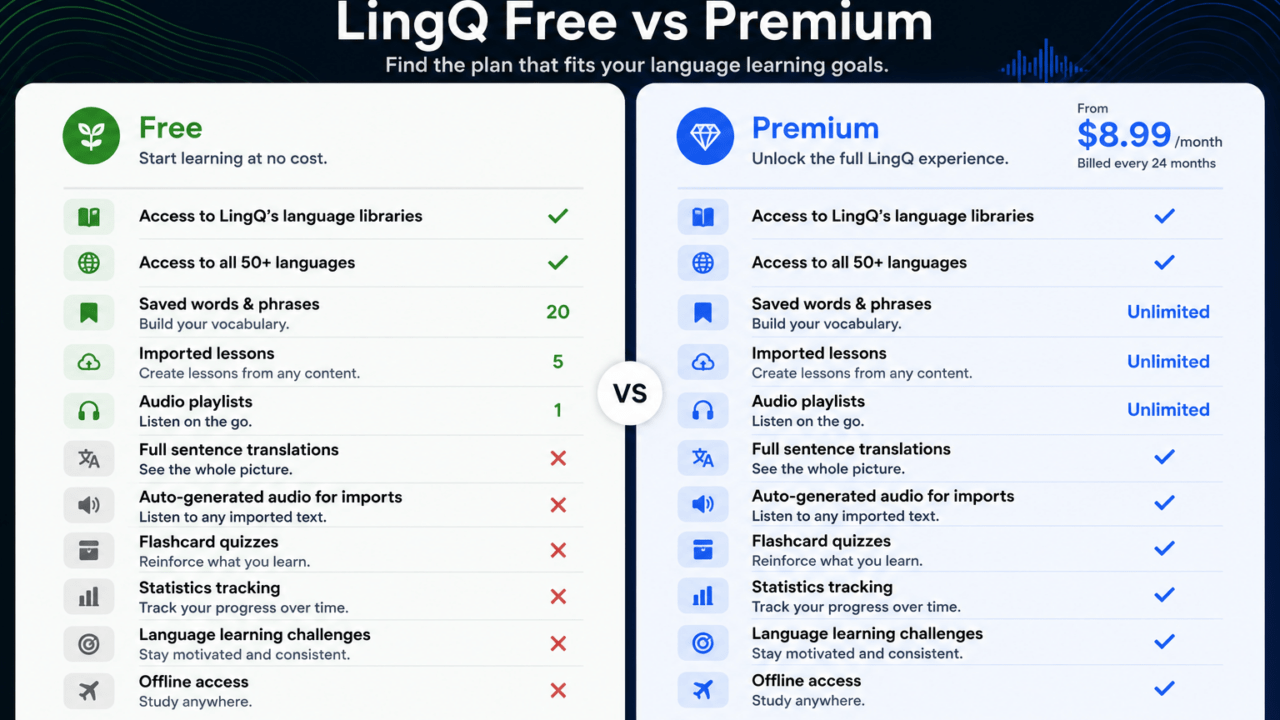
Ready to put comprehensible input to work? LingQ’s free tier lets you import any content and start reading and listening with built-in word tracking. Start learning for free.
Writer Bio

Tyler is an American language teacher and language learner. He’s taught Spanish, French and Latin in the K-12 system since 2018. Tyler also speaks Thai and Italian. Currently, he’s learning German and Polish on LingQ!
Twenty minutes a day beats a weekend of drilling.
Read and listen to things you’d have read anyway — LingQ counts every word you pick up along the way.
- 5M+ learners
- 4.7★
- Free to start


You might also like